

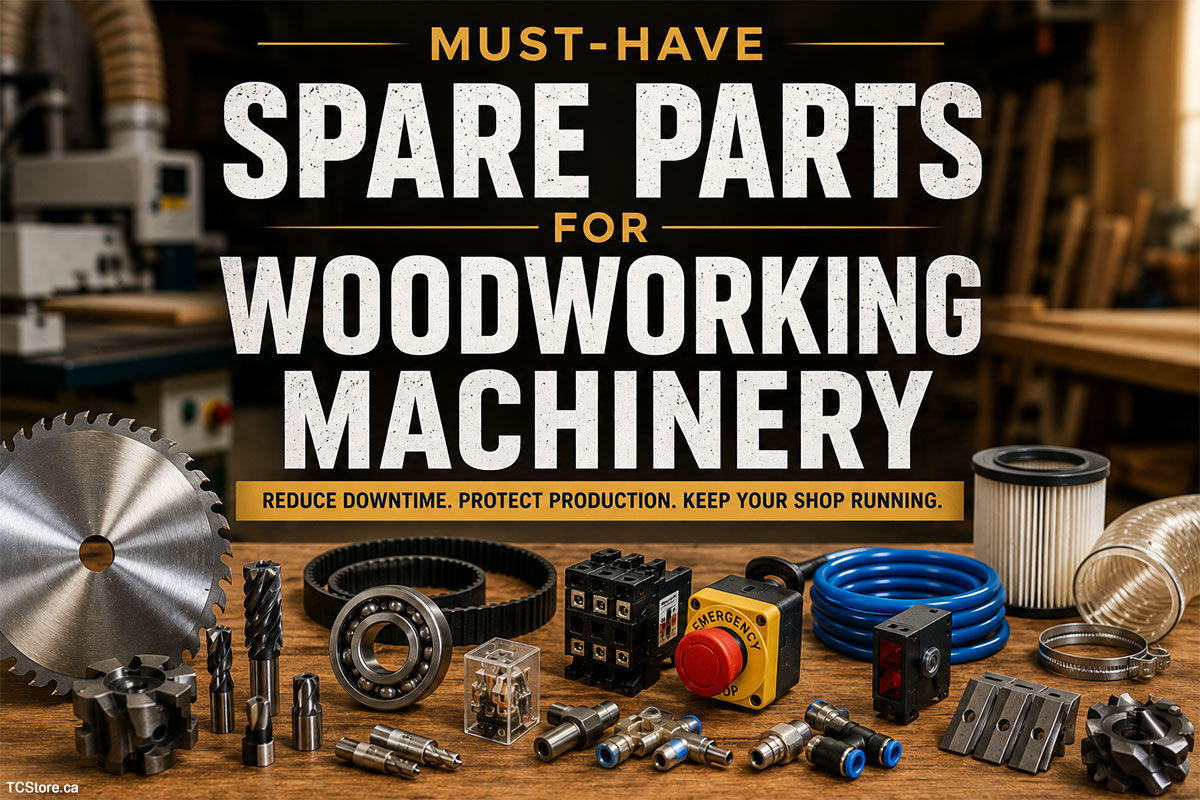
Must-Have Spare Parts for Woodworking Machinery
Posted by TCStore on 2026 Aug 10th
The most important spare parts for woodworking machinery are the components most likely to wear out, become damaged, or stop production when they fail.
These commonly include belts, bearings, switches, sensors, fuses, filters, blades, knives, inserts, hoses, pneumatic fittings, contactors, relays, and machine-specific wear parts.
A planned spare-parts inventory works alongside quality tooling, preventive maintenance, and the strategies outlined in How to Reduce Downtime With Better Woodworking Tooling.
A replacement part may cost only a few dollars.
The lost production caused by not having it can cost significantly more.
Quick Answer
Every professional woodworking shop should consider stocking:
✓ Drive belts
✓ Bearings and bushings
✓ Fuses and circuit breakers
✓ Contactors and relays
✓ Emergency-stop switches
✓ Proximity sensors and limit switches
✓ Pneumatic hoses and fittings
✓ Dust collection hoses and clamps
✓ Filters
✓ Saw blades and cutting tools
✓ Router bits, knives, and inserts
✓ Collets and toolholders
✓ Lubricants and maintenance fluids
✓ Machine-specific wear components
✓ Common fasteners, seals, and gaskets
The exact inventory should be based on the machinery used, production demands, supplier lead times, and the cost of downtime.
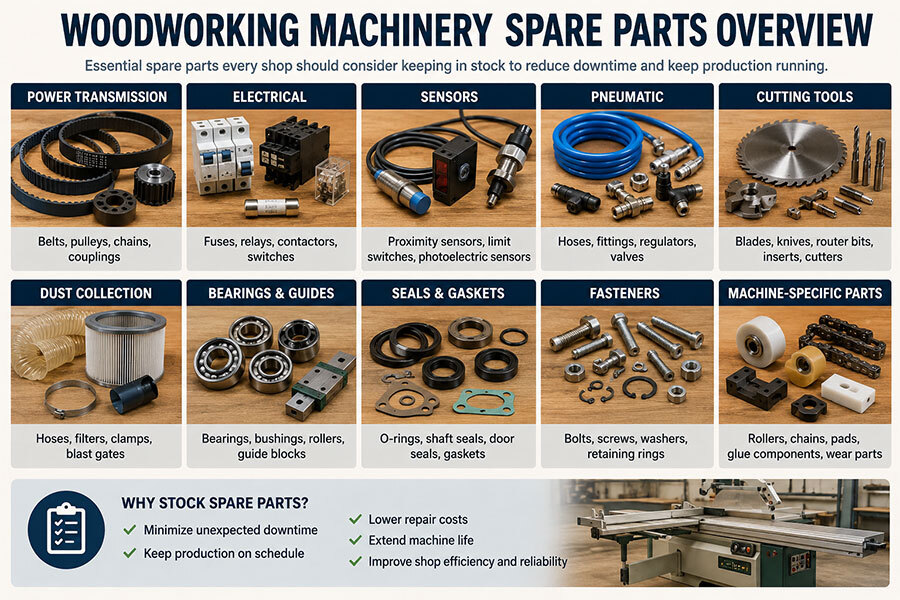
Woodworking Machinery Spare Parts Overview
|
Spare Part Category |
Common Examples |
Why It Should Be Stocked |
|
Power transmission |
Belts, pulleys, chains, couplings |
Keeps motors and moving systems operating |
|
Electrical |
Fuses, relays, contactors, switches |
Restores controls and machine power |
|
Sensors |
Proximity sensors, limit switches, photoelectric sensors |
Prevents control and positioning faults |
|
Pneumatic |
Hoses, fittings, regulators, valves |
Maintains clamps and automated movement |
|
Cutting tools |
Blades, knives, bits, inserts |
Protects production quality and capacity |
|
Dust collection |
Hoses, filters, clamps, blast gates |
Maintains airflow and shop cleanliness |
|
Bearings and guides |
Bearings, bushings, rollers, guide blocks |
Supports accurate movement |
|
Seals and gaskets |
O-rings, shaft seals, door seals |
Prevents leaks and contamination |
|
Fasteners |
Bolts, screws, washers, retaining rings |
Allows quick repairs and replacement |
|
Machine-specific parts |
Pads, rollers, chains, glue components |
Supports critical production equipment |
Why Spare Parts Matter in a Woodworking Shop
Woodworking machinery operates in a demanding environment.
Dust, vibration, heat, resin, adhesives, repeated movement, and long production cycles can gradually wear down components.
Even well-maintained machines can experience unexpected failures.
A damaged belt, faulty sensor, or blown fuse may stop a large machine just as effectively as a major mechanical failure.
The difference is that many small failures can be corrected quickly when the replacement part is already available.
Without the part, the shop may need to:
- Stop production
- Reschedule customer work
- Move jobs to another machine
- Pay for expedited shipping
- Wait for a technician
- Order an entire assembly instead of one component
- Miss a delivery deadline
A practical spare-parts inventory reduces the shop’s dependence on emergency orders.
Start With Production-Critical Machines
Not every machine requires the same number of spare parts.
Begin with the equipment that would create the largest production problem if it stopped.
This may include:
- CNC routers
- Panel saws
- Edgebanders
- Wide-belt sanders
- Moulders
- Planers
- Boring machines
- Dust collectors
- Air compressors
- Material-handling systems
A small secondary machine may be able to remain offline temporarily.
A CNC router or edgebander used in nearly every job may require a much stronger backup-parts strategy.
When evaluating which equipment deserves the highest inventory priority, review how different light industrial machines improve shop efficiency and where a machine failure would create the largest workflow bottleneck.
Spare-Part Priority Chart
|
Machine Importance |
Downtime Impact |
Recommended Inventory Level |
|
Production-critical |
Very high |
Stock common wear and failure parts |
|
Frequently used |
High |
Stock essential service parts |
|
Secondary machine |
Moderate |
Keep selected low-cost parts |
|
Backup equipment |
Low |
Order parts as needed |
|
Obsolete machinery |
Variable |
Stock hard-to-find components early |
Drive Belts
Drive belts transfer power from motors to spindles, rollers, conveyors, fans, and other machine systems.
They can stretch, crack, glaze, fray, or break over time.
Common belt types include:
- V-belts
- Timing belts
- Poly-V belts
- Flat belts
- Conveyor belts
- Edgebander feed belts
Belts should be matched by size, profile, material, tooth pattern, and manufacturer specification.
A belt that looks similar may not provide the correct tension or load capacity.
Shops should label replacement belts with the machine name and installation location to prevent confusion during a repair.
Bearings and Bushings
Bearings support rotating shafts, rollers, spindles, fans, and moving assemblies.
Worn bearings may create:
- Noise
- Heat
- Vibration
- Poor alignment
- Rough movement
- Dimensional inconsistency
- Premature wear on nearby components
Common replacement items include ball bearings, roller bearings, flange bearings, bushings, and guide rollers.
Standard bearings may be available quickly.
Machine-specific bearing assemblies can have longer lead times and may be worth stocking.
Fuses, Relays, and Contactors
Many machine stoppages are electrical rather than mechanical.
Fuses protect circuits from excessive current.
Relays and contactors control motors, heaters, pumps, valves, and other electrical loads.
A failed electrical component may prevent a machine from starting even when the mechanical systems are in good condition.
Useful electrical spares may include:
- Control fuses
- Main fuses
- Miniature circuit breakers
- Motor overloads
- Control relays
- Power relays
- Contactors
- Transformer fuses
- Terminal blocks
- Indicator lamps
Electrical parts must match the required voltage, current rating, coil voltage, pole configuration, and safety standard.
Repairs should be completed by qualified personnel.
Emergency Stops and Control Switches
Push buttons, selector switches, emergency-stop buttons, foot pedals, and control contacts can wear or become damaged.
These components are frequently handled and exposed to dust.
A broken start button may seem minor, but it can stop production until the correct replacement arrives.
Safety devices should never be bypassed to keep a machine operating.
Damaged switches, interlocks, and emergency-stop components should be replaced with compatible parts that preserve the intended safety function.
Sensors and Limit Switches
Modern woodworking machines rely on sensors to confirm position, detect material, monitor doors, and control automated sequences.
Common examples include:
- Proximity sensors
- Photoelectric sensors
- Limit switches
- Magnetic switches
- Pressure sensors
- Vacuum switches
- Encoder sensors
- Door interlocks
A dirty sensor may only need cleaning.
A failed sensor may stop an entire production cycle.
When stocking sensors, record the complete part number, electrical connection, sensing distance, output type, and mounting style.
Pneumatic Hoses and Fittings
Pneumatic systems operate clamps, cylinders, stops, gates, positioning devices, and automated tooling.
Air leaks can reduce pressure and cause slow or unreliable movement.
Useful pneumatic spares include:
- Air hose
- Push-to-connect fittings
- Elbows
- Tees
- Couplers
- Regulators
- Solenoid valves
- Flow controls
- Pressure gauges
- Cylinder seals
- Mufflers
Small fittings are inexpensive and easy to store.
Keeping a basic range of common sizes can allow maintenance teams to repair air leaks immediately.
Dust Collection Hoses, Filters, and Clamps
Woodworking machinery depends on effective dust extraction.
Damaged hoses, clogged filters, or loose connections can reduce airflow and allow dust to build up around the machine.
Dust collection spares may include:
- Flexible hose
- Hose clamps
- Reducers
- Connectors
- Gaskets
- Filter bags
- Cartridge filters
- Blast-gate components
- Cleanout caps
- Dust skirts and brushes
The TCStore guide to dust collector parts every shop should stock provides a more detailed breakdown of the components that commonly require replacement.
Filters should be matched to the dust collector and application.
Using an incorrect filter can reduce airflow or allow fine particles to pass through the system.
Maintaining these components is especially important because dust collection systems are critical for woodworking shops and support air quality, machinery cleanliness, product quality, and shop efficiency.
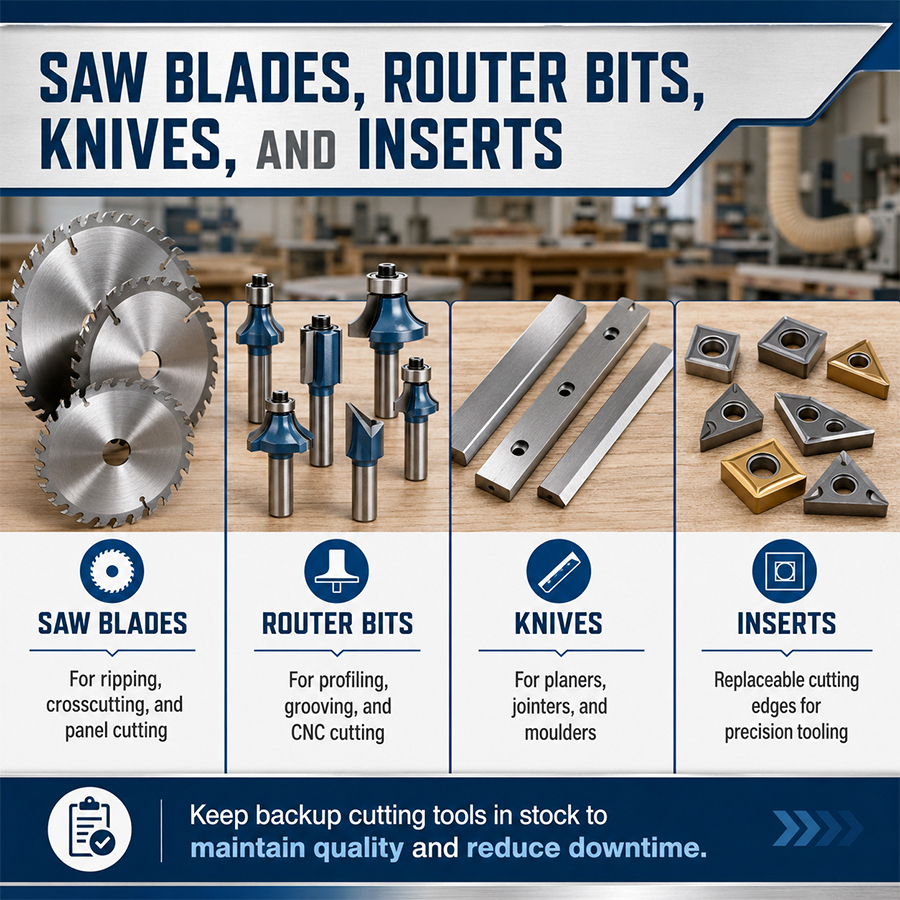
Saw Blades, Router Bits, Knives, and Inserts
Cutting tools are consumable production parts.
A shop should not rely on one blade, bit, or cutter for a critical process.
Backup tooling may include:
- Circular saw blades
- Scoring blades
- Router bits
- CNC cutters
- Drill bits
- Boring bits
- Planer knives
- Jointer knives
- Moulder knives
- Disposable inserts
- Edgebander trimming tools
- Profile cutters
For panel saws, table saws, and other cutting machinery, Essential Saw Blades for Woodworking Machinery explains how blade type, tooth geometry, material compatibility, and cutting application affect performance.
Frequently used tools should be rotated before they become severely dull.
This helps extend tool life and creates time for sharpening or replacement.
Operators should also understand the signs woodworking tooling needs replacement, including burn marks, rough finishes, chipping, increased machine load, vibration, and slower production.
When adding backup tooling, use the same application-based criteria described in How to Choose the Right Tooling for Woodworking Machinery.
Collets and Toolholders
Collets, arbors, chucks, and toolholders connect cutting tools to the machine.
Wear, dust, corrosion, and accidental damage can affect their ability to hold tools securely and concentrically.
A damaged collet can increase runout and cause:
- Poor cut quality
- Uneven tool wear
- Vibration
- Tool breakage
- Spindle damage
Shops using CNC routers should keep common collet sizes available.
Collets should be replaced when they lose clamping force, show damage, or can no longer maintain acceptable runout.
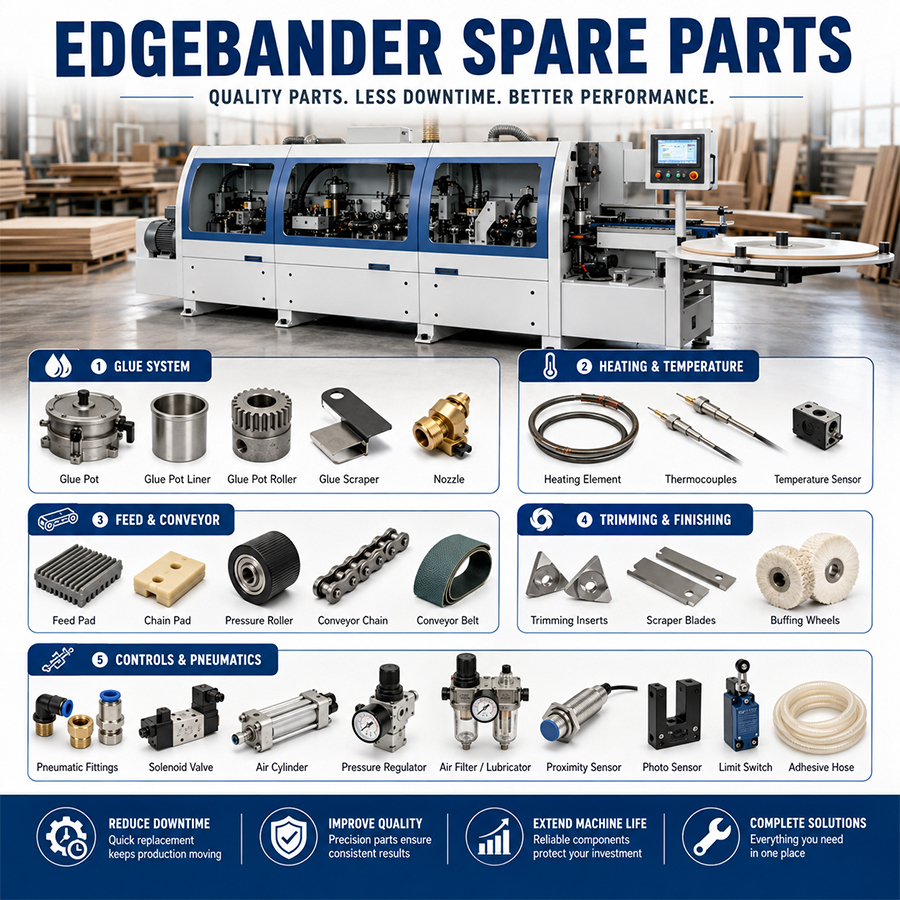
Edgebander Spare Parts
Edgebanders contain many components that are exposed to adhesive, heat, trimming waste, and repeated mechanical movement.
Useful edgebander spares may include:
- Glue-pot components
- Heating elements
- Thermocouples
- Pressure rollers
- Feed pads
- Scraper blades
- Buffing wheels
- Trimming inserts
- Chain pads
- Conveyor components
- Pneumatic fittings
- Sensors
- Adhesive hoses
The most important parts depend on the machine model and configuration.
Parts associated with glue application, feed movement, and trimming are often especially important.
The guide to must-have edgebander supplies for better results explains how adhesives, trimming tools, scraper blades, buffing wheels, cleaning products, and pressure rollers contribute to consistent edge quality.
Sander Spare Parts
Wide-belt sanders and other production sanders rely on belts, rollers, pads, sensors, and pneumatic systems.
Potential spares include:
- Sanding belts
- Contact pads
- Graphite pads
- Conveyor belts
- Tracking sensors
- Air-control components
- Pressure rollers
- Dust skirts
- Brushes
- Fuses and switches
A supply of correctly sized sanding products should be stored in a clean, dry environment.
Belts that absorb moisture or become distorted may not track or finish correctly.
Shops comparing belts, discs, sheets, wide-belt abrasives, and finishing products can use the recommendations in Choosing the Right Sanding Supplies for Your Shop.
Lubricants, Coolants, and Maintenance Products
Not every essential spare part is a mechanical component.
Maintenance supplies may include:
- Bearing grease
- Way lubricant
- Gear oil
- Hydraulic fluid
- Pneumatic oil
- Anti-seize compound
- Thread-locking compound
- Electrical contact cleaner
- Resin remover
- Machine cleaner
- Corrosion protection
- Replacement grease cartridges
Only use products that are compatible with the machine and manufacturer requirements.
Mixing incompatible lubricants can cause seal damage or reduce lubrication performance.
Machine-Specific Spare Parts
Generic parts are easy to replace.
Machine-specific parts require more planning.
These may include:
- Proprietary control boards
- Specialized motors
- Servo drives
- Operator panels
- Encoders
- Custom rollers
- Machine-specific belts
- Specialized heating components
- Tool-change components
- Vacuum pods
- Custom seals
- Unique safety switches
Businesses should identify critical proprietary parts before they fail.
This is especially important for older machinery where parts may become discontinued.
What Spare Parts Should You Keep in Stock?
The best inventory is based on risk rather than volume.
Ask four questions:
- How likely is the part to fail?
- How long would replacement take?
- How much production would be lost?
- How expensive is the part to keep in stock?
Low-cost parts with high downtime risk should usually be stocked.
Expensive parts with low failure rates may be ordered only when needed unless lead times are unusually long.
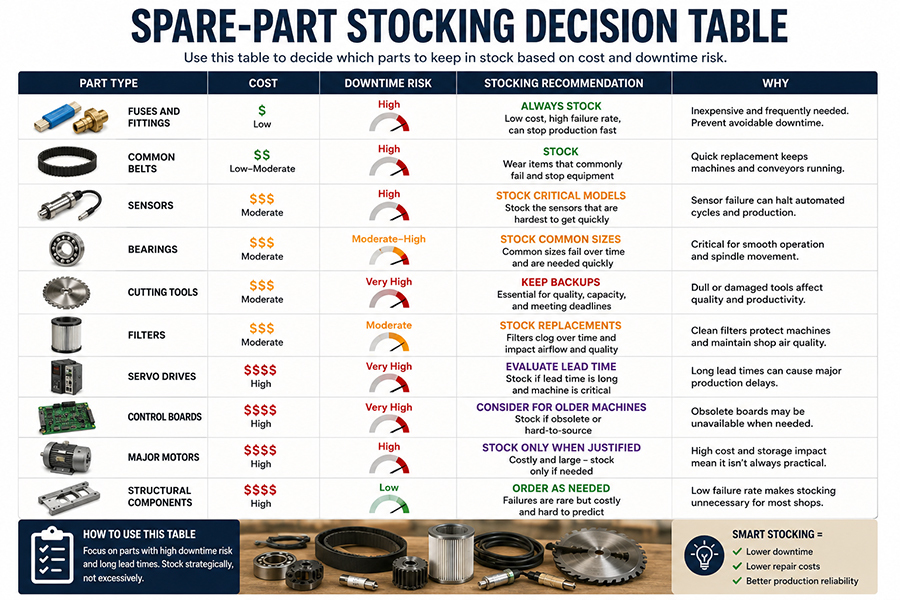
Spare-Part Stocking Decision Table
|
Part Type |
Cost |
Downtime Risk |
Stocking Recommendation |
|
Fuses and fittings |
Low |
High |
Always stock |
|
Common belts |
Low to moderate |
High |
Stock |
|
Sensors |
Moderate |
High |
Stock critical models |
|
Bearings |
Moderate |
Moderate to high |
Stock common sizes |
|
Cutting tools |
Moderate |
Very high |
Keep backups |
|
Filters |
Moderate |
Moderate |
Stock replacements |
|
Servo drives |
High |
Very high |
Evaluate lead time |
|
Control boards |
High |
Very high |
Consider for older machines |
|
Major motors |
High |
High |
Stock only when justified |
|
Structural components |
High |
Low |
Order as needed |
Create a Spare-Parts Inventory System
Parts are only useful when employees can find them.
A basic system should include:
- Part name
- Manufacturer
- Part number
- Compatible machine
- Storage location
- Minimum quantity
- Current quantity
- Supplier
- Lead time
- Last purchase date
- Replacement cost
Labels should be clear and durable.
Small electrical and pneumatic parts should be stored in divided bins.
Belts, hoses, blades, and filters should be protected from heat, moisture, sunlight, and physical damage.
Avoid Overstocking the Wrong Parts
A large parts room does not automatically create better maintenance.
Common inventory problems include:
- Duplicate parts under different names
- Components for machines no longer in service
- Expired adhesives and maintenance fluids
- Unlabelled electrical parts
- Damaged filters
- Corroded bearings
- Belts stored incorrectly
- Expensive parts with no confirmed application
Review the inventory at least once a year.
Remove obsolete parts, update quantities, and verify that critical components are still available from suppliers.
Final Thoughts
The best spare-parts inventory is not the largest inventory.
It is the one that protects the shop from its most likely and most expensive production interruptions.
Start with critical machines.
Identify common wear items, electrical controls, sensors, pneumatic components, filters, cutting tools, and machine-specific parts with long lead times.
Stock low-cost components that can stop production.
Maintain backup tooling for essential machining processes.
Label every part clearly and connect it to the correct machine.
TCStore supplies woodworking tooling, machine accessories, replacement components, sanding products, saw blades, dust collection parts, edgebanding supplies, power tool accessories, and maintenance products for professional woodworking operations.
Frequently Asked Questions
What spare parts should every woodworking shop keep?
Most shops should keep common belts, bearings, fuses, relays, contactors, switches, sensors, pneumatic fittings, hoses, filters, cutting tools, collets, fasteners, seals, and machine-specific wear parts.
How do I decide which machinery parts to stock?
Prioritize parts that are likely to fail, inexpensive to store, difficult to obtain quickly, or capable of stopping an important production machine.
Should I keep spare CNC router tools?
Yes. Shops should keep backup router bits, collets, toolholders, drill bits, and other frequently used CNC tooling so production can continue when a tool becomes dull or damaged.
How should woodworking spare parts be organized?
Organize parts by machine, component category, part number, and storage location. Use labelled bins, cabinets, racks, and a digital or spreadsheet inventory that records quantities and supplier information.
Are used spare parts worth keeping?
Used parts may be useful for temporary repairs when their condition is known and they can be installed safely. Critical electrical, safety, bearing, and precision components are generally better replaced with dependable new parts.