

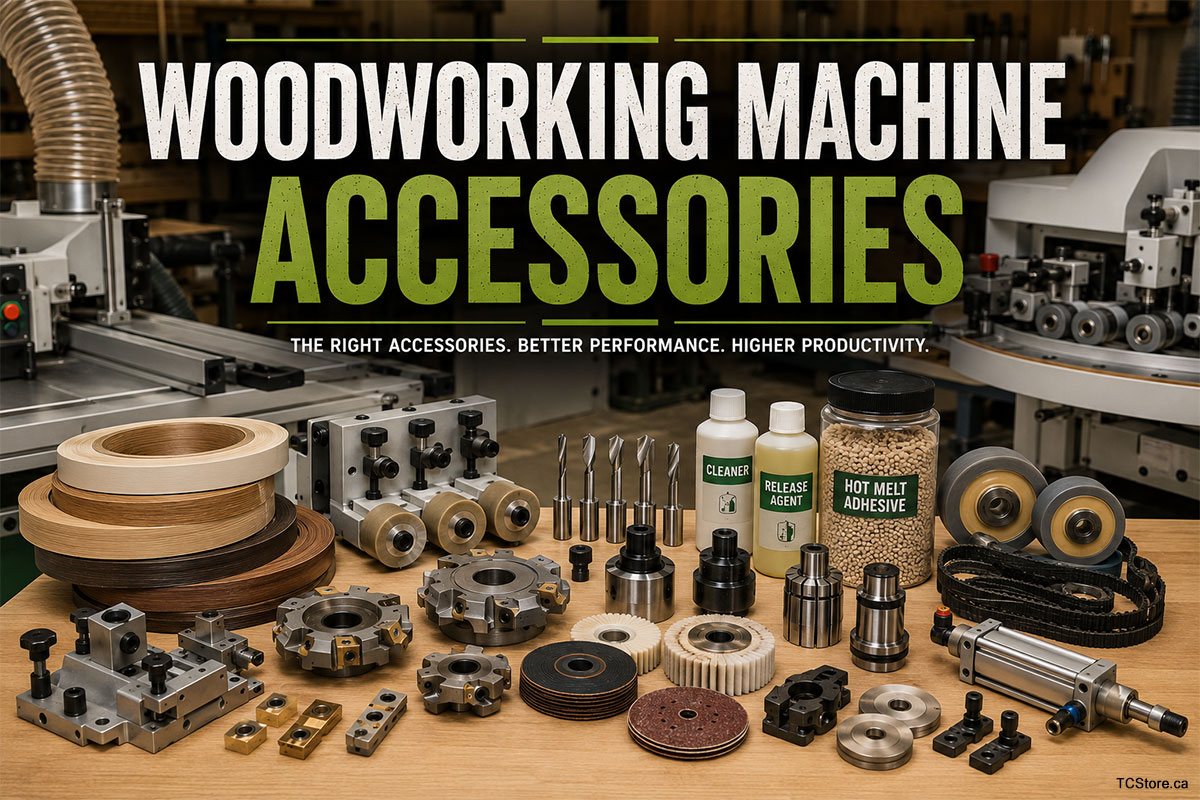
Woodworking Machine Accessories That Improve Productivity
Posted by TCStore on 2026 Aug 31st
Woodworking machine accessories improve productivity by reducing setup time, increrations efficiently.
The machine provides the primary cutting, shaping, sanding, drilling, or assembly function.
The accessories determine how effectively that machine fits into the complete production workflow.
The right fences, power feeders, roller supports, vacuum pods, toolholders, dust extraction components, worktables, measuring systems, and replacement parts can help operators produce more consistent work with fewer interruptions.
Quick Answer
The woodworking machine accessories with the greatest potential to improve productivity include:
✓ Power feeders
✓ Roller stands and material supports
✓ Machine fences and stops
✓ Digital measuring systems
✓ Vacuum pods and clamping accessories
✓ CNC collets and toolholders
✓ Dust collection hoods and hoses
✓ Mobile bases and machine stands
✓ Infeed and outfeed tables
✓ Sanding pads and pressure components
✓ Edgebander trimming and finishing accessories
✓ Drill heads, boring bits, and guides
✓ Lubrication and maintenance accessories
✓ Spare belts, bearings, sensors, and switches
The most productive accessories solve a specific workflow problem.
They reduce handling.
Improve repeatability.
Shorten setup.
Or prevent downtime.
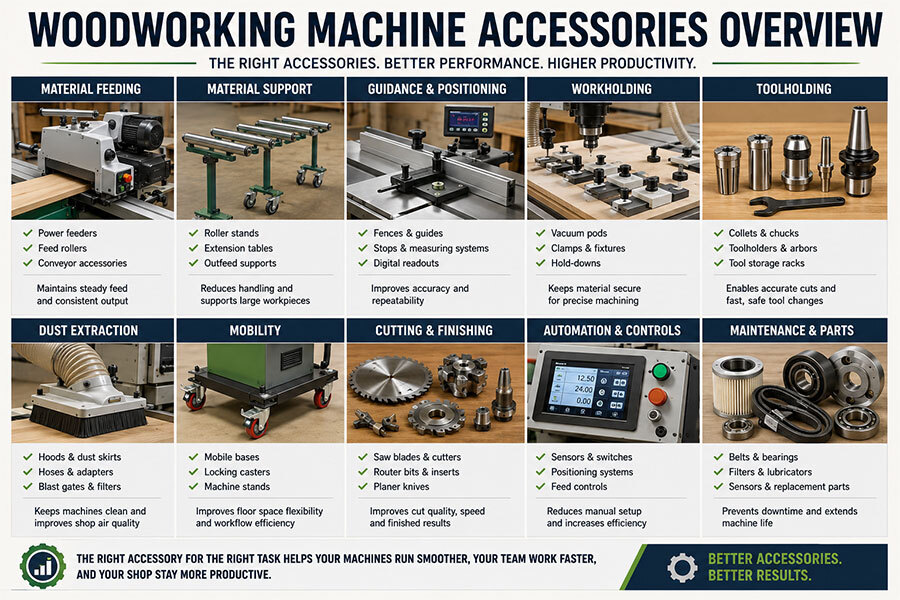
Woodworking Machine Accessories Overview
|
Accessory Category |
Common Examples |
Productivity Benefit |
|
Material feeding |
Power feeders, feed rollers, conveyor accessories |
Maintains steady material movement |
|
Material support |
Roller stands, extension tables, outfeed supports |
Reduces manual handling |
|
Guidance and positioning |
Fences, stops, guides, digital readouts |
Improves accuracy and repeatability |
|
Workholding |
Vacuum pods, clamps, fixtures, hold-downs |
Prevents movement during machining |
|
Toolholding |
Collets, chucks, arbors, toolholders |
Supports accurate and fast tool changes |
|
Dust extraction |
Hoods, hoses, adapters, brushes, blast gates |
Maintains airflow and machine cleanliness |
|
Mobility |
Mobile bases, casters, machine stands |
Improves floor-space flexibility |
|
Cutting and finishing |
Blades, cutters, sanding pads, inserts |
Improves speed and finished quality |
|
Automation |
Sensors, switches, feed controls, positioning systems |
Reduces manual setup |
|
Maintenance |
Lubrication systems, filters, replacement parts |
Prevents avoidable downtime |
Why Machine Accessories Affect Productivity
A woodworking machine rarely operates alone.
Material must be loaded.
Positioned.
Secured.
Processed.
Removed.
Inspected.
And moved to the next production stage.
Accessories improve the steps surrounding the main machining cycle.
A panel saw may complete a cut quickly, but productivity still suffers if operators struggle to support large sheets.
A CNC router may follow an accurate program, but weak vacuum hold-down can cause material movement and rejected parts.
A sander may have sufficient power, but worn pads or poor dust extraction can reduce finish quality and slow production.
The TCStore guide to light industrial machines that improve shop efficiency explains how support equipment can remove bottlenecks and prevent large machinery from being tied up with smaller tasks.
Accessories apply the same principle.
They help the existing machine perform more effectively within the complete workflow.
Power Feeders
Power feeders use driven rollers to move material through a woodworking machine at a steady rate.
They are commonly used with:
- Table saws
- Shapers
- Routers
- Jointers
- Sanders
- Moulders
A power feeder can improve productivity by:
✓ Maintaining a consistent feed speed
✓ Reducing operator fatigue
✓ Improving cut and profile consistency
✓ Keeping hands farther from the cutting area
✓ Supporting repeat production
✓ Reducing hesitation during material feeding
Consistent feed speed is especially valuable when edge quality depends on smooth, uninterrupted movement.
The feeder must be selected according to the machine, material dimensions, required speed range, roller configuration, and available mounting position.
Roller Stands and Material Supports
Long boards, sheet goods, panels, and assembled components can become difficult for one operator to manage.
Roller stands and material supports help stabilize workpieces before and after machining.
Common support accessories include:
- Infeed roller stands
- Outfeed roller stands
- Ball-transfer supports
- Extension tables
- Adjustable support arms
- Conveyor rollers
- Folding material stands
These accessories can reduce the need for a second operator during selected tasks.
They also help prevent material from lifting, twisting, or dropping as it passes through the machine.
Support height must be adjusted accurately.
A stand that is too high or too low can interfere with the cut and create additional handling problems.
Infeed and Outfeed Tables
Infeed and outfeed tables provide a larger, more stable surface around the machine.
They are useful for:
- Table saws
- Panel saws
- Planers
- Sanders
- Edgebanders
- Assembly stations
A well-designed table helps operators maintain control of large or heavy workpieces.
It can also create space for staging material before the next production cycle.
When evaluating an extension table, consider:
- Working height
- Load capacity
- Surface friction
- Available floor space
- Connection to the machine
- Mobility
- Storage requirements
Tables should support workflow without blocking operator access, emergency controls, dust ports, or maintenance panels.
Machine Fences, Stops, and Guides
Fences and stops help operators position material consistently.
Useful accessories include:
- Rip fences
- Crosscut fences
- Mitre gauges
- Flip stops
- Length stops
- Parallel guides
- Angle guides
- Sliding stops
- Fence extensions
These components reduce the time required to measure and mark every workpiece individually.
They also improve repeatability across production runs.
A fixed stop is especially useful when many components require the same length or drilling position.
The productivity gain comes from completing the setup once and repeating the operation accurately.
Digital Measuring and Positioning Systems
Digital readouts and positioning systems can reduce setup time and measuring errors.
They may display:
- Fence position
- Cutting width
- Blade height
- Spindle position
- Table position
- Material thickness
- Stop location
Some systems provide manual digital measurement.
Others use powered or programmable positioning.
Digital positioning can be valuable for shops that change between jobs frequently.
It allows operators to return to stored or documented settings more quickly than relying only on manual scales and repeated test cuts.
However, digital systems still require calibration and verification.
Automation does not correct a poorly aligned machine.
Vacuum Pods and Clamping Accessories
CNC routers and machining centres often use vacuum pods, vacuum cups, spoilboards, or dedicated fixtures to hold workpieces.
Effective workholding is essential for:
- Dimensional accuracy
- Edge quality
- Operator safety
- Tool life
- Repeatability
- Material utilization
Weak vacuum or damaged seals can allow parts to move during machining.
This may cause inaccurate cuts, damaged tooling, or rejected components.
Useful vacuum accessories include:
- Vacuum pods
- Replacement seals
- Manifold systems
- Vacuum cups
- Pod covers
- Fixture plates
- Spoilboard material
- Vacuum gauges
- Hose and fittings
Shops should inspect vacuum components for cracks, contamination, damaged seals, and blocked passages.
CNC Collets and Toolholders
Collets and toolholders connect cutting tools to the CNC spindle.
Their condition directly affects runout, vibration, tool retention, and cutting accuracy.
Important accessories include:
- ER collets
- Collet nuts
- Toolholders
- Chucks
- Arbors
- Pull studs
- Tool-setting devices
- Torque wrenches
- Toolholder storage racks
Dirty or worn collets can cause uneven tool wear and poor cut quality.
Toolholders should be cleaned and stored so their precision surfaces are protected.
The TCStore article on how to choose the right tooling for woodworking machinery explains how tooling compatibility, material type, machine requirements, and production volume affect performance.
Toolholding should be evaluated using the same approach.
Dust Collection Hoods and Extraction Accessories
Dust extraction accessories capture debris closer to the cutting or sanding source.
They may include:
- Machine hoods
- Dust skirts
- Flexible hoses
- Hose adapters
- Blast gates
- Brushes
- Clamps
- Reducers
- Extraction tools
- Replacement filters
Effective extraction reduces the amount of dust remaining inside the machine.
This supports better visibility, cleaner sensors, more reliable movement, and less manual cleanup.
It can also help prevent dust from interfering with workholding or finished surfaces.
The guide to dust collector parts every shop should stock identifies filters, hoses, fittings, belts, blast gates, gaskets, and seals as important replacement items for maintaining airflow.
Mobile Bases and Machine Stands
Floor space is limited in many woodworking shops.
A mobile base allows selected machines to be repositioned when needed.
Suitable machines may include:
- Small table saws
- Bandsaws
- Drill presses
- Sanders
- Planers
- Jointers
- Dust collectors
- Assembly equipment
Mobility can help shops create temporary production cells or clear space for large projects.
However, mobile equipment must remain stable during use.
The base should match the machine weight, footprint, centre of gravity, and operating forces.
Locking casters and levelling feet should be inspected regularly.
Saw Blades, Cutters, and Insert Tooling
Cutting accessories directly influence production speed and finished quality.
Common examples include:
- Circular saw blades
- Scoring blades
- Router cutters
- Shaper heads
- Drill bits
- Boring bits
- Planer knives
- Moulder knives
- Replaceable inserts
Insert tooling can improve productivity because worn cutting edges can often be rotated or replaced without removing and sharpening the entire tool body.
The correct choice depends on the machine, material, cutting speed, feed rate, and desired finish.
Using tooling designed for the application can reduce rework and allow the machine to operate closer to its intended production rate.
Worn tooling should be removed before it creates larger problems.
The article on signs woodworking tooling needs replacement identifies declining cut quality, increased vibration, higher machine load, slower production, and inconsistent results as common warning signs.
Sanding Pads and Pressure Components
Sanding machines rely on more than abrasive belts or discs.
Performance can also depend on:
- Contact pads
- Graphite pads
- Pressure shoes
- Backing pads
- Interface pads
- Conveyor belts
- Tracking components
- Brushes
Worn support components can create uneven sanding pressure and inconsistent finishes.
This may force operators to repeat sanding steps or perform additional manual work.
The guide to choosing the right sanding supplies for your shop explains how abrasive format, grit, material, and application affect finish quality and labour requirements.
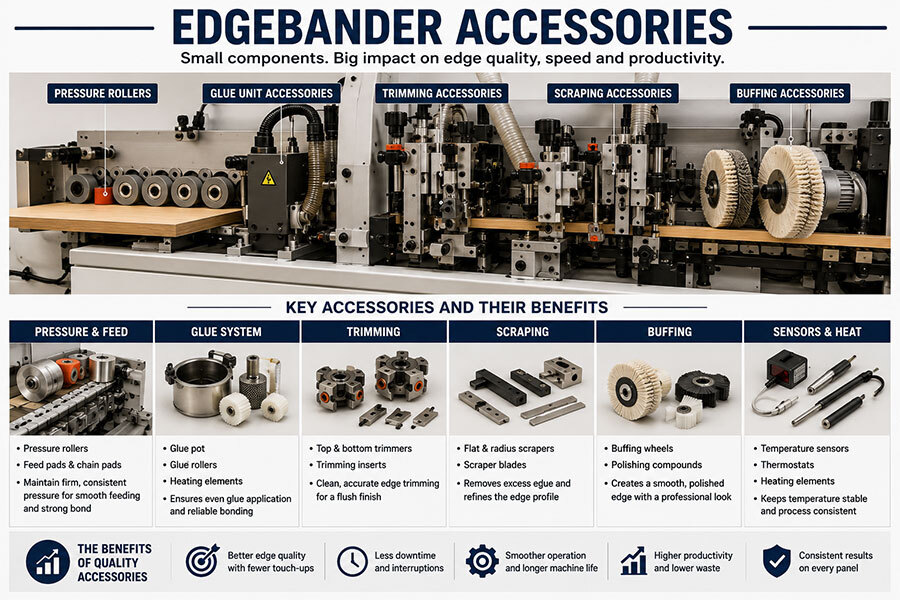
Edgebander Accessories
Edgebander productivity depends on the coordinated performance of glue, feed, trimming, scraping, and buffing systems.
Useful accessories include:
- Pressure rollers
- Feed pads
- Chain pads
- Glue-pot components
- Scraper blades
- Trimming inserts
- Buffing wheels
- Heating elements
- Temperature sensors
- Adhesive cleaners
A small worn component can reduce edge quality across every panel.
Keeping high-use edgebander supplies and accessories available helps prevent a minor problem from stopping the entire production line.
Machine Accessory Productivity Impact Chart
|
Accessory |
Potential Productivity Impact |
|
Power feeder |
Very high |
|
Material support system |
Very high |
|
Fences and repeat stops |
Very high |
|
Vacuum workholding |
Very high |
|
Digital positioning |
High |
|
CNC toolholders and collets |
High |
|
Dust extraction accessories |
High |
|
Infeed and outfeed tables |
High |
|
Cutting and insert tooling |
Very high |
|
Mobile machine base |
Moderate |
|
Spare sensors and switches |
High |
|
Tool and accessory storage |
Moderate to high |
The actual impact depends on the shop’s bottlenecks.
An accessory creates value when it solves a recurring production problem.
How to Choose Productive Machine Accessories
Identify the Bottleneck
Determine where production loses time.
Is material difficult to handle?
Does setup take too long?
Are operators repeating measurements?
Is dust interfering with machine performance?
Does workholding fail during CNC machining?
Start with the largest recurring problem.
Confirm Machine Compatibility
Check the machine make, model, mounting points, dimensions, electrical requirements, load capacity, and manufacturer recommendations.
Measure the Expected Time Savings
Estimate how much setup, handling, cleanup, or rework the accessory could eliminate.
Small time savings repeated throughout every shift can become significant.
Evaluate Production Volume
A high-volume shop may justify automated positioning or powered feeding.
A custom shop may benefit more from flexible guides, mobile supports, and quick-adjust fixtures.
Consider Installation and Training
The accessory should be installed correctly and operators should understand how to use it.
A complicated accessory that employees avoid will not improve productivity.
Keep Critical Replacements Available
Belts, bearings, sensors, switches, filters, pads, and other wear items should be stocked when their failure could stop production.
This supports the same preventive approach described in how to reduce downtime with better woodworking tooling.
Common Accessory Buying Mistakes
What Not to Do
X Buying accessories without identifying a workflow problem
X Choosing only by purchase price
X Assuming universal accessories fit every machine
X Ignoring machine weight and load limits
X Installing unsupported electrical modifications
X Using damaged collets, clamps, or vacuum seals
X Adding automation without operator training
X Blocking guards, controls, or maintenance access
X Buying duplicate accessories that remain unused
X Failing to stock critical replacement parts
Final Thoughts
Woodworking machine accessories can improve productivity without requiring a complete machinery replacement.
The right accessory can help operators move material faster, reduce setup time, improve positioning, maintain workholding, control dust, and produce more consistent parts.
Start with the shop’s actual bottlenecks.
Then choose accessories that provide measurable improvements in handling, accuracy, workflow, or machine availability.
TCStore supplies light industrial machines, tooling, CNC accessories, dust collection components, power feeders, work supports, sanding products, edgebander supplies, replacement parts, and other accessories for professional woodworking operations.
Frequently Asked Questions
Which woodworking machine accessories improve productivity the most?
Power feeders, material supports, fences, repeat stops, vacuum workholding, digital positioning systems, dust extraction components, and sharp cutting tooling often provide the greatest productivity improvements.
Can accessories improve an older woodworking machine?
Yes. Suitable fences, digital readouts, dust hoods, power feeders, mobile bases, work supports, and updated tooling can improve the usability of some older machines. Compatibility and machine condition should be confirmed first.
Are power feeders worth adding to woodworking machinery?
Power feeders can be valuable for repeated ripping, shaping, routing, and moulding operations. They provide a consistent feed rate and can reduce operator fatigue.
How do dust collection accessories improve productivity?
Effective hoods, hoses, adapters, blast gates, and filters help capture debris at the machine. This reduces cleanup, supports airflow, keeps components cleaner, and can prevent dust-related interruptions.
How should a shop prioritize machine accessory purchases?
Start with accessories that solve the most expensive or frequent bottlenecks. Consider setup time, material handling, quality problems, downtime, labour requirements, and the number of times the accessory will be used.