

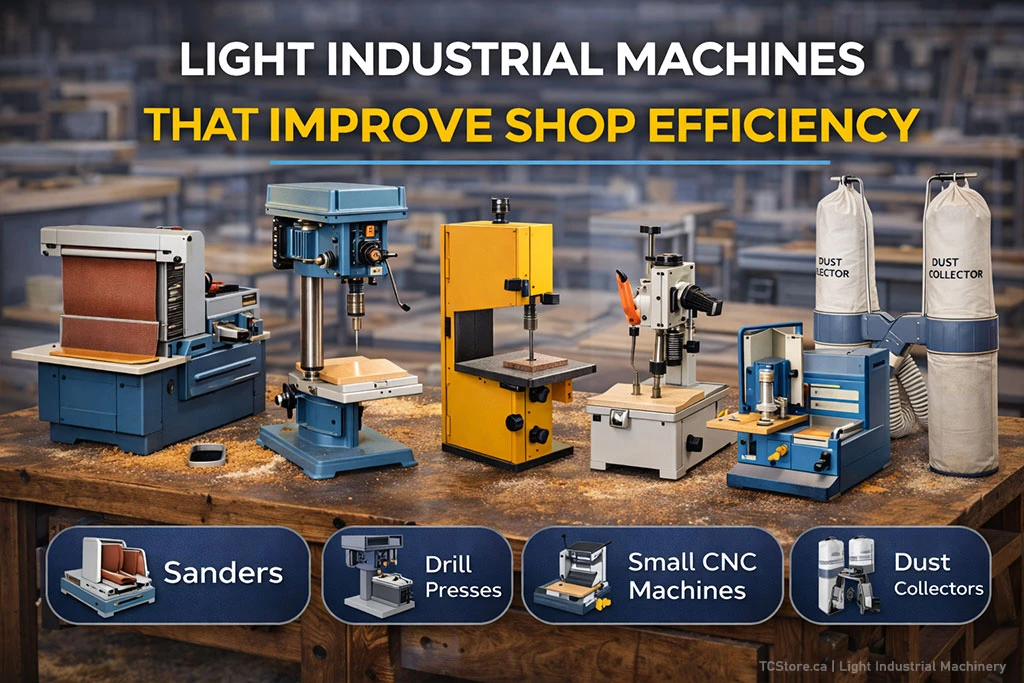
Light Industrial Machines That Improve Shop Efficiency
Posted by TCStore on 2026 Apr 30th
Efficiency is one of the most important factors in any woodworking or fabrication environment. Even small delays can affect output, labor costs, delivery timelines, and overall profitability. While large-scale equipment often gets the most attention, light industrial machines can play a major role in improving workflow, reducing bottlenecks, and supporting day-to-day production.
For many shops, the right light industrial machines help bridge the gap between hand tools and large machinery. They support precision work, improve consistency, reduce manual effort, and allow teams to complete more tasks in less time. Whether your business focuses on woodworking, cabinet production, millwork, or light manufacturing, these machines can make a noticeable difference across the shop floor.
Why Light Industrial Machines Matter
Not every production task requires a full-size CNC, large saw system, or heavy automated line. Many jobs rely on compact, reliable equipment that handles important support functions quickly and accurately. This is where light industrial machines are especially valuable.
The right equipment can help shops:
- Improve production flow
- Reduce manual labor
- Increase consistency
- Minimize downtime between tasks
- Support finishing, drilling, shaping, and assembly
- Improve space efficiency in smaller facilities
These machines may not always be the largest investment in the shop, but they often have a major impact on productivity.
What Are Light Industrial Machines
Light industrial machines are compact or mid-size production machines designed for frequent shop use without the scale of larger industrial systems. They are built to be more robust than portable tools, but more flexible and accessible than full production lines.
These machines are often used for:
- Precision drilling
- Sanding and finishing
- Small-part cutting
- Shaping and trimming
- Assembly support
- Material preparation
- Secondary operations after CNC or panel processing
Because of their versatility, they are commonly used in woodworking shops, furniture production, cabinet operations, and mixed manufacturing environments.
Drill Presses Improve Accuracy and Repeatability
A drill press is one of the most useful light industrial machinery a shop can have. While handheld drills are convenient, a drill press offers more accuracy, control, and repeatability for many production tasks.
Common uses include:
- Drilling consistent holes
- Creating hardware mounting points
- Repetitive boring tasks
- Small-part fabrication
- Precision alignment work
For shops that handle repeated drilling operations, a drill press helps reduce errors and improve speed. It also creates cleaner results and reduces operator fatigue compared to manual drilling.
Edge Sanders and Finishing Machines Save Time
Finishing can be one of the most time-consuming parts of production. This is where sanding-focused light industrial machines can have a strong impact. Edge sanders, spindle sanders, and bench-style finishing machines help create more consistent surfaces and reduce labor time.
These machines are especially useful for:
- Smoothing edges on panels and components
- Refining shaped parts
- Preparing surfaces for finishing
- Improving consistency in repeated sanding tasks
Instead of relying fully on handheld sanding, shops can use these machines to speed up finishing while improving surface quality.
Small Bandsaws and Cutoff Machines Increase Flexibility
Not every cut needs to go through a major saw system. Small bandsaws and cutoff-style light industrial woodworking help shops manage specialty cuts, quick material prep, curved work, and shorter production tasks.
They are useful for:
- Cutting small components
- Trimming stock to size
- Handling curved or irregular shapes
- Preparing parts for secondary operations
These machines improve shop flexibility and reduce the need to tie up larger equipment for smaller jobs.
Bench Mortisers and Specialty Joinery Machines Improve Workflow
For woodworking shops that still perform specialty joinery, bench mortisers and similar light industrial machines can improve both speed and accuracy. These tools help create cleaner joints and more repeatable results than fully manual methods.
They are often used for:
- Mortise and tenon preparation
- Frame and door construction
- Furniture joinery
- Custom millwork tasks
In shops where precision joinery matters, these machines support quality while saving time.
Compact Dust Collection and Support Machines Help the Entire Shop
Shop efficiency is not only about cutting and shaping. Support equipment also matters. Compact dust collection units, sharpening systems, and glue application tools are all examples of light industrial machines that help keep operations moving smoothly.
These systems help by:
- Keeping work areas cleaner
- Improving air quality
- Reducing cleanup time
- Supporting machine maintenance
- Improving adhesive application consistency
While they may not directly create finished parts, they support the workflow that makes efficient production possible.
Small CNC and Benchtop Automation Systems
In some shops, smaller CNC units also fall into the category of light industrial machines. These systems can be useful for prototyping, engraving, small-batch parts, custom details, and overflow work.
They are especially helpful for:
- Small production runs
- Sample making
- Custom engraving
- Detailed routing work
- Operator training and testing
For businesses that want some automation without committing every task to a large machine, these systems provide flexibility and efficiency.
How Light Industrial Machines Improve Overall Shop Efficiency
When chosen correctly, light industrial machines improve efficiency in several ways:
- They reduce dependence on manual labor for repetitive tasks
- They prevent larger machines from being tied up with smaller jobs
- They improve consistency and reduce rework
- They support better workflow between departments or stages
- They help smaller shops do more with limited floor space
In many cases, the best improvement to shop efficiency is not always another large machine. Sometimes it is the right supporting equipment placed in the right part of the workflow.
Choosing the Right Machines for Your Shop
The best light industrial woodworking machines for your business depend on the work you do every day. Before investing, it is important to evaluate:
- Which tasks slow production down
- Where manual work is taking too much time
- Which quality issues appear repeatedly
- How much floor space is available
- Whether operators need flexibility or dedicated stations
The goal is not just to add more equipment. The goal is to add the right machines that solve real production problems.
Final Thoughts
Light industrial machines may not always be the most visible part of a production environment, but they often have a major effect on output, consistency, and workflow. From drill presses and sanders to specialty cutting and joinery equipment, these machines help shops work smarter and more efficiently.
For woodworking and light manufacturing businesses looking to improve day-to-day performance, investing in the right light industrial machines can lead to better productivity, cleaner results, and stronger long-term efficiency.
Frequently Asked Questions About Light Industrial Machines
1. What are light industrial machines used for?
Light industrial machines are used for support and production tasks such as drilling, sanding, cutting, shaping, finishing, and assembly. They help improve efficiency without requiring the scale of larger industrial systems.
2. How do light industrial machines improve shop efficiency?
Light industrial machines improve shop efficiency by reducing manual labor, increasing consistency, speeding up repetitive tasks, and freeing larger machines for major production work.
3. What are examples of light industrial machines for woodworking shops?
Common light industrial machines for woodworking shops include drill presses, edge sanders, spindle sanders, small bandsaws, bench mortisers, compact dust collection systems, and small CNC units.
4. Are light industrial machines good for small shops?
Yes, light industrial machines are often a strong fit for small shops because they improve productivity while using less floor space than larger industrial equipment.
5. How do I choose the right light industrial machines?
To choose the right light industrial machines, look at your workflow, bottlenecks, available space, and the tasks your team performs most often. The best machines are the ones that solve recurring production issues and improve daily efficiency.