

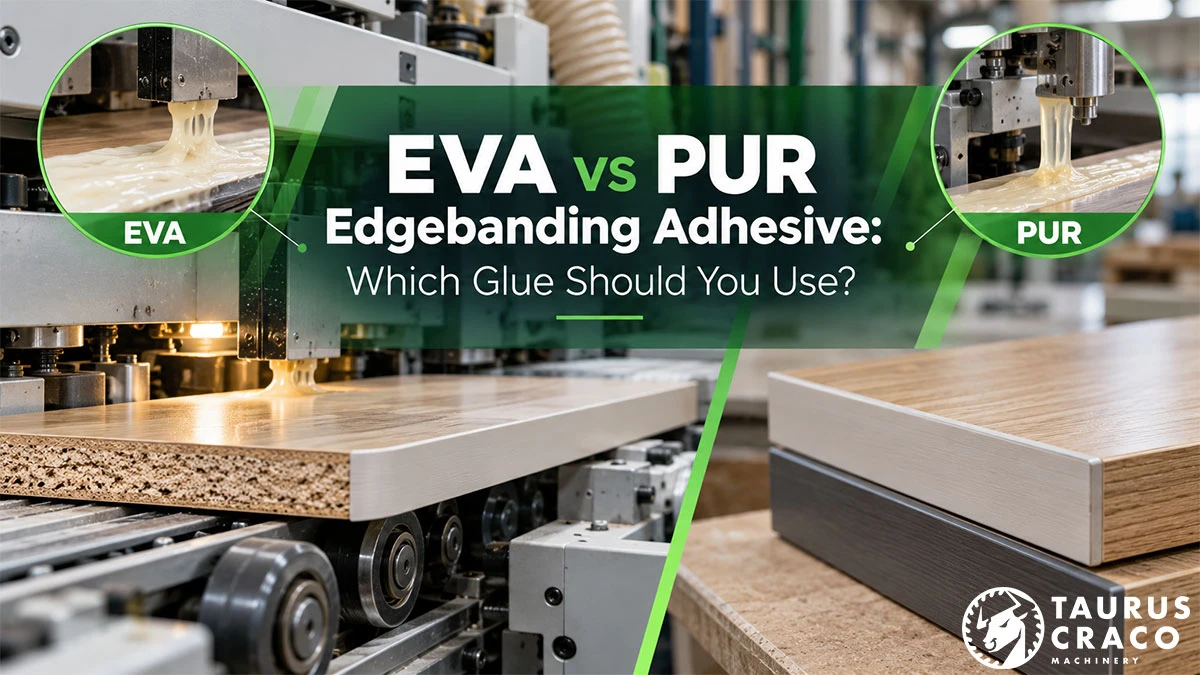
EVA vs PUR Edgebanding Adhesive: Which Glue Should You Use?
Posted by TCStore on 2026 Oct 12th
Choosing between EVA and PUR edgebanding adhesive affects bond strength, moisture resistance, heat resistance, glue-line appearance, cleanup requirements, production workflow, and the long-term durability of finished cabinet and furniture components.
Both adhesive types are widely used in professional edgebanding.
But they are not interchangeable.
EVA is practical, economical, and easy to process for many standard applications.
PUR is generally selected when stronger bonding, improved moisture resistance, or more demanding performance is required.
TCStore carries edgebanding glue for automatic and professional edgebanders, including EVA edgebanding adhesive and PUR edgebanding adhesive from Jowat.
This guide compares EVA vs PUR edgebanding adhesive so cabinet shops, furniture manufacturers, millwork companies, and panel processors can choose the right glue for their production requirements.
Quick Answer: EVA vs PUR Edgebanding Adhesive
Use EVA adhesive when you need:
✓ Cost-effective general production
✓ Straightforward processing
✓ Standard indoor cabinet applications
✓ Easier cleanup and changeover
✓ Reliable bonding under typical interior conditions
Use PUR adhesive when you need:
✓ Stronger moisture resistance
✓ Better heat resistance
✓ High-performance cabinet or commercial applications
✓ Very durable bonding
✓ Greater resistance to demanding service conditions
Neither adhesive is automatically better for every shop.
The correct choice depends on the panel, edge material, end-use environment, edgebander, production volume, cleanup procedure, and customer requirements.
EVA vs PUR Adhesive Comparison
|
Factor |
EVA Adhesive |
PUR Adhesive |
|
Typical application |
General cabinet and furniture production |
Premium and demanding applications |
|
Initial cost |
Lower |
Higher |
|
Ease of use |
Straightforward |
Requires greater process control |
|
Moisture resistance |
Moderate |
High |
|
Heat resistance |
Moderate to good |
High |
|
Bond strength |
Strong for standard applications |
Very strong |
|
Glue-line appearance |
Good |
Can support very thin glue lines |
|
Cleanup |
Generally easier |
More controlled cleaning required |
|
Storage and handling |
Simpler |
Requires careful handling |
|
Best fit |
Standard indoor products |
Kitchens, bathrooms, commercial work |
What Is EVA Edgebanding Adhesive?
EVA stands for ethylene-vinyl acetate.
EVA hot melt adhesive is widely used in automatic edgebanders because it melts quickly, bonds efficiently, and works well in many standard cabinet and furniture applications.
It is commonly available in:
- Granular form
- Cartridge form
- Natural or translucent colour
- White colour
- Different viscosities
- Different temperature ranges
TCStore carries products such as Jowat 286.30 Jowatherm Natural Hot Melt EVA Glue Cartridges for compatible edgebanders.
EVA is often used with:
- PVC edging
- ABS edging
- Veneer
- Resinated paper
- Solid-wood edge material
- Standard cabinet panels
Advantages of EVA Edgebanding Glue
Lower Operating Cost
EVA is typically more economical than PUR.
For high-volume general cabinet production, that price difference can be significant.
Easy Processing
EVA is familiar to many shops and generally straightforward to run in compatible glue pots or cartridge systems.
Faster Changeover and Cleanup
Compared with reactive PUR systems, EVA is usually easier to manage during machine shutdown, glue changes, and cleaning.
Good General Bond Strength
For standard interior cabinetry, furniture, shelving, closets, and casework, EVA can provide reliable bonding when processed correctly.
Wide Availability
EVA adhesives are available in multiple grades, colours, formats, and viscosities.
That makes it easier to match the adhesive to different edgebanders and edge materials.
When Is EVA Glue the Better Choice?
EVA is often a strong choice for:
✓ Bedroom furniture
✓ Closet systems
✓ Office furniture
✓ Shelving
✓ General residential cabinetry
✓ Shop fixtures
✓ Standard commercial casework
✓ Production where high moisture exposure is not expected
If the finished product will be used primarily in a normal indoor environment, EVA may provide all the performance required.
What Is PUR Edgebanding Adhesive?
PUR stands for polyurethane reactive adhesive.
PUR hot melt begins by melting and bonding like a traditional hot melt, but it also reacts with moisture as it cures.
That chemical reaction creates a highly durable bond.
TCStore carries multiple PUR edgebanding adhesive options, including translucent and white Jowat PUR formulations for compatible automatic edgebanders.
Examples include the Jowat 608.00 Jowatherm Translucent PUR Glue Cartridge and Jowat 608.01 Jowatherm White PUR Glue Cartridge.
Advantages of PUR Edgebanding Glue
Strong Moisture Resistance
PUR is commonly selected for environments where moisture exposure is more likely.
Examples include:
- Kitchens
- Bathrooms
- Laboratories
- Healthcare environments
- Commercial interiors
- Utility spaces
Improved Heat Resistance
PUR generally performs better when finished components may be exposed to elevated temperatures.
High Bond Strength
Once cured, PUR creates a durable bond that performs well in demanding applications.
Thin Glue-Line Potential
PUR can support very fine glue lines when the edgebander, adhesive application, temperature, panel preparation, and edge material are properly controlled.
That can be desirable for premium cabinetry and furniture.
Strong Long-Term Performance
PUR is frequently chosen when durability requirements justify the added adhesive and handling cost.
When Is PUR Glue the Better Choice?
PUR is often preferred for:
✓ Kitchen cabinets
✓ Bathroom vanities
✓ Commercial casework
✓ Laboratory furniture
✓ Healthcare cabinetry
✓ High-end furniture
✓ Premium architectural millwork
✓ Components exposed to moisture or heat
✓ Products where glue-line appearance is especially important
Is PUR Better Than EVA for Kitchen Cabinets?
For many kitchen-cabinet applications, PUR can provide performance advantages because kitchens experience moisture, steam, temperature changes, cleaning products, and repeated daily use.
That does not mean EVA is unsuitable for every kitchen.
A properly processed EVA adhesive can perform well in many standard residential applications.
PUR becomes more attractive when the cabinet manufacturer wants additional moisture and heat resistance or is producing premium components with stricter durability requirements.
Moisture Resistance: EVA vs PUR
Moisture resistance is one of the biggest differences between the two adhesive systems.
EVA
EVA performs well in normal indoor conditions.
Long-term exposure to high humidity, water, or repeated steam can be more demanding.
PUR
PUR reacts chemically during curing and creates a bond with stronger resistance to moisture.
This makes it particularly useful where water exposure cannot be ruled out.
Examples include sink cabinets, bathroom cabinetry, laundry-room components, and commercial interiors.
Heat Resistance: EVA vs PUR
Heat can soften hot-melt adhesive.
The temperature at which performance begins to decline depends on the specific adhesive formulation.
EVA products are available with different heat-resistance ratings, and higher-performance EVA can be suitable for many demanding indoor environments.
PUR generally provides greater resistance to elevated temperature after curing.
That can matter for:
- Kitchens
- Areas near appliances
- Commercial interiors
- Furniture exposed to sunlight
- Transportation interiors
- Products shipped or stored in hot environments
Always confirm the adhesive manufacturer's specifications for the intended application.
Glue-Line Appearance
A visible glue line can affect the appearance of high-end cabinetry.
Factors that influence glue-line visibility include:
- Adhesive colour
- Adhesive quantity
- Edge colour
- Panel colour
- Application temperature
- Pressure
- Glue-pot adjustment
- Edge thickness
- Machine setup
White adhesive may be selected for white or light-coloured panels.
Natural or translucent adhesive may be preferred for darker or woodgrain materials.
PUR is often associated with very fine glue lines, but excellent results still depend on machine setup.
The adhesive alone cannot compensate for incorrect pressure, temperature, trimming, or panel preparation.
Adhesive Colour: White vs Natural
Adhesive colour matters most where the glue line remains visible.
White Adhesive
White glue may help reduce contrast on:
- White melamine
- White PVC
- Light laminates
- Light decorative panels
Natural or Translucent Adhesive
Natural or translucent adhesive may blend better with:
- Woodgrain panels
- Darker colours
- Veneer
- Natural wood edge material
TCStore carries both white and natural or translucent EVA and PUR adhesive options, allowing shops to match the glue line more closely to finished materials.
EVA Cartridges vs Granular Adhesive
EVA is available in different formats.
Granular EVA
Granular adhesive is commonly used in traditional glue-pot edgebanders.
Advantages can include:
- Easy bulk supply
- Compatibility with many standard systems
- Multiple grades and colours
Cartridge EVA
Cartridge systems can make adhesive handling cleaner and more controlled on compatible machines.
For example, TCStore offers Jowat 286.30 EVA glue cartridges for compatible Holz-Her-style cartridge systems.
The machine determines which adhesive format is appropriate.
Never assume granular glue and cartridges are interchangeable.
PUR Cartridges, Slugs and Granular Formats
PUR is also supplied in different formats depending on the machine.
Options may include:
- Cartridges
- Slugs
- Granular adhesive
- Sealed containers
The adhesive system must match the edgebander.
Before purchasing, confirm:
✓ Machine make and model
✓ Glue unit design
✓ Adhesive format
✓ Operating temperature
✓ Application system
✓ Cleaning requirements
✓ Shutdown procedure
PUR Requires More Controlled Cleanup
One of the main operational differences between EVA and PUR is cleanup.
EVA can generally be reheated and processed more easily after cooling.
PUR behaves differently because it chemically cures.
Once cured, PUR cannot simply be remelted back into its original usable form.
That means PUR systems require disciplined shutdown and cleaning procedures.
TCStore carries PUR-related maintenance products such as Jowat PUR adhesive purge products for compatible systems.
Always follow the adhesive and edgebander manufacturer's instructions.
Why PUR Purging Matters
A purge material helps displace reactive adhesive from the system before extended shutdown or maintenance.
Failing to purge correctly can allow PUR adhesive to cure inside:
- Glue pots
- Hoses
- Nozzles
- Cartridge systems
- Application heads
Cured adhesive can create expensive maintenance problems.
For shops considering PUR, cleanup procedure should be evaluated before production begins, not after the first shutdown.
Adhesive Temperature Matters
Both EVA and PUR need to be processed within appropriate temperature ranges.
If adhesive is too cold:
- Viscosity may be too high
- Wetting may be poor
- Bond strength may decrease
- Glue spread may become inconsistent
If adhesive is too hot:
- Adhesive performance may degrade
- Glue can darken
- Excess fumes may develop
- Open time may change
- Equipment can accumulate residue
Machine temperature should be verified rather than assumed.
Panel Temperature Matters Too
The glue may be at the correct temperature while the panel is too cold.
Cold panels can remove heat from the adhesive rapidly.
That can reduce wetting and shorten the effective bonding window.
This becomes more important in:
- Winter
- Unheated storage
- Cold warehouses
- Shops receiving material directly from outdoor conditions
Panels and edge material should be conditioned appropriately before production.
Pressure Is Essential for Bond Strength
The adhesive must contact both surfaces effectively.
Pressure rollers push the edge material against the glued panel while the bond forms.
Problems with pressure can cause:
- Open glue lines
- Weak adhesion
- Edge lifting
- Inconsistent bonding
Inspect pressure rollers for:
- Wear
- Contamination
- Incorrect adjustment
- Adhesive buildup
- Alignment problems
Adhesive chemistry cannot fix a mechanical pressure problem.
Panel Preparation Affects Adhesion
A dirty, chipped, dusty, or poorly machined panel edge can reduce bonding performance.
Good preparation may include:
✓ Accurate panel sizing
✓ Clean edge machining
✓ Premilling where required
✓ Dust removal
✓ Correct feed speed
✓ Consistent panel thickness
This is why adhesive should be considered as part of the complete edgebanding process.
TCStore's guide to Choosing the Right Edgebanding Supplies for Cabinets explains how edge material, adhesive, tooling, cleaning products, pressure components, and finishing systems work together.
Edge Material Compatibility
Common edgebanding materials include:
- PVC
- ABS
- Veneer
- Melamine
- HPL
- CPL
- Solid wood
- Polypropylene
Adhesive compatibility depends on the specific formulation.
Do not assume every EVA or PUR adhesive bonds equally well to every edge material.
Check the adhesive manufacturer's supported applications.
EVA vs PUR by Application
|
Application |
Typical Choice |
Why |
|
Standard residential cabinetry |
EVA or PUR |
Depends on performance target |
|
Kitchen cabinets |
PUR often preferred |
Moisture and heat resistance |
|
Bathroom vanities |
PUR |
Higher moisture exposure |
|
Office furniture |
EVA |
Standard indoor environment |
|
Closet systems |
EVA |
Cost-effective production |
|
High-end millwork |
PUR |
Premium bond and glue line |
|
Commercial casework |
PUR or high-performance EVA |
Depends on specification |
|
Furniture |
EVA or PUR |
Based on environment and quality target |
|
Laboratory cabinetry |
PUR |
Demanding exposure conditions |
Which Adhesive Costs Less?
EVA usually costs less per unit of adhesive.
But purchase price is not the only cost.
Consider:
- Adhesive consumption
- Reject rate
- Cleanup labour
- Machine downtime
- Finished-product warranty risk
- Customer requirements
- Edge failure risk
- Production volume
A lower-cost adhesive is not economical if it causes failures in an application that requires higher resistance.
Likewise, using PUR on every standard interior component may add cost and handling complexity without creating enough additional value.
Common EVA Adhesive Mistakes
X Running glue at the wrong temperature
X Using the wrong viscosity
X Using a colour that creates a visible glue line
X Applying too little adhesive
X Applying too much adhesive
X Using cold panels
X Ignoring pressure-roller condition
X Running dull premilling or trimming tooling
Common PUR Adhesive Mistakes
X Treating PUR like EVA
X Ignoring purge requirements
X Leaving reactive adhesive in the system during shutdown
X Using incompatible cleaning products
X Failing to follow storage requirements
X Using the wrong cartridge or adhesive format
X Running outside recommended temperature ranges
X Ignoring moisture-curing behaviour
Edgebanding Adhesive Buying Checklist
Before ordering adhesive, confirm:
- What edgebander will use the glue?
- Does the machine use granular adhesive, cartridges, or slugs?
- What edge materials are being applied?
- What panel substrates are being processed?
- Is the finished product exposed to moisture?
- Is heat resistance important?
- What glue-line colour is required?
- What production volume is expected?
- What operating temperature does the adhesive require?
- What cleaning process is required?
- Does PUR require a purge product?
- How long will the machine sit between production runs?
- What adhesive is approved by the machine manufacturer?
- Should backup adhesive be stocked?
TCStore carries a complete range of edgebanding supplies, including EVA, PUR and polyolefin adhesives, cleaning products, release agents, lubricants, trimming tools, parts, and machine accessories.
Final Thoughts
The choice between EVA and PUR edgebanding adhesive should be based on finished-product requirements, not simply adhesive price.
EVA is an excellent general-purpose solution for many indoor cabinet, furniture, closet, shelving, and casework applications.
PUR is better suited to applications where moisture resistance, heat resistance, premium bond performance, or demanding service conditions justify the additional handling requirements.
Start with the end use.
Then confirm edge material, panel substrate, edgebander compatibility, glue format, temperature, adhesive colour, cleanup requirements, and production volume.
The right adhesive helps improve bond reliability, edge appearance, durability, and long-term product quality.
For a broader overview of edge materials, adhesives, tooling, scraper blades, buffing wheels, cleaning products, and pressure components, review Must-Have Edgebander Supplies for Better Results.
Frequently Asked Questions
Is PUR edgebanding adhesive better than EVA?
PUR generally provides stronger moisture and heat resistance, making it well suited to demanding applications. EVA is easier to process and more economical for many standard indoor cabinet and furniture applications. The better choice depends on the finished product and operating environment.
Should I use EVA or PUR glue for kitchen cabinets?
PUR is often preferred for kitchen cabinetry because kitchens experience moisture, heat, steam, and frequent cleaning. High-quality EVA may still be suitable for many standard indoor applications when processed correctly.
Can I switch from EVA to PUR in the same edgebander?
Possibly, but only if the edgebander and glue system are designed for both adhesive types. PUR requires specific cleaning, purging, storage, and shutdown procedures. Always confirm compatibility with the machine manufacturer before switching adhesives.
Why is PUR edgebanding glue harder to clean?
PUR is reactive. After application it cures through a chemical reaction with moisture, creating a durable bond that cannot simply be remelted like standard EVA. That is why compatible purge and cleaning procedures are important.
What colour edgebanding adhesive should I use?
Choose adhesive colour according to the panel and edge material. White adhesive can help minimize visible glue lines on white and light panels, while natural or translucent adhesive may blend better with woodgrain and darker materials.