

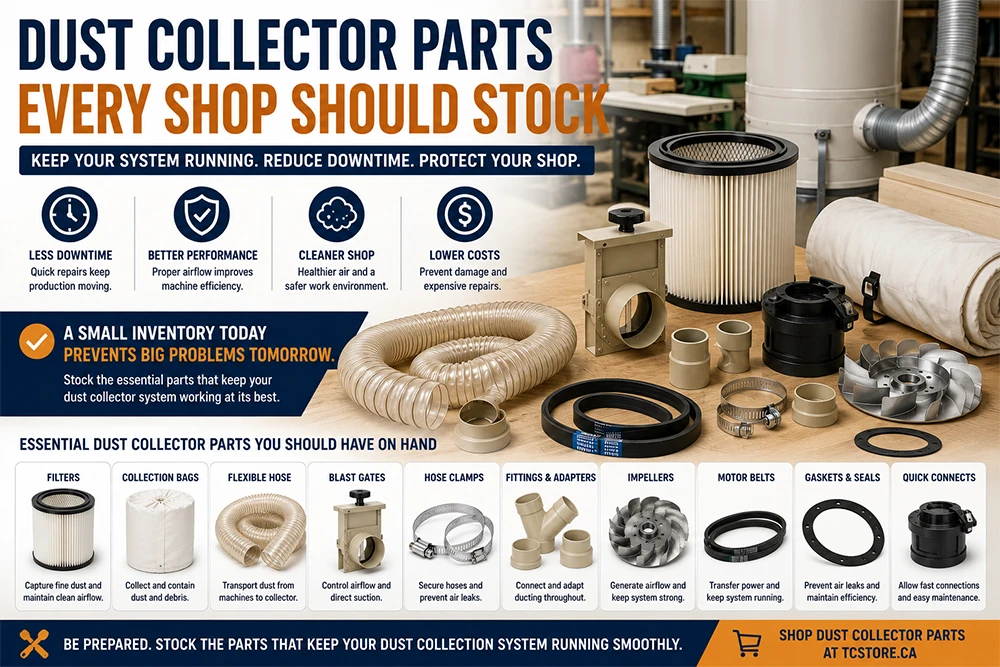
Dust Collector Parts Every Shop Should Stock
Posted by TCStore on 2026 Jun 15th
Dust collector parts are some of the most important yet overlooked items in a woodworking shop. While most manufacturers focus on woodworking machinery, tooling, and production equipment, a single failed dust collector component can bring production to a halt.
The reality is simple.
Dust collection is not optional.
Modern woodworking machinery depends on it.
CNC routers depend on it.
Panel saws depend on it.
Edgebanders depend on it.
Wide belt sanders depend on it.
Without proper dust collection, productivity drops, maintenance increases, machine life decreases, and workplace safety suffers.
The problem?
Many shops do not keep critical replacement dust collector parts in stock.
When something fails, production stops.
Then everyone waits.
The best woodworking businesses plan ahead.
Quick Answer
Every woodworking shop should keep the following dust collector parts in inventory:
✓ Dust Collection Filters
✓ Collection Bags
✓ Flexible Dust Hose
✓ Blast Gates
✓ Hose Clamps
✓ Dust Collection Fittings
✓ Impellers
✓ Motor Belts
✓ Gaskets And Seals
✓ Quick Connect Fittings
✓ Filter Cleaning Supplies
Keeping these parts available can significantly reduce downtime and prevent costly production interruptions.
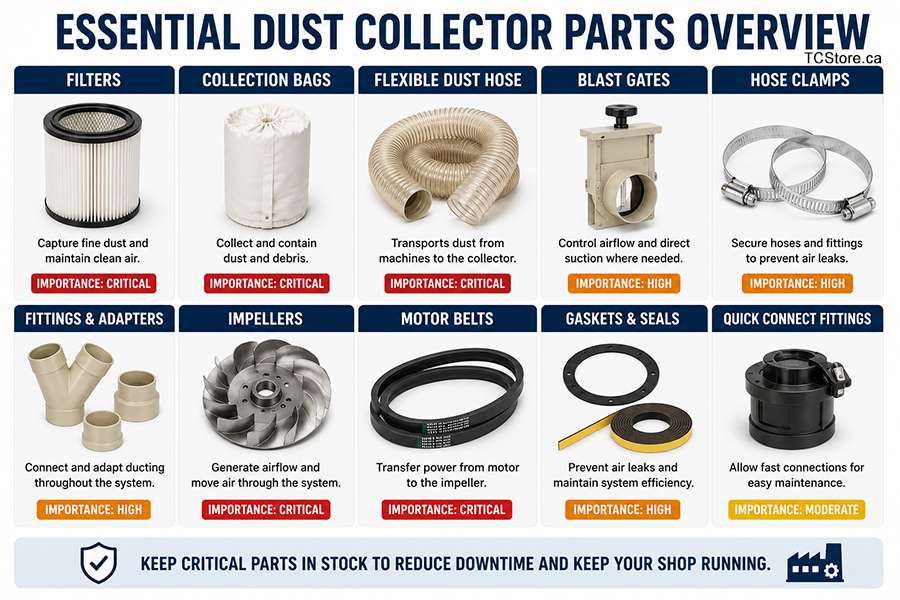
Essential Dust Collector Parts Overview
|
Dust Collector Part |
Primary Function |
Importance |
|
Filters |
Capture airborne dust |
Critical |
|
Collection Bags |
Store collected dust |
Critical |
|
Flexible Hose |
Transport dust |
Critical |
|
Blast Gates |
Control airflow |
High |
|
Hose Clamps |
Secure connections |
High |
|
Fittings & Adapters |
Connect systems |
High |
|
Motor Belts |
Power transfer |
Critical |
|
Impellers |
Generate airflow |
Critical |
|
Gaskets & Seals |
Prevent air leaks |
High |
|
Quick Connects |
Simplify maintenance |
Moderate |
Some parts wear gradually.
Others fail unexpectedly.
Both situations can cause downtime.
Why Dust Collection Matters
Dust collection affects much more than cleanliness.
It directly impacts:
- Machine performance
- Air quality
- Worker safety
- Product quality
- Maintenance costs
- Production efficiency
Poor dust collection can create expensive problems.
Benefits Of Effective Dust Collection
✓ Cleaner work environment
✓ Better machine performance
✓ Reduced maintenance
✓ Longer machinery lifespan
✓ Improved air quality
✓ Better finish quality
✓ Reduced downtime
Dust collection should be viewed as production infrastructure.
Not just housekeeping.
Dust Collection Filters
Filters are arguably the most important component in any dust collection system.
Their job is simple.
Capture dust.
Maintain airflow.
Protect equipment.
Over time, filters become clogged.
As airflow decreases, system performance suffers.
Signs Filters Need Attention
- Reduced suction
- Increased airborne dust
- Higher motor strain
- Poor machine extraction
- Increased cleanup requirements
Benefits Of Keeping Spare Filters
✓ Faster replacement
✓ Reduced downtime
✓ Better airflow
✓ Improved safety
✓ More consistent performance
Many shops keep backup filters specifically to avoid emergency downtime.
Dust Collection Bags
Dust collection bags hold dust and debris after it has been separated from the airflow.
While simple, they remain essential.
Damaged bags can lead to:
- Air leaks
- Dust contamination
- Reduced efficiency
- Cleanup problems
Common Bag Types
|
Collection Bag Type |
Typical Application |
|
Plastic Collection Bags |
General collection |
|
Fabric Collection Bags |
Traditional systems |
|
High-Capacity Bags |
Production facilities |
|
Disposable Bags |
Quick replacement |
Keeping spare bags available prevents unnecessary delays.
Flexible Dust Collection Hose
Flexible hose connects woodworking machinery to the dust collection system.
It experiences constant wear.
Especially in busy shops.
Common Causes Of Hose Failure
- Abrasion
- Crushing
- Punctures
- Kinks
- Age-related deterioration
Why Spare Hose Matters
✓ Faster repairs
✓ Reduced downtime
✓ Improved airflow
✓ Easier system modifications
Flexible hose is one of the most commonly replaced dust collection parts.
Blast Gates
Blast gates control airflow throughout the dust collection system.
They allow operators to direct suction where it is needed.
Proper airflow improves efficiency.
Improper airflow wastes energy.
Benefits Of Blast Gates
✓ Improved airflow control
✓ Better machine performance
✓ Increased efficiency
✓ Reduced energy consumption
Blast gates are inexpensive but highly valuable.
Hose Clamps And Connections
A dust collection system is only as strong as its connections.
Loose connections create:
- Air leaks
- Reduced suction
- Increased dust escape
- Lower system efficiency
Essential Connection Components
✓ Hose clamps
✓ Quick-connect fittings
✓ Reducers
✓ Adapters
✓ Couplers
These parts are inexpensive and worth stocking.
Dust Collection Fittings And Adapters
Woodworking shops often modify equipment layouts.
New machinery gets added.
Production areas evolve.
This creates a constant need for fittings.
Common Dust Collection Fittings
|
Fitting Type |
Purpose |
|
Y Branches |
Split airflow |
|
Elbows |
Change direction |
|
Reducers |
Adjust pipe size |
|
Couplers |
Join sections |
|
Adapters |
Connect components |
Waiting for a fitting can delay an entire installation.
Motor Belts
Many dust collection systems rely on belt-driven motors.
Belts wear naturally over time.
A broken belt can stop the entire system.
Signs Of Belt Wear
- Squealing noises
- Slipping
- Reduced airflow
- Visible cracking
- Vibration
Keeping replacement belts in stock often prevents hours or days of downtime.
Impellers
The impeller is the heart of many dust collection systems.
It generates airflow.
Without it, nothing moves.
Although impellers generally last a long time, damage can occur.
Causes Of Impeller Damage
- Foreign objects
- Imbalance
- Excessive wear
- Corrosion
- Mechanical failure
Replacement impellers may require longer lead times, making planning important.
Gaskets And Seals
Even small air leaks can reduce system performance.
Gaskets and seals help maintain proper airflow throughout the system.
Benefits
✓ Improved efficiency
✓ Reduced air leakage
✓ Better suction
✓ Lower energy consumption
These components are inexpensive but important.
Which Dust Collector Parts Cause The Most Downtime?
Some failures create greater disruption than others.
|
Dust Collection Part |
Downtime Risk |
|
Filters |
██████████ |
|
Motor Belts |
█████████ |
|
Flexible Hose |
████████ |
|
Impellers |
████████ |
|
Collection Bags |
███████ |
|
Blast Gates |
█████ |
|
Hose Clamps |
███ |
Filters and belts are often responsible for the most frequent interruptions.
Common Dust Collection Problems
Many production issues originate within the dust collection system.
|
Problem |
Likely Cause |
|
Weak Suction |
Dirty filters |
|
Air Leaks |
Damaged hose or seals |
|
Excessive Dust |
Filter failure |
|
Reduced Airflow |
Blocked ducting |
|
Motor Strain |
Restricted airflow |
|
Poor Machine Extraction |
System imbalance |
Many of these issues can be resolved quickly when replacement parts are available.
Common Mistakes Shops Make
What Not To Do
X Waiting until parts fail completely
X Not stocking replacement filters
X Ignoring hose wear
X Delaying belt replacement
X Overlooking air leaks
X Using incorrect fittings
X Ignoring preventative maintenance
X Running clogged filters
These mistakes often create preventable downtime.
Industries That Depend On Dust Collection Systems
|
Industry |
Common Dust Collection Needs |
|
Cabinet Manufacturing |
CNC, saws, edgebanders |
|
Furniture Manufacturing |
Sanders, routers |
|
Architectural Millwork |
CNC and sanding systems |
|
Closet Manufacturing |
Panel processing |
|
Retail Fixture Manufacturing |
Mixed woodworking equipment |
|
Commercial Millwork |
High-volume dust extraction |
Every woodworking industry depends on effective dust collection.
Buying Considerations For Dust Collector Parts
Before purchasing dust collector parts, ask:
|
Question |
Why It Matters |
|
Is the part compatible with the system? |
Prevents installation issues |
|
Is replacement inventory available? |
Reduces downtime |
|
What is the expected lifespan? |
Supports maintenance planning |
|
Is the part OEM or aftermarket? |
Impacts performance |
|
Does it affect airflow? |
Impacts efficiency |
|
Is technical support available? |
Simplifies troubleshooting |
Planning ahead often saves significant time and money.
Benefits Of Stocking Dust Collector Parts
✓ Reduced downtime
✓ Faster repairs
✓ Improved productivity
✓ Better air quality
✓ Lower maintenance costs
✓ Improved machine performance
✓ Longer equipment lifespan
✓ More predictable operations
A small inventory investment can prevent major production interruptions.
Final Thoughts
Dust collector supplies rarely receive the attention they deserve.
Yet they play a major role in productivity, machine performance, safety, and profitability.
The best woodworking shops do not wait for failures.
They prepare for them.
Keeping filters, hoses, belts, fittings, gaskets, and other critical dust collection parts in stock helps prevent downtime and keeps production moving.
Many woodworking businesses source dust collector parts, replacement filters, collection bags, fittings, hoses, blast gates, and maintenance supplies through TCStore to support efficient and reliable dust collection systems.
FAQ
What dust collector parts should every woodworking shop keep in stock?
Most shops should stock filters, collection bags, flexible hose, blast gates, hose clamps, fittings, motor belts, and gaskets.
How often should dust collector filters be replaced?
Replacement depends on usage, dust volume, and filter type. Monitoring airflow and system performance is usually the best indicator.
Why is dust collection important for woodworking machinery?
Dust collection improves air quality, protects machinery, reduces maintenance, and helps maintain efficient production.
What causes poor dust collector performance?
Dirty filters, damaged hoses, air leaks, clogged ducting, worn belts, and failing components are common causes.
Where can I buy dust collector parts?
Many woodworking shops source replacement filters, hoses, fittings, belts, blast gates, and dust collection accessories through suppliers such as TCStore.