

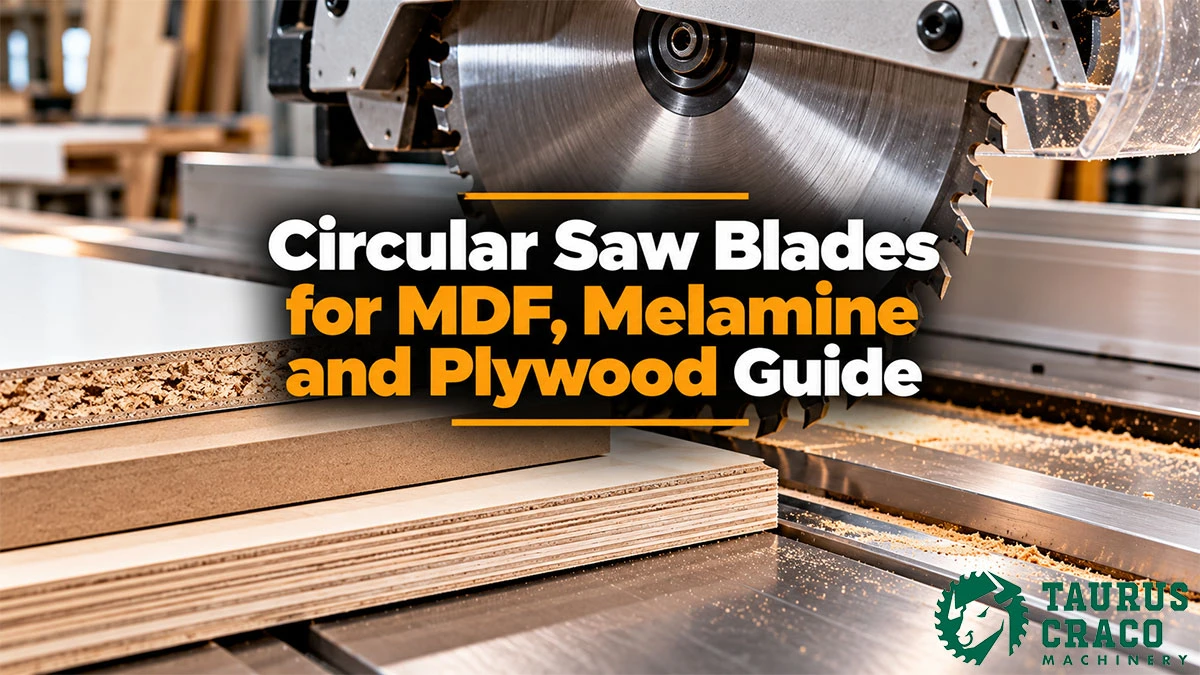
Circular Saw Blades for MDF, Melamine and Plywood Guide
Posted by TCStore on 2026 Sep 29th
Choosing the right circular saw blade for MDF, melamine, and plywood can make the difference between a clean production-ready edge and a panel covered in chips, tear-out, burn marks, or rough fibres.
Engineered wood products are especially demanding because each material behaves differently during cutting.
MDF is dense and abrasive.
Melamine has a brittle decorative surface that can chip easily.
Plywood combines multiple veneer layers with alternating grain directions.
That means a general-purpose blade may cut all three materials, but it may not produce the finish quality required by a cabinet shop, furniture manufacturer, millwork operation, or professional woodworking business.
TCStore carries circular saw blades for table saws, sliding table saws, portable saws, and other woodworking applications.
This guide explains how to choose the right blade based on material, tooth count, tooth geometry, kerf, blade diameter, scoring requirements, machine compatibility, and production volume.
Quick Answer: What Saw Blade Should You Use?
For clean panel cutting:
✓ MDF: Use a sharp carbide-tipped blade with enough teeth to create a clean edge while still clearing fine dust efficiently.
✓ Melamine: Use a high-tooth-count blade designed for laminated or coated panels, ideally with appropriate tooth geometry and a scoring blade when the machine supports one.
✓ Plywood: Use a fine-cut or crosscut-style blade with sufficient teeth to minimize veneer tear-out.
The exact blade must still match the saw's:
- Blade diameter
- Arbor size
- Maximum RPM
- Kerf requirements
- Motor power
- Scoring system
- Cutting direction
- Material thickness
A professional blade should be selected for both the machine and the material.
For broader guidance on saw blades, CNC cutters, drilling tools, inserts, and toolholders, review the Woodworking Tooling Buyer’s Guide for Every Shop.
MDF vs Melamine vs Plywood Blade Requirements
|
Material |
Main Cutting Challenge |
Blade Priority |
|
MDF |
Abrasiveness and fine dust |
Durable carbide and controlled chip removal |
|
Melamine |
Brittle decorative coating |
Chip-free top and bottom surfaces |
|
Plywood |
Alternating veneer grain |
Reduced tear-out and clean cross-grain cutting |
|
Particleboard |
Abrasive resin and loose core |
Durable carbide and clean surface entry |
|
Veneered panels |
Thin decorative veneer |
Fine tooth geometry and controlled cutting |
|
Solid wood |
Grain direction |
Match blade to ripping or crosscutting |
Why Blade Selection Matters for Engineered Panels
A circular saw blade is the part of the machine that actually contacts the material.
Its geometry determines how each tooth enters the panel, removes material, clears waste, and exits the cut.
The wrong blade can cause:
- Chipped decorative surfaces
- Veneer tear-out
- Rough MDF edges
- Excessive heat
- Burn marks
- Increased cutting resistance
- Vibration
- Premature carbide wear
- Additional sanding
- Rejected components
The right blade helps reduce those problems and allows the saw to operate more consistently.
TCStore's guide on how to choose the right tooling for woodworking machinery explains why cutting tools should always be matched to the machine, material, production volume, and desired finish.
Choosing Circular Saw Blades for MDF
Medium-density fibreboard is made from compressed wood fibres and binders.
The material is uniform, but it is also abrasive.
That means MDF can wear cutting edges faster than many natural woods.
A dull blade quickly creates problems.
What is the best circular saw blade for MDF?
For MDF, choose a sharp carbide-tipped blade with a tooth count and geometry designed to create a clean cut while still removing the fine waste produced during machining.
Important considerations include:
✓ Carbide quality
✓ Tooth count
✓ Blade rigidity
✓ Dust extraction
✓ Feed speed
✓ Kerf width
✓ Material thickness
Higher tooth counts can improve finish quality, but simply choosing the blade with the most teeth is not always the answer.
The blade must still clear waste effectively.
Too much heat from a dull or incorrectly matched blade can reduce tool life and leave darkened edges.
Choosing Circular Saw Blades for Melamine
Melamine is one of the most difficult common woodworking panels to cut cleanly.
The decorative surface is hard and brittle.
As a saw tooth enters or exits the panel, small pieces of the coating can break away.
This produces the familiar chipped white or coloured edge seen after a poor cut.
What blade gives the cleanest cut on melamine?
A fine-cut carbide blade designed for laminated panels is usually the strongest starting point.
Look for:
- Higher tooth counts
- Tooth geometry suitable for coated panels
- A rigid blade body
- Accurate machine setup
- Sharp carbide edges
- Correct feed speed
On professional sliding table or panel saws, a scoring blade can further improve the bottom surface.
Why Scoring Blades Matter for Melamine
A scoring blade creates a shallow cut on the underside of the panel immediately before the main blade completes the cut.
This helps prevent the main blade from breaking the decorative coating as it exits.
Scoring is especially useful for:
- Melamine
- Laminates
- Veneered panels
- High-quality cabinet components
- Decorative sheet goods
A properly adjusted scoring blade should align accurately with the kerf of the main blade.
If the scoring width or position is incorrect, the panel may still show chipping or a visible step along the cut.
Choosing Saw Blades for Plywood
Plywood presents a different challenge.
Each veneer layer runs in a different grain direction.
That means the blade is continually cutting with and across the grain as it passes through the sheet.
The outer veneer is particularly vulnerable to tear-out.
What is the best circular saw blade for plywood?
A fine-cut carbide blade with more teeth than a typical ripping blade is generally a good choice.
For high-quality cabinet plywood, focus on:
✓ Clean tooth geometry
✓ Sharp carbide
✓ Higher tooth count
✓ Stable blade plate
✓ Controlled feed speed
✓ Correct blade height
Plywood used for rough structural work may not require the same blade as premium veneered cabinet plywood.
Always match blade quality to the required finished surface.
Tooth Count: More Is Not Always Better
Tooth count affects both finish quality and chip removal.
Fewer teeth generally create larger chip spaces and faster material removal.
More teeth usually create a finer cut.
But increasing tooth count too far for the application can create additional friction and heat.
Lower Tooth Count
Best suited to:
- Fast ripping
- Solid wood
- Rough cutting
- Applications where finish quality is secondary
Medium Tooth Count
Best suited to:
- General-purpose work
- Mixed materials
- Combination cutting
- Shops that need one blade for several operations
TCStore carries options such as the 40 Tooth Combination Table Saw Blade for general table-saw applications.
Higher Tooth Count
Best suited to:
- Crosscutting
- Finished plywood
- Decorative panels
- Furniture components
- Cabinet work
- Applications requiring cleaner edges
For example, the 60 Tooth Combination Table Saw Blade provides a higher tooth count for precision cutting applications.
Saw Blade Tooth Geometry
The shape of each saw tooth affects how the blade enters and removes material.
Common woodworking tooth geometries include:
Alternate Top Bevel
Alternate top bevel teeth alternate between left and right cutting angles.
This geometry is commonly used for clean crosscuts in wood and sheet products.
Triple Chip Grind
Triple chip geometry alternates between a chamfered tooth and a flat tooth.
It is often used for abrasive or brittle materials where edge quality and durability are important.
Applications may include:
- Laminates
- Melamine
- Composite panels
- Selected plastics
Flat Top Grind
Flat-top teeth are efficient for material removal and ripping.
They are generally more focused on speed than extremely fine panel finishes.
Combination Geometry
Combination blades balance ripping and crosscutting performance.
They can be practical for general shop use when the same saw processes several materials.
Blade Diameter Must Match the Machine
Circular saw blades are not interchangeable simply because they look similar.
The blade diameter must be compatible with the saw.
Blade diameter influences:
- Cutting depth
- Maximum RPM
- Tooth speed
- Machine clearance
- Guard compatibility
- Scoring alignment
TCStore carries machine-specific replacement blades such as the 12-inch Main Blade for Fimal P350 / P3200.
Machine-specific blades simplify selection because the diameter, arbor, and application are designed around compatible equipment.
Always confirm the machine manual or manufacturer specifications before installing a different blade size.
Arbor Size Is Critical
The centre hole of the blade must fit the saw arbor correctly.
A blade with the wrong arbor should never be forced onto the machine.
An incorrect fit can create:
- Blade movement
- Vibration
- Poor cut quality
- Runout
- Unsafe operation
- Damage to the arbor or flange
Also inspect arbor flanges and mounting surfaces for contamination or damage whenever blades are changed.
Even a high-quality blade can perform poorly if it is not mounted flat and concentric.
Kerf Width Affects Performance
Kerf is the width of material removed by the blade.
A thicker kerf generally produces a more rigid blade but removes more material and requires more cutting power.
A thin-kerf blade removes less material and can require less power.
However, very thin blades may be more sensitive to:
- Deflection
- Feed pressure
- Heat
- Machine alignment
Professional production saws should use the kerf specified for the equipment and application.
If the machine uses a scoring blade, scoring kerf must also coordinate with the main blade.
Blade Plate Stability Matters
The blade body must remain stable at operating speed.
A blade that flexes or vibrates cannot maintain a consistently straight kerf.
Blade stability can be influenced by:
- Plate thickness
- Blade diameter
- Manufacturing quality
- Arbor condition
- Flange condition
- Feed rate
- Heat buildup
- Machine bearings
Expansion slots and blade-body design may also help manage vibration and thermal movement.
The blade should run smoothly without visible wobble.
Ripping vs Crosscutting Blades
Ripping and crosscutting are different operations.
Ripping
Ripping means cutting parallel to the wood grain.
Ripping blades generally use:
- Fewer teeth
- Larger gullets
- Faster chip removal
Crosscutting
Crosscutting means cutting across the grain.
Crosscut blades generally have:
- More teeth
- Finer cutting action
- Cleaner finished edges
MDF and melamine do not have natural grain like solid lumber, so blade selection is more focused on surface quality, abrasiveness, and chip control.
Plywood contains grain in multiple directions, making fine-cut geometry particularly useful.
Feed Rate Can Ruin a Good Blade
Blade quality alone cannot guarantee a clean cut.
Feed too quickly and the teeth may tear material rather than cut it cleanly.
Feed too slowly and excessive rubbing can create heat.
The correct feed rate depends on:
- Blade diameter
- Tooth count
- Material
- Machine power
- Blade sharpness
- Material thickness
Production shops should establish repeatable machine settings for common panels rather than adjusting feed speed randomly from job to job.
Blade Height Also Affects the Cut
On table saws and sliding table saws, blade projection above the workpiece can affect cutting geometry.
Excessive blade exposure is generally unnecessary.
Follow the machine and blade manufacturer's setup requirements.
A consistent machine setup helps maintain:
- Cutting quality
- Operator control
- Dust extraction
- Blade performance
Dust Collection Is Important When Cutting MDF
MDF produces large amounts of fine particulate.
A sharp blade reduces unnecessary friction, but effective dust extraction remains essential.
Dust accumulation around the blade can:
- Interfere with visibility
- Increase cleanup
- Accumulate inside machinery
- Affect moving components
- Increase airborne particulate
Professional shops should keep saw extraction ports, hoses, filters, and dust systems maintained.
The same principle applies to plywood and particleboard.
TCStore carries dust collection and air filtration supplies for maintaining extraction systems alongside cutting machinery.
How to Know When a Circular Saw Blade Is Dull
A blade does not need to lose a tooth before it requires service.
Common warning signs include:
✓ Increased chipping
✓ Rough MDF edges
✓ Veneer tear-out
✓ Burn marks
✓ Increased cutting resistance
✓ Slower feed speed
✓ More noise
✓ Vibration
✓ Excessive heat
✓ Additional sanding after cutting
The guide on signs your woodworking tooling needs replacement explains how declining cutting performance can indicate wear before complete tool failure occurs.
Clean Saw Blades Before Replacing Them
Resin, adhesives, pitch, and panel residue can accumulate on a blade.
This buildup increases friction.
It can also make a sharp blade behave like a dull one.
Before discarding a blade, inspect it for:
- Resin deposits
- Adhesive buildup
- Burned residue
- Chipped carbide
- Missing teeth
- Cracks
- Distortion
Appropriate cleaning can restore performance when buildup rather than edge wear is the problem.
For additional maintenance strategies, see How to Extend the Life of Your Woodworking Tooling.
Keep Backup Circular Saw Blades
A production saw without a usable blade is a machine that cannot produce parts.
Shops should stock backups for blades used every day.
Critical inventory may include:
✓ Main production blade
✓ Scoring blade
✓ Fine-finish blade
✓ General-purpose combination blade
✓ Material-specific panel blade
✓ Machine-specific replacement blade
Backup tooling is particularly important when a blade must be sent out for sharpening.
The article How to Reduce Downtime With Better Woodworking Tooling explains why critical replacement tooling should be available before failure stops production.
Circular Saw Blade Selection Chart
|
Application |
Blade Priority |
Typical Strategy |
|
MDF |
Carbide durability |
Fine, stable cutting with good dust evacuation |
|
Melamine |
Chip control |
High tooth count and scoring where available |
|
Cabinet plywood |
Veneer protection |
Fine crosscut-style blade |
|
Rough plywood |
Cutting speed |
Moderate tooth count |
|
Solid-wood ripping |
Material removal |
Lower tooth count and larger gullets |
|
Solid-wood crosscutting |
Surface finish |
Higher tooth count |
|
Mixed shop work |
Versatility |
Combination blade |
Common Circular Saw Blade Buying Mistakes
Avoid These Problems
X Buying solely by blade diameter
X Ignoring arbor size
X Using a ripping blade for finished melamine
X Assuming the highest tooth count is always best
X Using dull tooling until cut quality becomes unacceptable
X Ignoring scoring-blade adjustment
X Mixing incompatible kerf widths
X Running beyond the blade's rated RPM
X Ignoring the material being cut
X Installing a blade on a dirty arbor or flange
X Keeping no backup production blade
X Using one general-purpose blade for every application
Circular Saw Blade Buying Checklist
Before purchasing a blade, confirm:
- What machine will use the blade?
- What blade diameter does the machine require?
- What is the arbor size?
- What is the maximum permitted RPM?
- What material will be cut?
- Is the cut a rip or crosscut?
- Does the panel have a decorative surface?
- Is top-and-bottom chip control required?
- Does the machine have a scoring unit?
- What kerf is required?
- What tooth geometry is appropriate?
- What production volume is expected?
- Can the blade be professionally sharpened?
- Should a backup blade be ordered at the same time?
Professional shops can browse TCStore's complete selection of circular saw blades for machine-specific and general woodworking applications.
Final Thoughts
The best circular saw blade for MDF, melamine, or plywood is the blade that matches both the material and the machine.
For MDF, prioritize durable carbide, sharp cutting edges, and efficient dust evacuation.
For melamine, prioritize chip control, fine tooth geometry, and proper scoring when available.
For plywood, prioritize a clean cutting action that protects the outer veneer from tear-out.
Then verify blade diameter, arbor size, kerf, tooth count, geometry, maximum RPM, and machine compatibility.
A properly matched blade helps woodworking shops achieve cleaner cuts, reduce sanding and rework, improve material yield, and maintain more consistent production.
Saw blades are also part of the larger tooling system. TCStore's Power Tool Accessories Every Woodworking Shop Needs provides additional guidance on blades, bits, abrasives, guide systems, batteries, and other accessories that influence professional woodworking performance.
Frequently Asked Questions
What is the best circular saw blade for MDF?
A sharp carbide-tipped blade with enough teeth to provide a clean finish is generally suitable for MDF. The blade should also provide effective waste clearance because MDF produces fine, abrasive dust.
What blade should I use to cut melamine without chipping?
Use a high-quality fine-cut blade designed for laminated or coated panels. On machines equipped with a scoring unit, a properly adjusted scoring blade can further reduce chipping on the underside of the panel.
Is a 40-tooth or 60-tooth blade better for plywood?
A 60-tooth blade generally produces a finer crosscut than a 40-tooth combination blade, making it useful when finished edge quality is important. A 40-tooth blade may offer greater versatility for mixed woodworking tasks. The ideal choice depends on blade diameter, material thickness, machine, and required finish.
Can I use the same saw blade for MDF, melamine, and plywood?
A quality combination blade may cut all three materials, but it may not provide the best finish or tool life for every application. Production shops usually benefit from using material-appropriate blades for critical cutting operations.
When should a circular saw blade be replaced or sharpened?
Service the blade when cutting quality declines, chipping increases, feed resistance rises, burning develops, vibration appears, or cleaning no longer restores performance. Do not wait for severe dullness or tooth failure before removing a production blade.