

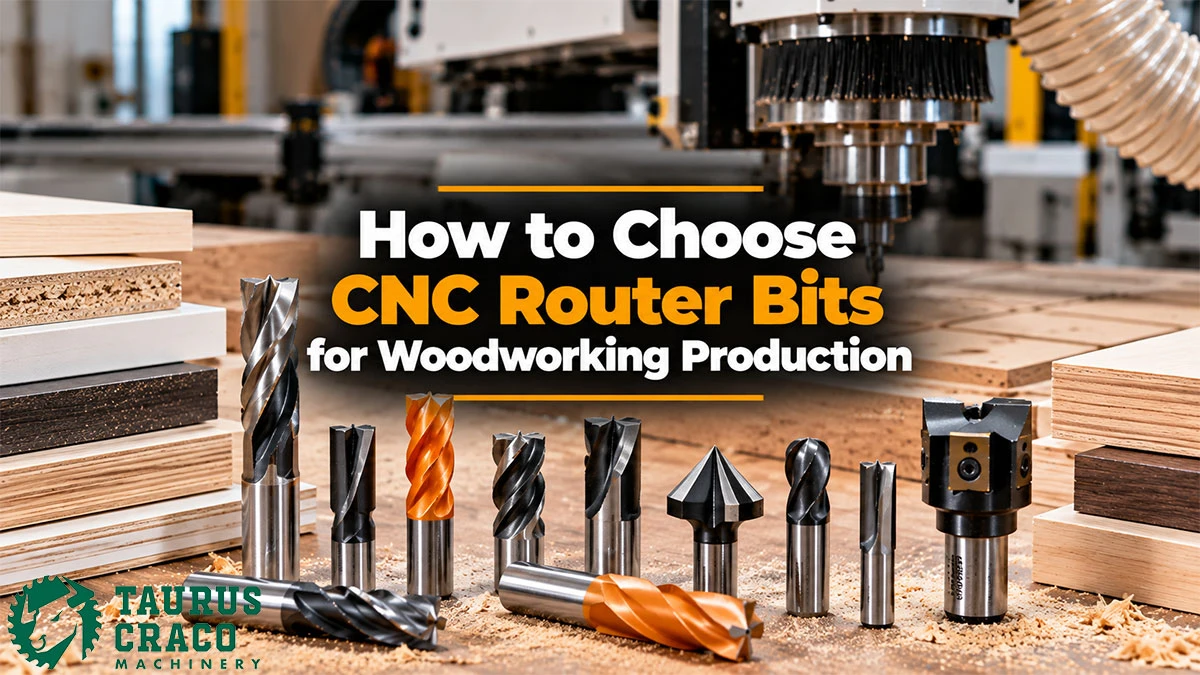
How to Choose CNC Router Bits for Woodworking Production
Posted by TCStore on 2026 Sep 25th
Choosing the right CNC router bits can directly affect cut quality, machining speed, tool life, material waste, and overall woodworking production efficiency.
A CNC router can only perform as well as the tooling installed in its spindle.
The wrong bit can create chipped laminate, fuzzy edges, excessive heat, poor chip evacuation, premature tool wear, and slower feed rates. The right bit allows the CNC to produce cleaner components while operating closer to its intended production capacity.
Professional shops should select CNC tooling and accessories according to the machine, material, cut direction, required finish, production volume, spindle speed, feed rate, and workholding system.
This guide explains how to choose CNC router bits for MDF, plywood, melamine, hardwood, softwood, laminates, and other common woodworking materials.
Quick Answer: How Do You Choose a CNC Router Bit?
Choose a CNC router bit by matching these factors:
✓ Material being machined
✓ Required cut direction
✓ Top and bottom surface quality
✓ Tool diameter
✓ Number of flutes
✓ Cutting length
✓ Shank diameter
✓ Spindle RPM
✓ Feed rate
✓ Depth of cut
✓ Chip evacuation
✓ Production volume
✓ Toolholder and collet compatibility
✓ Whether the application requires solid carbide or insert tooling
A bit should never be selected by diameter alone.
For a broader overview of cutting tools, toolholders, saw blades, inserts, and machine compatibility, review the Woodworking Tooling Buyer’s Guide for Every Shop.
CNC Router Bit Types at a Glance
|
Router Bit Type |
Best Use |
Main Advantage |
|
Straight bit |
General routing and grooving |
Simple, versatile cutting |
|
Upcut spiral |
Deep cuts and chip removal |
Excellent chip evacuation |
|
Downcut spiral |
Finished top surfaces |
Reduces top-edge tear-out |
|
Compression bit |
Laminated sheet goods |
Clean top and bottom edges |
|
Ball-nose bit |
3D profiling and contours |
Smooth curved machining |
|
V-groove bit |
Engraving and decorative grooves |
Precise angled cuts |
|
Dovetail bit |
Joinery and specialty machining |
Produces mechanical dovetail profiles |
|
Mortising bit |
Joinery and pockets |
Controlled plunge cutting |
|
Insert cutter |
High-volume production |
Replaceable cutting edges |
Start With the Material
Material should be one of the first considerations when selecting CNC router bits.
Different products create different cutting conditions.
A bit that performs well in hardwood may not provide the best results in melamine-faced particleboard.
MDF
MDF is dense, consistent, and abrasive.
It produces extremely fine dust and can wear cutting edges faster than many natural woods.
For production MDF machining, look for tooling that provides:
✓ Efficient chip and dust evacuation
✓ Durable carbide cutting edges
✓ Geometry suitable for high feed rates
✓ Clean edge quality
Tool wear should be monitored closely because dull tooling can generate heat and leave darkened or fuzzy edges.
Plywood
Plywood contains alternating veneer layers.
Cutting across those layers can create tear-out on either surface.
Compression tooling is particularly useful when both the top and bottom faces must remain clean.
Melamine and Laminated Panels
Melamine, laminate, and other decorative panel products can chip easily.
The router bit must control cutting forces at both surfaces.
Compression cutters are frequently used in cabinet and panel production because they combine upward and downward cutting geometry.
Hardwood
Hardwoods create greater cutting resistance.
Tool selection should consider:
- Wood density
- Grain direction
- Moisture
- Depth of cut
- Feed rate
- Tool diameter
A durable carbide router bit with appropriate chip load can provide better results than simply reducing the feed rate whenever cutting resistance increases.
Softwood
Softwood generally machines easily, but resin and pitch can accumulate on cutting edges.
Regular cleaning becomes important because buildup increases friction and heat.
Upcut Router Bits
An upcut spiral bit pulls chips upward and away from the cutting area.
This provides excellent chip evacuation.
Upcut tooling works well for:
- Deep routing
- Slotting
- Pocketing
- Solid wood
- Applications where bottom-edge quality is especially important
The trade-off is that upward cutting force can lift fibres or decorative surfaces along the top edge.
For unfinished materials, this may not matter.
For a finished panel, it may.
Downcut Router Bits
A downcut spiral pushes cutting forces toward the worktable.
This can help protect the visible top surface of the material.
Downcut bits are useful for:
- Veneered panels
- Laminated materials
- Shallow grooves
- Decorative surfaces
- Parts where the top edge must remain clean
However, pushing chips downward can make chip evacuation more difficult in deep cuts.
That means depth of cut and extraction must be considered carefully.
Compression Router Bits
Compression cutters combine upcut and downcut geometry within one tool.
The lower section cuts upward.
The upper section cuts downward.
When the tool is engaged correctly through the material thickness, cutting forces are directed toward the centre of the panel.
This can help produce clean edges on both faces.
Compression bits are commonly used for:
✓ Plywood
✓ Melamine
✓ Laminated particleboard
✓ Veneered panels
✓ Cabinet components
✓ Nested sheet production
What is the best CNC router bit for plywood and melamine?
A compression router bit is often one of the best choices when plywood or melamine needs a clean finished edge on both the top and bottom surfaces.
The bit still needs the correct diameter, flute geometry, cutting length, feed rate, spindle speed, and depth of cut for the application.
Straight Router Bits
Straight bits are among the simplest router tools.
They may be used for:
- Grooves
- Dados
- Pockets
- General routing
- Edge machining
They remain useful for many applications, but spiral tooling often provides more efficient chip evacuation and smoother cutting in production environments.
Ball-Nose Router Bits
Ball-nose bits have a rounded cutting end.
They are commonly used for:
- 3D machining
- Curved surfaces
- Relief carving
- Moulds
- Sculpted components
- Decorative work
These tools are less about high-speed sheet cutting and more about accurately creating complex contours.
V-Groove Router Bits
V-groove cutters are used for:
- Signmaking
- Engraving
- Decorative grooves
- Lettering
- Folding applications
- Chamfer-style machining
Different included angles create different groove widths and depths.
The correct angle should be chosen according to the design and finished appearance.
Dovetail Router Bits
Dovetail tooling produces angled mechanical joints and specialized grooves.
TCStore carries application-specific tooling such as the Dovetail Bit Replacement for Omec 650 / 750 Series for compatible dovetailing equipment.
Dovetail cutters should match the machine, joint geometry, depth, material, and production requirements exactly.
A small change in cutter angle or dimension can affect joint fit.
Router Bit Diameter Matters
Tool diameter affects several aspects of machining.
Larger-diameter tools generally provide:
- Greater rigidity
- Higher material-removal capacity
- Better resistance to deflection
- Potential for faster feed rates
Smaller tools provide:
- Tighter inside radii
- More detailed machining
- Access to narrow features
- Smaller grooves
The largest bit that can efficiently produce the required geometry is often advantageous in production because increased rigidity can improve stability and tool life.
However, spindle capacity, toolholder specifications, clearance, and maximum RPM must always be respected.
How Many Flutes Should a CNC Router Bit Have?
Flute count affects chip evacuation and cutting frequency.
Single-Flute Tools
Single-flute tooling provides a large flute space for chip evacuation.
It can be useful when cutting:
- Plastics
- Aluminium
- Selected wood products
- Applications requiring large chip clearance
Two-Flute Tools
Two-flute router bits are extremely common in woodworking.
They provide a practical balance between:
- Cutting-edge engagement
- Chip evacuation
- Surface finish
- Feed rate
Three or More Flutes
Additional flutes can create more cutting engagements per revolution.
However, they also reduce the space available for chips.
Higher flute counts are therefore not automatically better.
Tool geometry must be matched to material, spindle speed, feed rate, and chip load.
Chip Load Is Critical
One of the most important CNC tooling concepts is chip load.
Chip load describes how much material each cutting edge removes during each revolution.
If chip load is too low, the cutting edge may rub instead of cutting efficiently.
This can create:
- Excessive heat
- Burn marks
- Resin buildup
- Premature dulling
If chip load is too high, cutting forces may become excessive.
That can produce:
- Vibration
- Rough finishes
- Tool deflection
- Broken cutters
- Machine overload
A premium router bit cannot compensate for incorrect speeds and feeds.
The tool, spindle RPM, feed rate, flute count, and material must work together.
The TCStore guide on how to choose the right tooling for woodworking machinery explains why tooling selection should always be evaluated alongside the machine and production process.
Cutting Length and Overall Length
Do not automatically choose the longest router bit available.
Longer tools generally have more opportunity to deflect.
Use enough cutting length to complete the operation safely without adding unnecessary extension.
Excessive tool projection can contribute to:
- Vibration
- Chatter
- Poor surface quality
- Tool deflection
- Reduced tool life
For deep operations, choose tooling specifically designed for the required depth rather than extending a standard bit farther from the toolholder.
The Collet Matters as Much as the Router Bit
A CNC router bit depends on the collet and toolholder to remain securely positioned and concentric with the spindle.
A worn or contaminated collet can cause runout.
Runout means the tool rotates slightly off-centre.
This may produce:
- Uneven tool wear
- Poor cut quality
- Vibration
- Heat
- Premature router-bit failure
- Tool breakage
TCStore stocks CNC workholding components such as the IMS ER 32 6-7mm Collet along with other sizes in its CNC tooling and accessories selection.
Collets should be inspected and cleaned regularly rather than treated as permanent machine components.
Dust Extraction Tooling
Chip evacuation becomes even more important when machining MDF, particleboard, and other dusty materials.
TCStore also carries specialized CNC accessories such as dust extraction tools within its CNC tooling category.
Better extraction around the cutting area can help:
✓ Keep the toolpath clearer
✓ Reduce recutting of chips
✓ Improve visibility
✓ Control dust accumulation
✓ Support cleaner tooling and machine components
Dust extraction should work together with the CNC machine's central dust-collection system.
Signs a CNC Router Bit Is Dull
A router bit does not need to break before it should be replaced or serviced.
Warning signs include:
- Increasingly rough edges
- Fuzzy MDF
- Melamine chipping
- Burn marks
- Higher cutting noise
- Vibration
- Increased spindle load
- Slower feed rates
- More finishing work
- Excessive heat
- Tool discoloration
The article Signs Your Woodworking Tooling Needs Replacement explains how declining tool performance affects both finished quality and machinery.
How Long Do CNC Router Bits Last?
There is no universal number of sheets or machining hours.
Router-bit life depends on:
- Material
- Carbide quality
- Tool geometry
- Feed rate
- Spindle speed
- Cutting depth
- Number of passes
- Dust extraction
- Collet condition
- Machine rigidity
- Resin buildup
- Required finish quality
A tool cutting hardwood occasionally may have a completely different service life from the same diameter tool running MDF continuously.
Production shops should track tooling performance rather than relying only on a calendar replacement interval.
For maintenance strategies, see How to Extend the Life of Your Woodworking Tooling.
Keep Backup CNC Router Bits in Stock
A CNC router can become one of the highest-output machines in a woodworking operation.
That also makes tooling failure expensive.
Critical router bits should have backups available before the active tool reaches the end of its useful life.
High-priority inventory may include:
✓ Primary nesting cutters
✓ Compression bits
✓ Frequently used spiral tools
✓ Common drill bits
✓ Profile cutters
✓ Replacement inserts
✓ Collets
✓ Toolholders
The TCStore article on how to reduce downtime with better woodworking tooling explains why backup tooling should be treated as production insurance rather than excess inventory.
CNC Router Bit Selection by Material
|
Material |
Common Tooling Choice |
Main Goal |
|
MDF |
Carbide spiral or compression tooling |
Tool life and dust evacuation |
|
Plywood |
Compression bit |
Clean top and bottom veneers |
|
Melamine |
Compression cutter |
Reduce surface chipping |
|
Particleboard |
Durable carbide tooling |
Control wear and edge quality |
|
Hardwood |
Spiral carbide cutter |
Efficient chip removal |
|
Softwood |
Spiral cutter |
Clean cutting with resin control |
|
Veneered panels |
Compression or downcut tooling |
Protect visible surfaces |
|
Laminates |
Application-specific compression tooling |
Reduce decorative surface damage |
Common CNC Router Bit Buying Mistakes
Avoid These Problems
X Choosing tooling only by price
X Using one router bit for every material
X Ignoring flute direction
X Running a compression cutter at the wrong cutting depth
X Using an excessively long tool
X Ignoring shank diameter
X Using worn collets
X Running incorrect spindle speeds
X Reducing feed rate until the bit begins rubbing
X Waiting for complete tool failure before replacement
X Keeping no backup production tooling
X Failing to clean resin and adhesive buildup
X Ignoring machine and spindle specifications
CNC Router Bit Buying Checklist
Before purchasing a router bit, confirm:
- Which CNC machine will use the tool?
- What spindle and collet system does it use?
- What is the required shank diameter?
- Which material will be machined?
- Does the top surface need a finished edge?
- Does the bottom surface need a finished edge?
- What diameter can the toolpath accommodate?
- What cutting length is required?
- How many flutes are appropriate?
- What RPM will the spindle run?
- What feed rate is expected?
- What chip load does the manufacturer recommend?
- Will the tool be sharpened or replaced?
- Is backup tooling available?
TCStore carries router, drill and screwdriver bits as well as industrial CNC tooling, collets, extraction accessories, and machine-specific cutting tools for professional woodworking operations.
Final Thoughts
Choosing CNC router bits for woodworking production requires more than matching a cutter diameter to a toolpath.
Start with the material.
Determine which surfaces must remain clean.
Choose the appropriate cutting direction.
Match the diameter, flute count, cutting length, shank, and geometry to the job.
Then operate the bit at suitable spindle speeds and feed rates using a clean, properly sized collet.
The correct tooling helps a CNC router produce cleaner parts, maintain higher production speeds, reduce material waste, and avoid unnecessary machine downtime.
For shops building a complete tooling strategy, TCStore's woodworking tooling buyer’s guide provides additional guidance on router tooling, saw blades, drilling tools, inserts, toolholders, maintenance, and replacement planning.
Frequently Asked Questions
What CNC router bit is best for plywood?
Compression router bits are commonly used for plywood when clean top and bottom surfaces are required. The correct tool still depends on panel thickness, veneer quality, machine settings, feed rate, and the required finish.
What CNC router bit should I use for melamine?
A compression cutter is often suitable for melamine-faced panels because its cutting geometry helps reduce chipping on both surfaces when the bit is engaged at the correct depth.
What is the difference between an upcut and downcut router bit?
An upcut bit pulls chips upward and generally provides excellent chip evacuation. A downcut bit pushes cutting forces downward, which can help protect the top surface but may make chip evacuation more difficult during deep machining.
How do I know when a CNC router bit needs replacement?
Replace or service the bit when you notice persistent rough edges, chipping, burning, increased vibration, excessive heat, slower cutting, increased spindle load, or more manual finishing.
Should CNC shops keep spare router bits?
Yes. Frequently used production cutters should have backups available. Keeping spare router bits, collets, inserts, and other critical tooling can prevent a small tooling failure from stopping an entire CNC production process.