

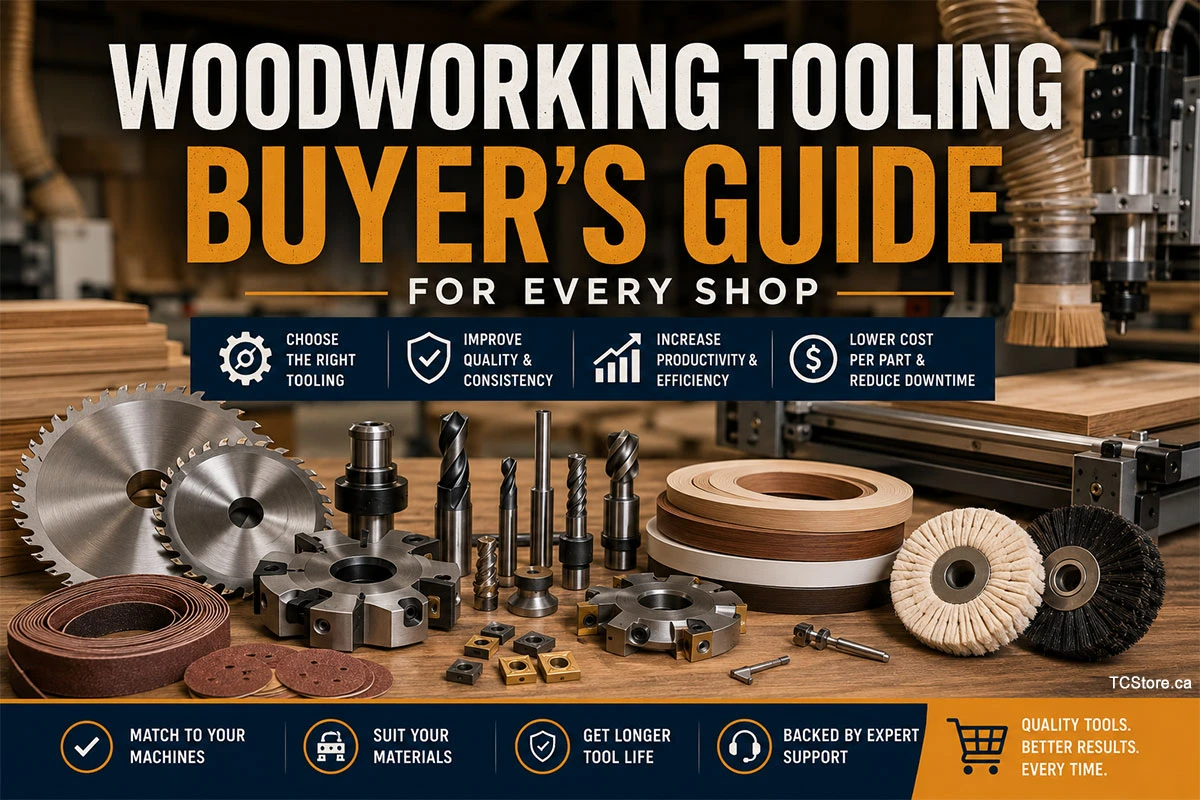
Woodworking Tooling Buyer’s Guide for Every Shop
Posted by TCStore on 2026 Sep 16th
A woodworking tooling buyer’s guide should help a shop choose cutting tools based on its machinery, materials, production volume, required finish, maintenance capacity, and cost per completed part.
The cheapest tool is rarely the least expensive option over its complete service life.
Poorly matched tooling can create chipped panels, rough surfaces, excessive heat, slower feed rates, additional sanding, rejected parts, machine strain, and unexpected downtime.
The right woodworking tooling helps machinery cut accurately, maintain production speed, reduce waste, and deliver more consistent finished products.
Quick Answer
Before buying woodworking tooling, confirm:
✓ The machine make and model
✓ Spindle, arbor, shank, or mounting requirements
✓ Materials being processed
✓ Required cutting direction and tool geometry
✓ Maximum operating speed
✓ Feed rate and depth of cut
✓ Required surface or edge quality
✓ Daily and weekly production volume
✓ Whether the tool can be sharpened or indexed
✓ Availability of replacement inserts and spare tools
✓ Supplier lead time and technical support
✓ Total cost per completed component
Tooling should be selected as part of the production system—not as an isolated consumable.
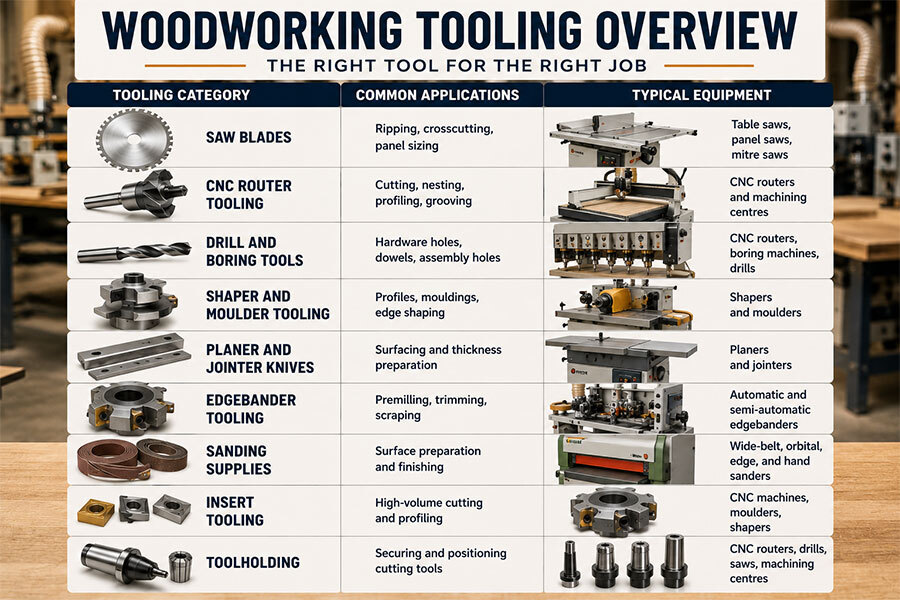
Woodworking Tooling Overview
|
Tooling Category |
Common Applications |
Typical Equipment |
|
Saw blades |
Ripping, crosscutting, panel sizing |
Table saws, panel saws, mitre saws |
|
CNC router tooling |
Cutting, nesting, profiling, grooving |
CNC routers and machining centres |
|
Drill and boring tools |
Hardware holes, dowels, assembly holes |
CNC routers, boring machines, drills |
|
Shaper and moulder tooling |
Profiles, mouldings, edge shaping |
Shapers and moulders |
|
Planer and jointer knives |
Surfacing and thickness preparation |
Planers and jointers |
|
Edgebander tooling |
Premilling, trimming, scraping |
Automatic and semi-automatic edgebanders |
|
Sanding supplies |
Surface preparation and finishing |
Wide-belt, orbital, edge, and hand sanders |
|
Insert tooling |
High-volume cutting and profiling |
CNC machines, moulders, shapers |
|
Toolholding |
Securing and positioning cutting tools |
CNC routers, drills, saws, machining centres |
Why Woodworking Tooling Selection Matters
Machinery supplies power, movement, positioning, and control.
Tooling makes contact with the material.
That means the tool directly influences:
- Cut quality
- Dimensional accuracy
- Surface finish
- Feed speed
- Cycle time
- Machine load
- Material waste
- Tool-change frequency
- Secondary finishing
- Production consistency
A high-quality machine cannot compensate for tooling that is dull, damaged, incorrectly sized, or designed for a different material.
The TCStore guide on how to choose the right tooling for woodworking machinery explains why machine type, material, production volume, tool geometry, and finish requirements should all be considered before purchasing.
Start With the Machinery
Every tooling purchase should begin with the machine.
Record the complete:
- Manufacturer
- Model
- Serial number
- Spindle type
- Arbor size
- Collet size
- Toolholder interface
- Maximum RPM
- Motor or spindle power
- Feed-speed range
- Available clearance
- Dust extraction arrangement
Do not assume a tool is compatible because it physically fits.
The machine must be capable of operating the tool at the required speed, feed rate, cutting depth, and load.
A large-diameter cutter may exceed the machine’s permitted speed or available clearance.
A router bit with the wrong shank diameter may not be held securely.
A saw blade with an incorrect arbor or kerf can create alignment and safety problems.
Match Tooling to the Material
Woodworking shops process materials with very different properties.
Common examples include:
- Hardwood
- Softwood
- Plywood
- MDF
- Particleboard
- Melamine
- Laminated panels
- Veneered panels
- Acrylic-faced boards
- Wood-plastic composites
- Reclaimed lumber
Tooling that performs well in solid wood may not provide a clean result on melamine.
A general-purpose router bit may wear quickly when cutting abrasive MDF throughout every shift.
Composite panels and adhesive-heavy materials can generate more heat and cutting-edge wear than many natural woods.
Material-specific tooling may provide:
✓ Cleaner top and bottom surfaces
✓ Reduced tear-out
✓ Less chipping
✓ Better chip evacuation
✓ Lower cutting temperatures
✓ Longer service life
✓ More predictable production
The correct tool geometry should be selected for the material actually being processed—not simply the material the shop expects to use occasionally.
Saw Blades
Saw blades should be selected according to the machine, cut direction, panel type, required finish, and production speed.
Important specifications include:
- Blade diameter
- Arbor diameter
- Kerf width
- Plate thickness
- Tooth count
- Tooth geometry
- Hook angle
- Maximum RPM
- Carbide grade
- Expansion slots
- Scoring requirements
Ripping blades generally use fewer teeth to remove material efficiently along the grain.
Crosscut blades use more teeth to produce cleaner cuts across the grain.
Panel-sizing blades may require specialized tooth geometries to cut laminates, melamine, plywood, and veneered products without excessive chipping.
Scoring blades help prevent damage to the lower panel surface during panel-saw cutting.
More detailed blade-selection guidance is available in Essential Saw Blades for Woodworking Machinery.
CNC Router Tooling
CNC router tooling may be used for:
- Panel nesting
- Profiling
- Grooving
- Pocketing
- Drilling
- Engraving
- Joinery
- Edge shaping
- Cutouts
Common CNC tools include:
- Straight bits
- Upcut spiral bits
- Downcut spiral bits
- Compression cutters
- Ball-nose tools
- V-groove tools
- Mortising bits
- Insert cutters
- Drill bits
- Engraving tools
An upcut bit removes chips effectively but may pull fibres upward at the top surface.
A downcut bit can improve the top edge but pushes chips downward.
A compression cutter combines cutting directions to help produce clean top and bottom surfaces on laminated panels.
Tool diameter, flute count, cutting length, shank size, chip load, spindle speed, and feed rate must work together.
Choosing a premium tool without setting it up correctly will not guarantee premium performance.
Drill and Boring Tooling
Cabinet, furniture, closet, and millwork production often requires accurate drilling for:
- Hinges
- Drawer slides
- Dowels
- Shelf pins
- Confirmat screws
- Cam fittings
- Assembly hardware
Common drilling tools include:
- Brad-point bits
- Through-hole bits
- Dowel drills
- Hinge-boring bits
- Countersinks
- Forstner bits
- Router drills
- Multi-boring bits
Left-hand and right-hand rotation must be confirmed for multi-spindle boring equipment.
Bit diameter, overall length, working length, shank type, and rotation direction should match the machine and application.
A worn drilling tool may produce oversized holes, chipped entry points, rough exits, heat, or inaccurate hardware positioning.
Shaper, Moulder, Planer, and Jointer Tooling
Shapers and moulders use profile tooling to produce repeatable edges, mouldings, frames, doors, and architectural components.
Planers and jointers use knives or insert cutterheads to create flat, dimensionally consistent surfaces.
Options may include:
- High-speed steel knives
- Carbide knives
- Brazed cutters
- Profile cutterheads
- Insert cutterheads
- Helical cutterheads
- Corrugated-back knives
- Custom profile tooling
Insert cutterheads allow individual cutting edges to be rotated or replaced.
This can reduce service time compared with removing and sharpening an entire solid knife set.
Custom profile tools may be justified when a shop repeatedly manufactures the same moulding or architectural detail.
Edgebander Tooling
Edgebanders require several tooling stages to create a professional cabinet edge.
These may include:
- Premilling cutters
- End-trimming blades
- Top and bottom trimming cutters
- Corner-rounding tools
- Radius scraper blades
- Flat scraper blades
- Glue scrapers
- Buffing wheels
Worn edgebander tooling can create visible lines, rough corners, chipped edge material, excess glue, and additional hand finishing.
The tool must match the edge material, thickness, profile, feed speed, and edgebander configuration.
Shops operating automatic edgebanders can review Must-Have Edgebander Supplies for Better Results for guidance on trimming tools, scraper blades, buffing wheels, adhesives, pressure components, and cleaning products.
Sanding Supplies and Abrasives
Sanding supplies are also production tooling.
Abrasive performance affects surface quality, labour requirements, finishing preparation, and throughput.
Common abrasive formats include:
- Wide sanding belts
- Narrow belts
- Sanding discs
- Sheets
- Rolls
- Sponge abrasives
- Flap wheels
- Polishing pads
- Non-woven abrasives
Selection factors include:
- Grit
- Abrasive mineral
- Backing material
- Coating density
- Belt joint
- Hole pattern
- Workpiece material
- Desired finish
- Machine speed
- Dust extraction
Lower grits remove material quickly.
Higher grits refine the surface.
Skipping excessive grit steps can leave deep scratches that remain visible after staining or coating.
The TCStore guide to choosing the right sanding supplies for your shop provides a more detailed comparison of abrasive formats and applications.
Solid Tooling vs Insert Tooling
|
Factor |
Solid Tooling |
Insert Tooling |
|
Initial cost |
Often lower |
Usually higher |
|
Cutting edge |
Integral to tool body |
Replaceable or indexable |
|
Maintenance |
Tool may require sharpening |
Inserts can be rotated or replaced |
|
Setup time |
Tool may need removal for service |
Faster edge replacement |
|
Profile flexibility |
Depends on tool design |
Depends on cutterhead and inserts |
|
Best use |
General or lower-volume work |
Repetitive, high-volume production |
|
Inventory |
Backup complete tools may be needed |
Replacement inserts must be stocked |
|
Long-term value |
Application dependent |
Strong for repeat production |
Insert tooling is not automatically the better choice.
Its value depends on production volume, replacement-insert availability, setup requirements, finish quality, and total operating cost.
Carbide vs High-Speed Steel
|
Tool Material |
Main Strength |
Common Applications |
|
High-speed steel |
Sharp edge and practical sharpening |
Knives, selected drills, solid wood cutting |
|
Carbide |
Wear resistance and longer life |
CNC tools, saw blades, panel products |
|
Diamond tooling |
Very high wear resistance |
Abrasive panels and high-volume production |
High-speed steel can provide an excellent cutting edge for selected solid-wood applications.
Carbide usually offers better resistance to abrasive panel products.
Diamond tooling can be valuable for high-volume operations processing MDF, particleboard, laminates, and composite panels.
The correct choice depends on production volume and cost per part—not only the initial tool price.
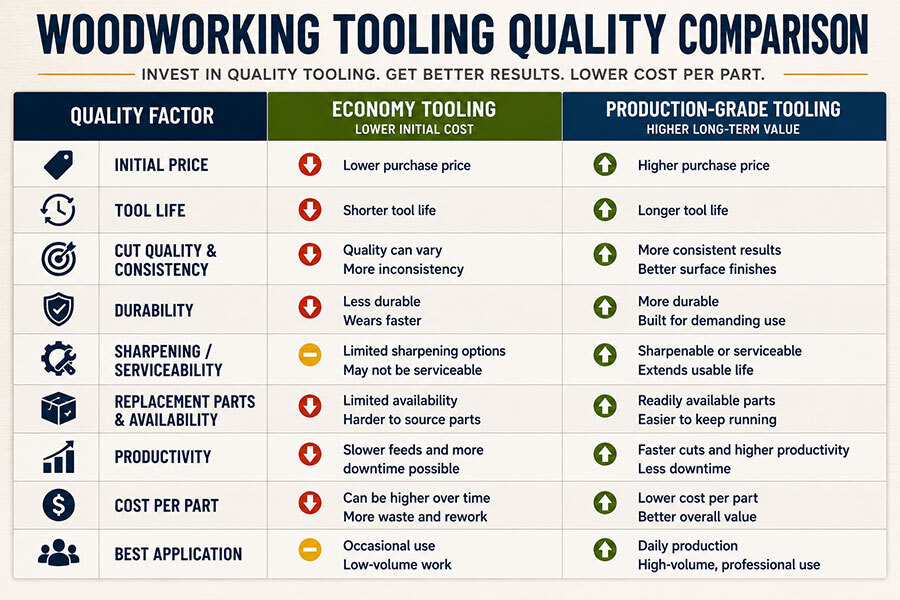
Woodwork Tooling Quality Comparison
|
Buying Factor |
Economy Tooling |
Production-Grade Tooling |
|
Initial price |
Lower |
Higher |
|
Tool life |
Often shorter |
Usually longer |
|
Cut consistency |
May vary |
More predictable |
|
Sharpening potential |
Limited on some tools |
Often better |
|
Replacement availability |
Variable |
Usually supported |
|
Best application |
Occasional or low-risk work |
Daily production |
|
Cost per part |
Can become high |
Often lower at volume |
|
Downtime risk |
Higher if life is unpredictable |
Easier to manage |
How to Evaluate Tooling Cost
Purchase price is only one part of the cost.
A better calculation considers:
- Tool purchase price
- Number of parts produced
- Sharpening or replacement-insert costs
- Setup time
- Tool-change time
- Material waste
- Secondary sanding
- Rejected components
- Downtime
- Expedited shipping
- Operator labour
A $300 tool that reliably produces 6,000 acceptable parts may provide better value than a $100 tool that produces 1,000 parts and requires more finishing.
Measure cost per acceptable finished component whenever possible.
Signs Tooling Needs Replacement
Tooling should be inspected when operators notice:
✓ Burn marks
✓ Rough edges
✓ Chipped laminates
✓ Increased vibration
✓ Unusual cutting noise
✓ Higher spindle or motor load
✓ Slower feed rates
✓ Excessive dust
✓ Poor surface finishes
✓ Dimensional inconsistency
✓ Frequent tool breakage
✓ More sanding or hand finishing
Waiting for complete failure can damage the workpiece, toolholder, spindle, or machine.
The article Signs Your Woodworking Tooling Needs Replacement outlines the most common warning signs and explains how worn tooling affects machinery and production.
Tooling Maintenance and Storage
Tool life depends on how tooling is maintained between production cycles.
Good practices include:
- Remove resin and adhesive buildup
- Inspect cutting edges regularly
- Sharpen tools before severe wear develops
- Use the correct speeds and feeds
- Clean collets and toolholders
- Protect precision surfaces
- Store blades vertically or in separated slots
- Keep router bits in individual holders
- Prevent carbide edges from touching
- Record sharpening and replacement history
- Remove cracked tooling from service immediately
Tooling should be stored in a clean, dry, organized area.
Loose storage can chip cutting edges before a tool reaches the machine.
Keep Critical Tooling in Stock
A shop should not rely on one tool for a production-critical process.
Important backup inventory may include:
- CNC compression cutters
- Common router bits
- Panel-saw blades
- Scoring blades
- Drill bits
- Edgebander cutters
- Scraper blades
- Replaceable inserts
- Collets
- Toolholders
- Sanding belts
- Specialty profile tools
Keeping suitable backups reduces emergency orders and allows worn tooling to be serviced before failure.
The principles in How to Reduce Downtime With Better Woodworking Tooling can help shops identify the tooling categories that create the greatest production risk.
Woodworking Tooling Buying Checklist
Before placing an order, ask:
- Which machine will use the tool?
- Is the mounting system compatible?
- What materials will be processed?
- What cut or finish is required?
- What production volume is expected?
- What speed and feed range will be used?
- Can the tool be sharpened?
- Are replacement inserts available?
- How long is the supplier lead time?
- Should a backup be ordered immediately?
- What is the expected cost per part?
- Is technical support available?
Common Tooling Buying Mistakes
What Not to Do
X Buying solely on the lowest price
X Choosing one tool for every material
X Ignoring maximum RPM
X Using the wrong shank, arbor, or rotation direction
X Running dull tooling until failure
X Failing to stock replacement inserts
X Ignoring toolholder and collet condition
X Selecting tooling without checking feed rates
X Using abrasive products with the wrong hole pattern or dimensions
X Ordering custom tooling without verifying the profile
X Failing to document successful machine settings
X Assuming a machinery problem is never caused by tooling
Professional power tools also depend on properly matched blades, bits, batteries, abrasives, guide systems, and dust extraction components. Shops purchasing portable equipment can review Power Tools Every Professional Woodworking Shop Needs when planning their complete tool and accessory inventory.
Final Thoughts
The best woodworking tooling is not simply the sharpest, most expensive, or longest-lasting option.
It is the tooling that matches the machine, material, application, production volume, and required finish.
Professional shops should compare compatibility, geometry, tool material, serviceability, replacement availability, supplier support, and total cost per completed part.
Tooling should also be inspected, cleaned, stored correctly, and replaced before excessive wear disrupts production.
A structured purchasing strategy helps shops achieve cleaner cuts, faster production, lower waste, more predictable maintenance, and better use of their woodworking machinery.
TCStore supplies saw blades, CNC router tooling, drill bits, insert tooling, edgebander cutters, sanding products, power tool accessories, toolholders, replacement parts, and other production supplies for cabinet shops, furniture manufacturers, architectural millwork companies, commercial woodworkers, and custom woodworking operations.
Frequently Asked Questions
What woodworking tooling does a professional shop need?
Most professional shops need saw blades, router bits, CNC cutters, drill and boring tools, sanding supplies, toolholders, and machine-specific tooling. Edgebander, shaper, moulder, planer, and jointer tooling may also be required.
How do I choose tooling for MDF and melamine?
Choose tooling designed for abrasive panel products and clean laminated surfaces. Compression cutters, suitable carbide grades, specialized saw blades, and efficient dust evacuation can help reduce chipping and premature wear.
Is carbide woodworking tooling better than high-speed steel?
Carbide generally provides greater wear resistance, especially when cutting engineered panels. High-speed steel can provide a sharp edge and practical sharpening for selected solid-wood applications. The better option depends on the material and production volume.
Is insert tooling worth the additional cost?
Insert tooling can be valuable for repetitive, high-volume work because individual cutting edges can be rotated or replaced quickly. Its value depends on insert availability, finish quality, setup requirements, and cost per part.
How often should woodworking tooling be replaced?
There is no universal replacement schedule. Tool life depends on material, operating settings, production volume, tool quality, maintenance, and required finish. Replace or service tooling when performance begins to decline rather than waiting for complete failure.