


Choosing the Right Sanding Supplies for Your Shop
Posted by TCStore on 2026 Jun 12th
Sanding supplies play a major role in woodworking production, product quality, labor efficiency, and overall profitability. Whether you're manufacturing cabinets, furniture, millwork, doors, retail fixtures, or custom woodworking projects, the right sanding supplies can improve finish quality, reduce labor costs, and help your shop operate more efficiently.
Many woodworking businesses invest heavily in machinery.
Then overlook sanding supplies.
That can become expensive.
Poor-quality abrasives wear out faster.
Inferior sanding products reduce finish quality.
The wrong sanding supplies increase labor and material costs.
The right sanding supplies do the opposite.
For many woodworking shops, sanding is one of the most labor-intensive stages of production.
Optimizing sanding supplies can create significant improvements throughout the workflow.
Quick Answer
The best sanding supplies for woodworking shops typically include:
✓ Sanding Belts
✓ Sanding Discs
✓ Sanding Sheets
✓ Abrasive Rolls
✓ Wide Belt Sanding Abrasives
✓ Orbital Sander Discs
✓ Sponge Abrasives
✓ Specialty Finishing Abrasives
The ideal sanding supplies depend on your machinery, material type, production volume, and desired finish quality.
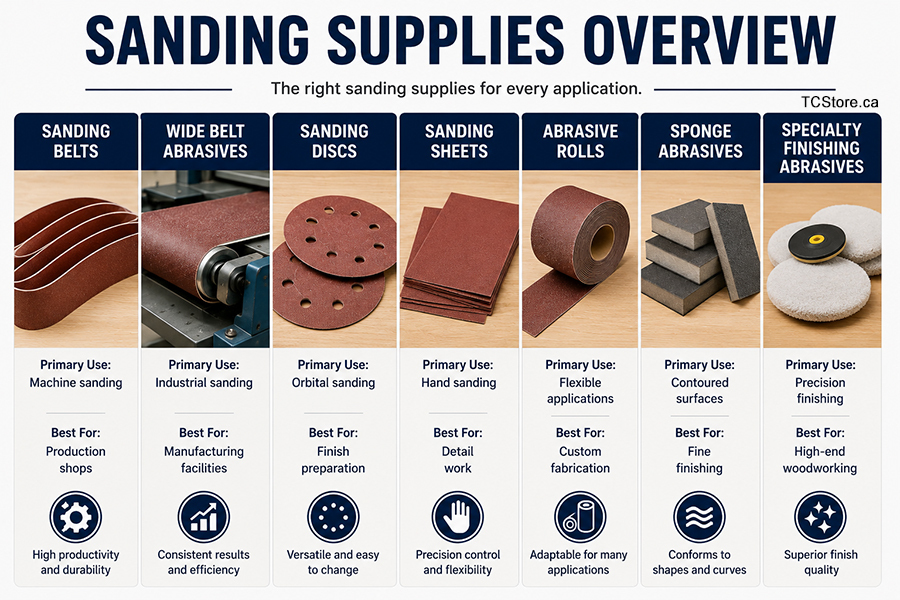
Sanding Supplies Overview
|
Sanding Supply |
Primary Use |
Best For |
|
Sanding Belts |
Machine sanding |
Production shops |
|
Wide Belt Abrasives |
Industrial sanding |
Manufacturing facilities |
|
Sanding Discs |
Orbital sanding |
Finish preparation |
|
Sanding Sheets |
Hand sanding |
Detail work |
|
Abrasive Rolls |
Flexible applications |
Custom fabrication |
|
Sponge Abrasives |
Contoured surfaces |
Fine finishing |
|
Specialty Abrasives |
Precision finishing |
High-end woodworking |
Every shop requires a different combination depending on production requirements.
Why Sanding Supplies Matter
Sanding affects more than appearance.
It impacts:
- Production speed
- Finish quality
- Material waste
- Labor costs
- Customer satisfaction
Poor sanding creates problems that become visible later.
Especially during staining and finishing.
Benefits Of Quality Sanding Supplies
✓ Better finish quality
✓ Faster sanding
✓ Reduced labor
✓ Improved consistency
✓ Less rework
✓ Longer abrasive life
✓ Lower operating costs
In many cases, upgrading abrasives produces a stronger return than upgrading machinery.
Sanding Belts For Production Shops
Sanding belts are among the most commonly used sanding supplies in woodworking.
They are used in:
- Belt sanders
- Edge sanders
- Wide belt sanders
- Industrial sanding systems
Common Applications
- Cabinet doors
- Furniture components
- Hardwood panels
- Millwork products
Benefits
✓ Fast material removal
✓ Consistent performance
✓ High productivity
✓ Excellent durability
Production facilities often rely heavily on sanding belts throughout manufacturing.
Wide Belt Sanding Abrasives
Wide belt sanding systems are common in manufacturing environments.
The abrasives used in these systems directly affect throughput and finish quality.
Benefits
✓ Uniform sanding
✓ Reduced labor
✓ Better consistency
✓ Increased throughput
✓ Improved finish preparation
For furniture manufacturers and cabinet shops, wide belt abrasives are often critical.
Sanding Discs For Orbital Sanders
Orbital sanders remain one of the most versatile tools in woodworking.
The performance of the tool depends heavily on the sanding disc.
Common Uses
- Finish preparation
- Surface smoothing
- Between-coat sanding
- Detail work
Benefits
✓ Flexible application
✓ Excellent finish quality
✓ Easy grit changes
✓ Suitable for many materials
Many woodworking shops use sanding discs daily.
Sanding Sheets
Hand sanding still plays an important role in woodworking production.
Some surfaces simply cannot be reached effectively by machines.
Common Applications
- Corners
- Edges
- Profiles
- Touch-ups
- Final finishing
Benefits
✓ Precision control
✓ Low cost
✓ Flexible use
✓ Suitable for detail work
Hand sanding remains valuable even in highly automated environments.
Understanding Sandpaper Grit
Choosing the correct grit is one of the most important sanding decisions.
Different grits serve different purposes.
|
Grit Range |
Typical Use |
|
40-60 |
Heavy stock removal |
|
80-100 |
Surface leveling |
|
120-150 |
General sanding |
|
180-220 |
Finish preparation |
|
320+ |
Fine finishing |
Using the wrong grit often creates unnecessary work.
Sanding Supply Selection By Application
Different woodworking applications require different abrasives.
|
Application |
Recommended Sanding Supply |
|
Cabinet Manufacturing |
Wide belt abrasives, sanding discs |
|
Furniture Manufacturing |
Belts, discs, sheets |
|
Architectural Millwork |
Fine finishing abrasives |
|
Door Manufacturing |
Wide belt abrasives |
|
Retail Fixtures |
Sanding belts and discs |
|
Custom Woodworking |
Mixed abrasive systems |
Selecting the correct abrasive improves both efficiency and quality.
Signs Your Sanding Supplies Need Replacement
Abrasives wear gradually.
Many operators continue using them beyond their effective lifespan.
Common warning signs include:
- Burn marks
- Slow sanding
- Excessive dust
- Uneven sanding
- Increased heat
- Poor finish quality
Warning Signs Chart
|
Symptom |
Likely Cause |
|
Slow Material Removal |
Worn abrasive |
|
Burn Marks |
Dull abrasive |
|
Uneven Finish |
Abrasive wear |
|
Excessive Dust |
Abrasive breakdown |
|
Increased Labor Time |
Inefficient sanding |
Replacing abrasives early often reduces overall operating costs.
Which Sanding Supplies Produce The Best ROI?
Some sanding supplies create greater production improvements than others.
|
Sanding Supply |
Business Impact |
|
Wide Belt Abrasives |
██████████ |
|
Sanding Belts |
█████████ |
|
Orbital Sanding Discs |
████████ |
|
Specialty Abrasives |
███████ |
|
Sanding Sheets |
█████ |
|
Sponge Abrasives |
████ |
The greatest returns often come from high-production sanding applications.
Common Sanding Mistakes
Many woodworking businesses create unnecessary costs through poor sanding practices.
What Not To Do
X Using worn abrasives too long
X Skipping grit sequences
X Buying solely based on price
X Using the wrong abrasive for the material
X Applying excessive pressure
X Ignoring machine maintenance
X Using damaged sanding belts
X Mixing inconsistent abrasive grades
These mistakes often increase labor and reduce finish quality.
Premium Abrasives vs Budget Abrasives
Budget abrasives may appear attractive initially.
However, purchase price is only one factor.
Premium Abrasives Often Provide
✓ Longer lifespan
✓ Better consistency
✓ Faster sanding
✓ Reduced downtime
✓ Better finish quality
✓ Lower total operating costs
Budget Abrasives Often Result In
X More frequent replacement
X Reduced consistency
X Slower production
X Higher labor costs
The cheapest abrasive is not always the least expensive option.
Industries That Depend On Quality Sanding Supplies
|
Industry |
Typical Sanding Requirements |
|
Cabinet Manufacturing |
Wide belt abrasives, discs |
|
Furniture Manufacturing |
Belts, discs, sheets |
|
Architectural Millwork |
Fine finishing abrasives |
|
Retail Fixture Manufacturing |
Sanding belts |
|
Door Manufacturing |
Wide belt systems |
|
Custom Woodworking |
Mixed abrasive applications |
Every woodworking sector depends on quality surface preparation.
Buying Considerations For Sanding Supplies
Before purchasing sanding supplies, ask:
|
Question |
Why It Matters |
|
What materials are being sanded? |
Determines abrasive type |
|
What machinery is being used? |
Impacts compatibility |
|
What finish quality is required? |
Influences grit selection |
|
What production volume exists? |
Affects abrasive durability needs |
|
Are replacement supplies readily available? |
Reduces downtime |
|
Is consistency important? |
Supports premium abrasive selection |
The right abrasive should match both the application and production goals.
Benefits Of Choosing The Right Sanding Supplies
✓ Better finish quality
✓ Increased production efficiency
✓ Reduced labor costs
✓ Less material waste
✓ Improved consistency
✓ Reduced rework
✓ Better customer satisfaction
✓ Higher profitability
Many woodworking shops discover that improving abrasives is one of the simplest ways to improve production performance.
Final Thoughts
Sanding supplies play a major role in product quality, workflow efficiency, and manufacturing profitability.
The right sanding belts, sanding discs, wide belt abrasives, and finishing products can dramatically improve production results while reducing labor and operating costs.
Rather than treating sanding supplies as simple consumables, successful woodworking businesses view them as production tools.
Many manufacturers, cabinet shops, and woodworking facilities source sanding supplies, abrasives, replacement products, and finishing materials through TCStore to help maximize efficiency and maintain consistent production quality.
FAQ
What are the most important sanding supplies for woodworking shops?
Wide belt abrasives, sanding belts, sanding discs, sanding sheets, and specialty finishing abrasives are among the most commonly used sanding supplies.
How often should sanding supplies be replaced?
Replacement depends on production volume, material type, and abrasive quality. Monitoring finish quality is often the best indicator.
Are premium sanding supplies worth the cost?
Many woodworking businesses find premium abrasives last longer, sand faster, and reduce overall operating costs.
What grit sandpaper should I use for woodworking?
The correct grit depends on the application. Lower grits are used for material removal, while higher grits are used for finish preparation.
Where can I buy sanding supplies for woodworking machinery?
Many woodworking shops source sanding supplies, abrasive belts, sanding discs, finishing abrasives, and replacement products through suppliers such as TCStore.