

Essential Saw Blades for Woodworking Machinery
Posted by TCStore on 2026 Jun 23rd
Saw blades are one of the most important yet overlooked components in woodworking machinery. Whether you're operating a sliding table saw, panel saw, beam saw, miter saw, table saw, or industrial cutting system, the quality and condition of your saw blades directly affect productivity, cut quality, material waste, machine performance, and profitability.
Many woodworking businesses invest heavily in machinery.
Then try to save money on blades.
That often becomes an expensive mistake.
A high-quality saw blade can improve production speed, reduce rework, minimize material waste, and extend machinery life.
A poor blade can do the opposite.
For cabinet shops, furniture manufacturers, millwork companies, closet manufacturers, and woodworking production facilities, selecting the right saw blades is critical.
Quick Answer
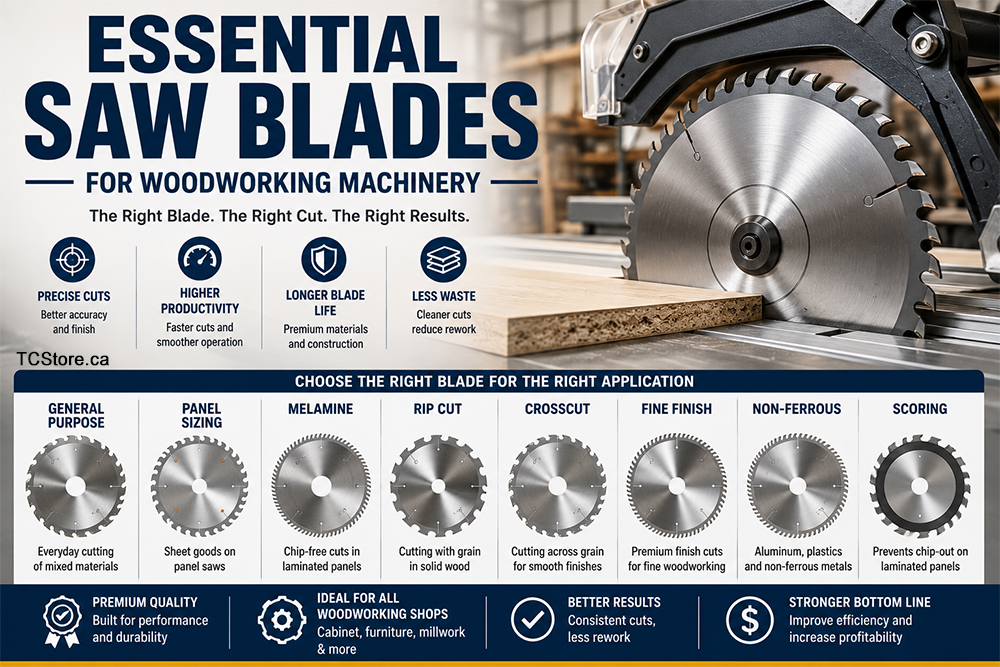
The most essential saw blades for woodworking machinery include:
✓ General Purpose Saw Blades
✓ Panel Sizing Saw Blades
✓ Melamine Saw Blades
✓ Rip Cut Saw Blades
✓ Crosscut Saw Blades
✓ Fine Finish Saw Blades
✓ Non-Ferrous Cutting Blades
✓ Scoring Blades
Most woodworking shops use multiple blade types depending on the material being processed and the desired finish quality.
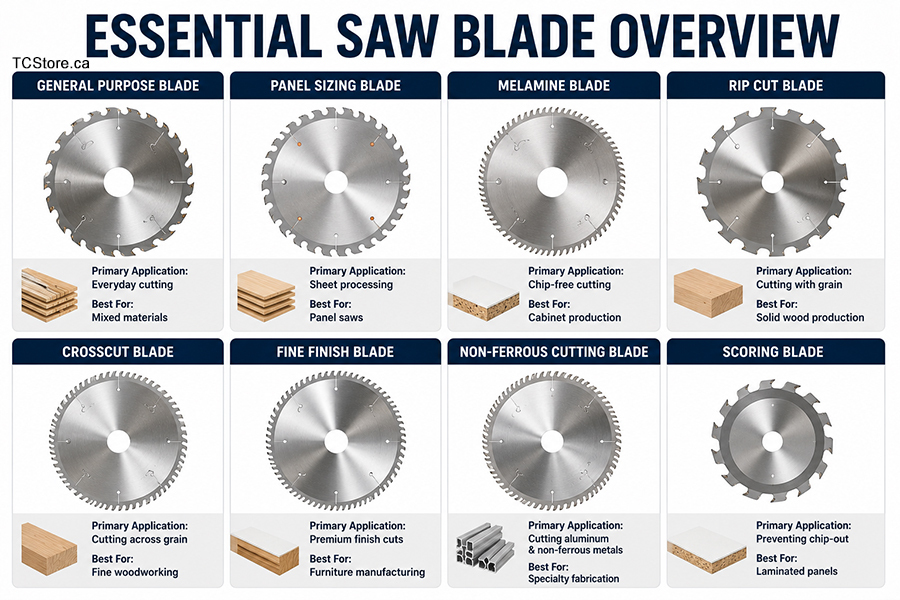
Essential Saw Blade Overview
|
Saw Blade Type |
Primary Application |
Best For |
|
General Purpose Blade |
Everyday cutting |
Mixed materials |
|
Rip Blade |
Cutting with grain |
Solid wood production |
|
Crosscut Blade |
Cutting across grain |
Fine woodworking |
|
Melamine Blade |
Chip-free cutting |
Cabinet production |
|
Panel Sizing Blade |
Sheet processing |
Panel saws |
|
Fine Finish Blade |
Premium finish cuts |
Furniture manufacturing |
|
Scoring Blade |
Preventing chip-out |
Laminated panels |
|
Non-Ferrous Blade |
Aluminum and plastics |
Specialty fabrication |
Different materials require different blade designs.
There is no single blade that does everything perfectly.
Why Saw Blades Matter
Many production issues can be traced back to blade selection.
Common symptoms include:
- Chipping
- Tear-out
- Burn marks
- Rough edges
- Excessive dust
- Slow feed rates
- Material waste
These issues affect more than appearance.
They affect profitability.
Benefits Of Using The Right Saw Blade
✓ Cleaner cuts
✓ Reduced material waste
✓ Faster production
✓ Longer machine life
✓ Better finish quality
✓ Reduced labor costs
✓ Less rework
✓ Improved profitability
For many shops, blade selection has a larger impact than expected.
General Purpose Saw Blades
General purpose blades are among the most commonly used saw blades in woodworking machinery.
They are designed to perform reasonably well across multiple materials.
Common uses include:
- Plywood
- MDF
- Hardwood
- Softwood
- Particle board
Benefits
✓ Versatile
✓ Cost-effective
✓ Suitable for mixed workloads
✓ Good overall performance
Many smaller shops rely heavily on general purpose blades.
However, specialized blades often produce better results for specific applications.
Rip Cut Saw Blades
Rip blades are designed for cutting along the grain of solid wood.
They typically have fewer teeth and larger gullets.
This allows them to remove material more efficiently.
Best Applications
- Hardwood ripping
- Softwood ripping
- Solid wood production
- Furniture manufacturing
Benefits
✓ Faster feed rates
✓ Efficient material removal
✓ Reduced heat buildup
✓ Improved productivity
Rip blades are ideal when speed matters.
Crosscut Saw Blades
Crosscut blades are designed to cut across the grain.
They typically have more teeth than rip blades.
This creates cleaner edges and smoother finishes.
Best Applications
- Furniture components
- Trim work
- Molding
- Fine woodworking
Benefits
✓ Cleaner cuts
✓ Better finish quality
✓ Reduced tear-out
✓ Improved appearance
Crosscut blades prioritize quality over speed.
Melamine Saw Blades
Melamine is one of the most common materials in cabinet manufacturing.
It is also one of the most difficult materials to cut cleanly.
Standard blades often cause chipping.
Melamine blades are specifically designed to reduce chip-out.
Best Applications
- Kitchen cabinets
- Closets
- Office furniture
- Commercial millwork
Benefits
✓ Cleaner edges
✓ Reduced chipping
✓ Better finished appearance
✓ Less rework
For cabinet shops, melamine blades are often essential.
Panel Sizing Saw Blades
Panel sizing blades are designed for high-volume sheet processing.
They are commonly used on:
- Panel saws
- Beam saws
- Sliding table saws
Typical Materials
- MDF
- Melamine
- Particle board
- Plywood
Benefits
✓ High accuracy
✓ Consistent cuts
✓ Reduced material waste
✓ Strong production performance
Panel sizing blades are a staple of modern woodworking production.
Fine Finish Saw Blades
Some projects demand exceptional cut quality.
This is where fine finish blades excel.
These blades typically feature higher tooth counts and specialized geometries.
Common Applications
- Furniture manufacturing
- Premium cabinetry
- Architectural millwork
- Decorative woodworking
Benefits
✓ Exceptional finish quality
✓ Reduced sanding requirements
✓ Cleaner edges
✓ Better visual appearance
These blades often reduce secondary finishing labor.
Scoring Blades
Scoring blades are often paired with panel saws and beam saws.
They create a shallow preliminary cut before the main blade passes through the material.
This reduces chip-out on laminated surfaces.
Benefits
✓ Cleaner cuts
✓ Reduced edge chipping
✓ Better panel quality
✓ Improved production consistency
For laminated panels, scoring blades can dramatically improve results.
Saw Blade Selection By Material
Choosing the correct blade matters.
Different materials create different cutting challenges.
|
Material |
Recommended Blade |
|
Hardwood |
Rip Blade / Crosscut Blade |
|
Softwood |
Rip Blade / Crosscut Blade |
|
MDF |
Panel Sizing Blade |
|
Melamine |
Melamine Blade |
|
Particle Board |
Panel Sizing Blade |
|
Plywood |
Fine Finish Blade |
|
Laminate Panels |
Scoring + Main Blade |
|
Aluminum |
Non-Ferrous Blade |
Matching the blade to the material improves both quality and productivity.
Signs Your Saw Blades Need Replacement
Saw blades wear gradually.
Many operators become accustomed to declining performance.
Warning signs include:
- Burn marks
- Chipping
- Excessive vibration
- Rough cuts
- Increased feed resistance
- Excessive noise
Common Warning Signs
|
Symptom |
Likely Cause |
|
Burn Marks |
Dull blade |
|
Chipping |
Worn teeth |
|
Rough Edges |
Blade wear |
|
Increased Noise |
Damaged teeth |
|
Slow Cutting |
Dull blade |
|
Excessive Heat |
Worn cutting edges |
Ignoring blade wear often increases downtime and waste.
Which Saw Blades Deliver The Best ROI?
Certain blades consistently generate strong returns.
|
Blade Type |
Business Impact |
|
Melamine Blade |
██████████ |
|
Panel Sizing Blade |
█████████ |
|
Fine Finish Blade |
████████ |
|
Rip Blade |
███████ |
|
Crosscut Blade |
███████ |
|
General Purpose Blade |
██████ |
The best blade is usually the one that reduces rework and waste.
Common Saw Blade Mistakes
Many woodworking shops create unnecessary problems through blade selection.
What Not To Do
X Using one blade for every material
X Running blades until complete failure
X Ignoring blade maintenance
X Buying solely based on price
X Using dull blades
X Choosing the wrong tooth geometry
X Ignoring scoring blade requirements
X Delaying blade replacement
These mistakes often cost more than premium blades.
Industries That Depend On Quality Saw Blades
|
Industry |
Typical Blade Requirements |
|
Cabinet Manufacturing |
Melamine, Panel Sizing |
|
Furniture Manufacturing |
Rip, Crosscut, Fine Finish |
|
Architectural Millwork |
Fine Finish, Crosscut |
|
Closet Manufacturing |
Melamine, Panel Sizing |
|
Retail Fixtures |
Panel Sizing, Fine Finish |
|
Commercial Millwork |
Melamine, Scoring Systems |
Every woodworking sector depends on blade performance.
Buying Considerations For Saw Blades
Before purchasing saw blades, consider:
|
Question |
Why It Matters |
|
What materials are being cut? |
Determines blade type |
|
What machinery is being used? |
Impacts compatibility |
|
What finish quality is required? |
Influences tooth geometry |
|
What production volume exists? |
Affects blade durability |
|
Are sharpening services available? |
Impacts operating costs |
|
Is downtime costly? |
Supports premium blade investment |
The right blade should fit both the material and the production environment.
Benefits Of Premium Saw Blades
✓ Longer blade life
✓ Better cut quality
✓ Reduced downtime
✓ Faster production
✓ Less waste
✓ Lower operating costs
✓ Improved consistency
✓ Better finished products
Circular saw blades often produce lower overall production costs despite higher purchase prices.
Final Thoughts
Saw blades are one of the most important components in woodworking machinery.
The right blade improves quality, reduces waste, increases production efficiency, and minimizes downtime.
Rather than viewing saw blades as simple consumables, successful woodworking businesses view them as productivity tools.
Many manufacturers, cabinet shops, and woodworking facilities source saw blades, tooling, replacement parts, and production supplies through TCStore to help maximize machine performance and maintain efficient production workflows.
FAQ
What is the best saw blade for woodworking machinery?
The best saw blade depends on the material being cut. Melamine blades, panel sizing blades, rip blades, and fine finish blades all serve different purposes.
How often should saw blades be replaced?
Replacement intervals depend on material type, production volume, and blade quality. Monitoring cut quality is usually the best indicator.
Are premium saw blades worth the cost?
Many woodworking businesses find premium saw blades reduce downtime, improve quality, and lower long-term operating costs.
What causes saw blade chipping?
Chipping is often caused by dull blades, incorrect blade selection, poor feed rates, or inadequate scoring systems.
Where can I buy saw blades for woodworking machinery?
Many woodworking shops source saw blades, tooling, sharpening services, and replacement components through suppliers such as TCStore.