

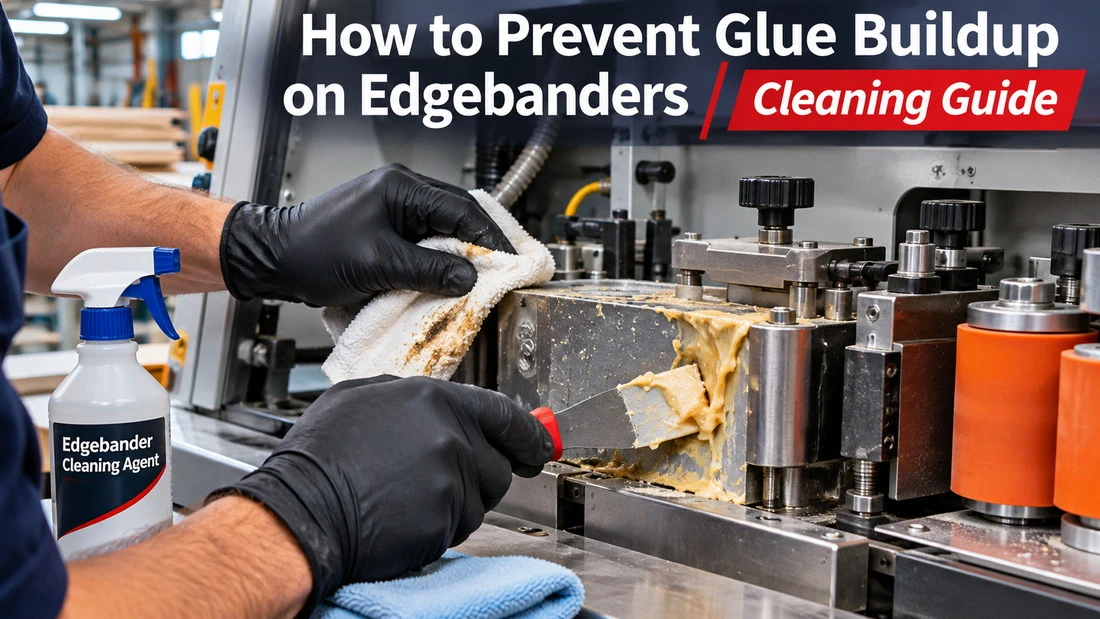
How to Prevent Glue Buildup on Edgebanders: Cleaning Guide
Posted by TCStore on 2026 Nov 10th
Glue buildup on an edgebander can turn a clean, repeatable production process into a cycle of dirty panels, marked rollers, poor edge quality, extra hand cleaning, and unexpected machine downtime.
The best approach is prevention: keep adhesive from sticking to sensitive surfaces, remove residue before it hardens, and use cleaning products designed for the adhesive and machine components involved.
TCStore carries edgebanding cleaning and finishing agents along with release agents, edgebanding glue, lubricants, replacement parts, and other edgebanding supplies for professional cabinet and furniture production.
This guide explains where glue buildup occurs, how release agents and cleaners serve different roles, and how to build a practical cleaning routine around EVA and PUR edgebanding.
Quick Answer: How Do You Prevent Glue Buildup on an Edgebander?
- Use the correct adhesive temperature and application rate
- Keep panel edges clean and properly prepared
- Apply compatible release agent where the process requires it
- Clean glue residue before it hardens
- Inspect pressure rollers, guides, scrapers, and buffing stations
- Use machine-safe cleaning agents
- Follow special purge and cleaning procedures for PUR adhesive
- Keep spray nozzles and application systems calibrated
- Replace worn scrapers, brushes, and pads
Cleaning should be part of production, not something done only after glue contamination begins affecting finished parts.
Where Glue Buildup Commonly Appears
|
Area |
Typical Problem |
Possible Result |
|
Pressure rollers |
Adhesive transferred from the edge |
Marks, inconsistent pressure |
|
Feed chain / pads |
Glue contamination |
Panel marking and feeding problems |
|
Guides |
Residue accumulation |
Tracking or surface marks |
|
Trimming stations |
Glue mixed with chips |
Poor trimming and buildup |
|
Scraper stations |
Adhesive contamination |
Haze and poor final edge |
|
Buffing wheels |
Glue transferred into fibres |
Smearing instead of polishing |
|
Glue pot / applicator |
Overheated or cured adhesive |
Poor spread and maintenance |
|
Finished panel surface |
Squeeze-out or transfer |
Manual cleanup and rework |
Why Glue Buildup Happens
- Too much adhesive
- Incorrect glue temperature
- Cold panels or edging
- Poor panel preparation
- Incorrect pressure
- Worn rollers or guides
- Misaligned trimming or scraping units
- Incorrect spray-agent setup
- Delayed cleaning
- Using incompatible cleaning chemistry
For adhesive selection and process differences, review EVA vs PUR Edgebanding Adhesive: Which Glue Should You Use?.
Release Agent vs Cleaning Agent
|
Product Type |
When Used |
Primary Purpose |
|
Release agent |
Before or during edgebanding |
Prevent adhesive from sticking to protected surfaces |
|
Cleaning agent |
After adhesive transfer / before finishing |
Remove loose glue residue and contamination |
|
PUR cleaner / purge product |
During specified maintenance or shutdown procedures |
Clean compatible reactive-adhesive systems |
These products are not interchangeable. A release agent is preventive. A cleaning agent removes residue. PUR systems may require additional products and procedures because cured polyurethane adhesive behaves differently from standard EVA hot melt.
Using Release Agents
A release agent creates a temporary protective layer on selected surfaces so emerging adhesive is less likely to stick.
For example, the Riepe LPZ/ II Release Agent is designed to help prevent emerging glue from adhering to the workpiece.
Other edgebander systems may apply release chemistry to pressure rollers, panel surfaces, or other zones depending on the spray setup and process design.
- Use only compatible products
- Apply the correct amount
- Aim nozzles accurately
- Avoid soaking the panel or machinery
- Inspect spray consistency
- Keep nozzles clean
Using Cleaning Agents Before Buffing
Cleaning chemistry is often applied near the final stages so loose adhesive residue can be removed before buffing wheels polish the edge.
The Riepe LP 163/93 Cleaning Agent is intended for use before buffing wheels, cleaning brushes, and manual board cleaning.
A properly maintained cleaning stage helps the buffing unit polish rather than smear glue across the panel edge.
Why Buffing Wheels Get Dirty
Buffing wheels are designed to refine the finished edge. If adhesive reaches the wheel, the fibres can become contaminated and transfer residue from one panel to the next.
- Inspect wheels for hardened glue
- Replace heavily contaminated or worn wheels
- Verify upstream cleaning is working
- Check scraper performance before blaming the buffing stage
Glue Buildup on Pressure Rollers
Pressure rollers must press the edging firmly against the panel. Glue contamination can change roller surface condition and transfer marks onto following workpieces.
- Inspect rollers at the beginning of production
- Remove residue using approved products
- Check roller surface for wear
- Confirm pressure and alignment
- Investigate repeated glue transfer rather than cleaning the symptom indefinitely
EVA Glue Cleanup
EVA hot melt can often be managed with conventional edgebander cleaning procedures when the correct cleaner and temperature conditions are used.
Problems become harder to correct when adhesive is allowed to build up repeatedly around the glue pot, roller, guides, trimming units, and pressure system.
- Do not let residue accumulate for days
- Clean at planned intervals
- Remove charred or degraded adhesive according to the machine procedure
- Keep the glue application system within its specified temperature range
PUR Glue Requires More Discipline
PUR adhesive chemically cures after application. Once cured, it cannot simply be reheated back into its original usable form.
That makes shutdown, purge, cleaning, storage, and moisture-control procedures especially important.
- Follow the edgebander and adhesive manufacturer's shutdown procedure
- Use compatible PUR cleaner or purge products
- Do not leave reactive adhesive in areas where it can cure unintentionally
- Keep containers and cartridges handled according to specification
TCStore's EVA vs PUR adhesive guide explains the broader performance and maintenance differences between the two adhesive systems.
Adhesive Temperature and Glue Buildup
Incorrect temperature can change viscosity and glue spread. Adhesive that is too cold may not wet the surface correctly, while excessive heat can accelerate degradation and create residue.
- Verify displayed temperature against machine condition
- Allow the system to reach operating temperature
- Avoid prolonged overheating during idle periods
- Use adhesive within the supplier's processing range
Panel Temperature Matters
Cold panels can cool hot-melt adhesive quickly and reduce wetting time. In winter or unheated storage, this can contribute to inconsistent glue behaviour.
Condition panels and edge material appropriately before production rather than compensating with excessive glue application.
Too Much Glue Creates More Cleanup
More adhesive does not automatically create a stronger edge. Excess glue increases squeeze-out and contamination.
The correct adhesive quantity depends on panel edge quality, edge material, glue system, viscosity, temperature, feed speed, and machine setup.
Premilling and Edge Preparation Reduce Problems
A clean, accurately machined panel edge gives adhesive a consistent surface. Poorly prepared edges may encourage operators to compensate with more glue.
The broader Choosing the Right Edgebanding Supplies for Cabinets guide explains how adhesive, edge material, premilling, trimming, scraping, pressure, and finishing work together.
Daily Edgebander Cleaning Checklist
- Inspect glue application area
- Check pressure rollers
- Inspect feed pads and guides
- Check trimming and scraper stations
- Inspect buffing wheels
- Clean spray nozzles if required
- Remove loose glue residue
- Inspect glue pot or cartridge area
- Check hoses and agent levels
- Record unusual buildup or repeated contamination
Weekly / Preventative Cleaning Tasks
- Deep-clean accessible glue-contact areas
- Inspect scraper blades and trimming tools
- Check spray-agent calibration
- Inspect rollers and pads for wear
- Check glue-pot condition
- Inspect brushes and buffing wheels
- Review repeated contamination points
- Verify operators are using the correct cleaning products
Glue Buildup Troubleshooting Chart
|
Symptom |
Possible Cause |
What to Check |
|
Glue on panel face |
Excess adhesive or failed release process |
Glue amount, release spray, pressure |
|
Dirty pressure roller |
Adhesive transfer |
Roller cleaning, spray system, edge pressure |
|
Glue smeared at buffing |
Upstream residue not removed |
Cleaning agent, scraper, buffing wheel |
|
Heavy glue squeeze-out |
Too much adhesive / poor setup |
Application rate, panel prep, temperature |
|
Recurring glue at one station |
Mechanical or alignment problem |
Guides, cutters, scrapers, roller position |
|
Cured PUR in system |
Improper shutdown / purge |
PUR procedure and cleaning chemistry |
Common Edgebander Cleaning Mistakes
- Using one cleaner for every adhesive and surface
- Cleaning only when panels are already dirty
- Applying excessive release agent
- Ignoring spray-nozzle alignment
- Running contaminated buffing wheels
- Using aggressive solvents on seals or plastics
- Treating PUR like EVA
- Ignoring the root cause of repeated glue transfer
- Allowing hardened residue to build around precision components
Edgebander Cleaning Product Buying Checklist
- Identify the edgebander make and model.
- Confirm whether the adhesive is EVA, PUR, polyolefin, or another system.
- Identify where buildup occurs.
- Determine whether you need prevention, cleaning, or PUR purge chemistry.
- Check compatibility with panel surfaces, seals, plastics, rollers, and paint.
- Confirm spray-system requirements.
- Review container size and production usage.
- Keep backup supply before the active container is empty.
Final Thoughts
The best way to control glue buildup is to treat cleaning as part of the edgebanding process. Correct adhesive temperature, panel preparation, glue quantity, pressure, release chemistry, scraping, and final cleaning all influence how much residue reaches the finished panel.
Browse TCStore's cleaning and finishing agents and edgebanding supplies for release agents, cleaners, adhesives, lubricants, parts, and accessories.
For a broader supply checklist, review Must-Have Edgebander Supplies for Better Results.
Frequently Asked Questions
What causes glue buildup on an edgebander?
Common causes include excessive adhesive, incorrect temperature, poor panel preparation, spray-system problems, pressure or alignment issues, worn finishing components, and cleaning that is delayed until residue hardens.
What is the difference between release agent and cleaning agent?
Release agent is used preventively to reduce adhesive sticking to protected surfaces. Cleaning agent is used to remove loose glue residue and contamination, often before buffing or final cleaning.
Can I use the same cleaner for EVA and PUR adhesive?
Not automatically. PUR is reactive and may require different cleaning or purge chemistry. Always use products approved for the adhesive and edgebander system.
Why is glue getting on my edgebander pressure rollers?
Possible causes include excessive glue, poor edge positioning, inadequate release protection, incorrect pressure, panel alignment problems, or residue being carried forward from another station.
How often should an edgebander be cleaned?
High-contact areas should be inspected frequently during production, with daily cleaning and scheduled preventative maintenance based on adhesive type, production volume, machine design, and manufacturer recommendations.