

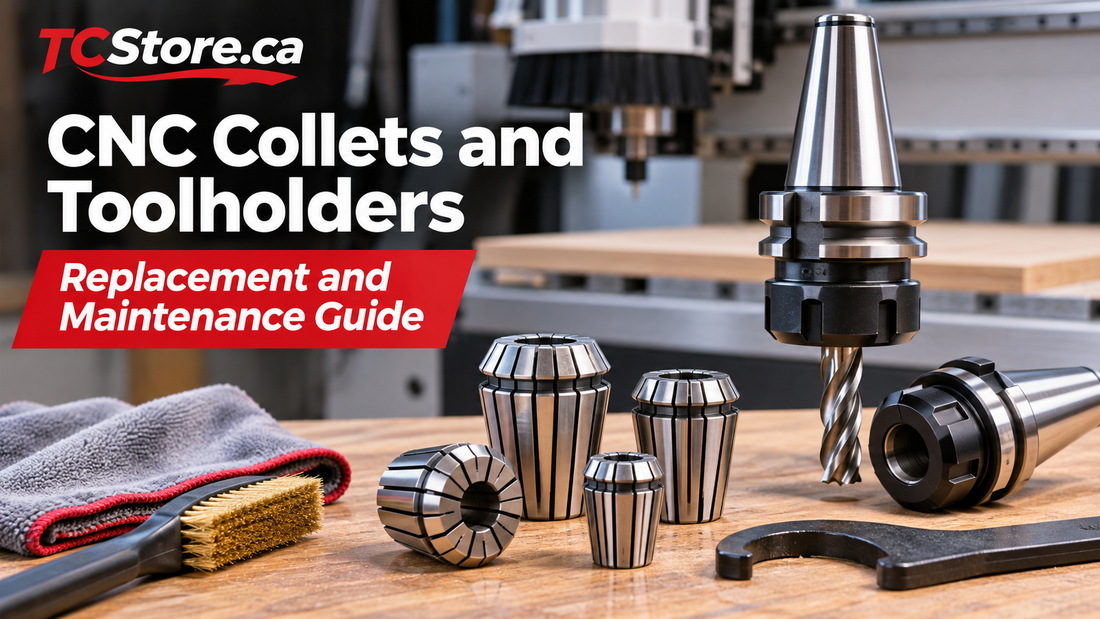
CNC Collets and Toolholders: Replacement and Maintenance Guide
Posted by TCStore on 2026 Nov 17th
CNC collets and toolholders are small components with a major influence on machining accuracy, router-bit life, spindle performance, vibration, and finished-part quality.
A premium router bit cannot cut accurately if it is held by a dirty, worn, damaged, or incorrectly sized collet.
Professional woodworking shops should treat CNC collets and tooling accessories as precision production components rather than permanent hardware that never requires inspection or replacement.
This guide explains how CNC collets and toolholders work, how runout develops, what to inspect, how to clean and store toolholding components, and when replacement is more practical than continued use.
Quick Answer: When Should CNC Collets and Toolholders Be Replaced?
Replace or service CNC toolholding components when they can no longer hold the cutter securely and concentrically.
- Visible cracks, scoring, corrosion, distortion, or damaged threads
- Loss of clamping force
- Increasing runout
- Persistent vibration after the tool and spindle taper are cleaned
- Uneven router-bit wear
- Repeated tool slippage
- Poor cut quality that follows the toolholder rather than the cutter
- Damaged collet nuts or wrench flats
- A holder that no longer seats correctly in the spindle or tool-change system
There is no single replacement interval for every shop. Condition, runout, operating hours, material, tool changes, contamination, spindle speed, and operator handling all affect service life.
CNC Toolholding Components Overview
|
Component |
Main Function |
Common Maintenance Concern |
|
Collet |
Clamps the tool shank |
Wear, contamination, loss of spring tension |
|
Collet nut |
Applies clamping force to the collet |
Thread wear, face damage, incorrect torque |
|
Toolholder |
Connects the tool assembly to the spindle |
Taper contamination, runout, impact damage |
|
Pull stud / retention knob |
Allows compatible automatic tool changing |
Thread damage, wear, incorrect specification |
|
Spindle taper |
Locates the toolholder in the spindle |
Dust, resin, corrosion, burrs |
|
Wrench / torque tool |
Tightens the collet nut |
Incorrect tightening force or damaged wrench |
|
Storage rack |
Protects holders between jobs |
Contamination and impact damage when absent |
What Does a CNC Collet Do?
A collet is a precision spring sleeve that contracts around the router-bit or drill shank as the collet nut is tightened. The goal is to hold the tool securely while keeping its centreline aligned with the spindle.
ER-series collets are common in CNC woodworking. The correct ER family and clamping range must match the holder and tool shank.
TCStore carries multiple ER32 and ER40 collets for professional CNC tooling systems, including products such as the IMS ER 32 7-8mm Collet.
Why Runout Matters
Runout occurs when the cutting tool does not rotate perfectly around its intended centreline. Even a small amount of off-centre rotation can cause one cutting edge to remove more material than the others.
- Uneven cutter wear
- Chatter or vibration
- Poor edge quality
- Oversized holes or grooves
- Additional heat
- Premature router-bit failure
- Reduced spindle and bearing life
- Inconsistent dimensions
The issue is covered briefly in TCStore's CNC router bit selection guide, but toolholding deserves its own maintenance routine because a new cutter cannot correct a worn collet or damaged holder.
Common Causes of CNC Collet Runout
- Dust or resin trapped between the tool shank and collet
- Contamination between the collet and nut
- Dirty spindle taper
- Worn spring segments
- Incorrect collet size for the shank
- Excessive tool projection
- Damaged tool shank
- Over-tightening or under-tightening
- Toolholder impact damage
- Spindle or bearing problems
How to Inspect a CNC Collet
Inspect the collet every time abnormal tool wear, vibration, or finish quality appears.
- Remove the cutter and collet from the holder.
- Clean all contact surfaces before deciding that a part is worn.
- Inspect each slot and spring segment for cracks or distortion.
- Check the inside bore for scoring, rust, resin, or embedded debris.
- Inspect the outside taper for damage.
- Confirm that the collet snaps correctly into the compatible nut where the system is designed for that arrangement.
- Check the tool shank for scoring or contamination.
- Reassemble using the correct collet size and tightening procedure.
- Measure runout if the shop has suitable inspection equipment.
Cleaning CNC Collets and Toolholders
Precision toolholding components should be cleaned without scratching their locating surfaces. Compressed dust, resin, fine MDF particulate, and grease can prevent proper seating.
- Use a clean, lint-free cloth on toolholder tapers and collet surfaces.
- Use appropriate non-damaging brushes for collet slots and threads.
- Remove resin before it hardens into the contact surfaces.
- Keep the spindle taper clean according to the machine manufacturer's procedure.
- Do not use abrasive methods that alter precision surfaces.
- Dry components before storage if a compatible cleaner has been used.
The same maintenance principle applies across the wider tooling system. TCStore's guide to extending woodworking tooling life explains how cleaning, setup, sharpening, storage, and machine condition work together to prevent premature wear.
Correct Collet Size Is Essential
A collet should clamp within its specified range. Using a collet that is too large or too small for the tool shank can reduce clamping force and concentricity.
|
Selection Factor |
What to Confirm |
|
Collet family |
ER32, ER40, or other system specified by the holder |
|
Clamping range |
Actual tool-shank diameter falls within the collet range |
|
Toolholder |
Collet family matches the holder and nut |
|
Tool shank |
Clean, undamaged, and long enough for proper insertion |
|
Machine specification |
Holder and retention system approved for the spindle |
Do Not Insert the Router Bit Too Shallow
A cutter needs enough shank engagement to be held securely. Clamping close to the end of the shank can increase leverage on the collet and contribute to vibration.
At the same time, a router bit should not be inserted so deeply that the cutting geometry, relief, or transition radius is clamped incorrectly. Follow the cutter and machine manufacturer's insertion guidance.
Toolholder Maintenance
The toolholder itself should be treated as a precision component. The taper, collet seat, threads, and retention features must remain clean and undamaged.
- Protect holders from impacts and drops.
- Do not place precision tapers directly on dirty benches.
- Keep holders in dedicated racks or protective storage.
- Inspect threads before installing a collet nut.
- Check automatic-tool-change retention components where applicable.
- Remove holders showing burrs, severe corrosion, cracks, or persistent runout.
Collet Nut and Tightening Practices
The collet nut creates the force that compresses the collet. Under-tightening can permit tool movement, while excessive tightening can damage components.
Use the correct wrench and tightening method for the tooling system. If the manufacturer specifies a torque value, use an appropriate torque wrench rather than relying on feel.
When Should a CNC Collet Be Replaced?
Replacement should be based on condition and performance rather than appearance alone. A collet can look acceptable while no longer maintaining dependable concentricity or clamping force.
- Runout remains excessive after cleaning and correct assembly
- The tool repeatedly slips in the collet
- Spring segments are cracked or distorted
- The bore is scored or damaged
- The collet has corrosion on clamping surfaces
- The shop sees recurring uneven cutter wear
- The collet no longer clamps consistently within its rated range
TCStore's spare-parts guide for woodworking machinery recommends keeping common collet sizes available because a low-cost toolholding failure can stop a high-value CNC machine.
When Should a Toolholder Be Replaced?
- Persistent runout follows the holder between tools
- The taper has impact marks, burrs, or severe wear
- Threads are damaged
- The retention system is damaged or out of specification
- The holder has been involved in a crash
- Tool clamping is no longer stable
A damaged holder should not be kept in production merely because a new collet temporarily improves the cut. Toolholders should be evaluated as part of the spindle-tooling system.
CNC Toolholding Maintenance Schedule
|
Frequency |
Recommended Check |
|
Each tool change |
Wipe tool shank and inspect visible collet contamination |
|
Daily / frequent production |
Inspect common holders, nuts, and tool racks for debris or damage |
|
When cut quality changes |
Clean and inspect the entire toolholding stack; verify runout |
|
After a crash or impact |
Remove affected holders and inspect before reuse |
|
Preventative maintenance |
Review recurring runout, clamping, and replacement history |
Keep Backup Collets for Critical CNC Work
A production CNC should not depend on one collet for every commonly used shank size. Shops can reduce downtime by stocking the collets used most often.
Browse TCStore's CNC tooling and accessories for common ER collets and related CNC components.
This supports the same inventory strategy described in How to Reduce Downtime With Better Woodworking Tooling: inexpensive backup tooling is often far less costly than an idle CNC router.
Common CNC Collet and Toolholder Mistakes
- Treating collets as permanent lifetime components
- Installing dirty tool shanks
- Using the wrong collet range
- Overtightening collet nuts
- Using damaged wrenches
- Letting holders roll around in drawers
- Clamping excessive tool projection
- Ignoring taper cleanliness
- Assuming every vibration problem is caused by the router bit
- Keeping no spare collets for critical tool sizes
CNC Collet and Toolholder Buying Checklist
- Confirm the CNC spindle and toolholder interface.
- Confirm the collet family required by the holder.
- Measure the actual cutter-shank diameter.
- Choose a collet whose specified range matches that shank.
- Check the nut, wrench, and retention system.
- Inspect the holder taper and threads.
- Confirm the machine's maximum spindle speed and tooling requirements.
- Keep backups for frequently used sizes.
- Record recurring runout or replacement problems.
Final Thoughts
CNC collets and toolholders directly affect how accurately the cutting tool rotates, how securely it is held, and how long both the cutter and spindle system remain productive.
Keep them clean. Protect precision surfaces. Match the collet to the exact tool shank. Use correct tightening procedures. Measure runout when performance changes. And replace worn components before they begin damaging cutters or finished parts.
For a complete view of machine compatibility, cutting tools, drilling tooling, edgebander tooling, abrasives, and toolholding, review the Woodworking Tooling Buyer's Guide for Every Shop.
Frequently Asked Questions
How often should CNC collets be replaced?
There is no universal replacement interval. Replace a collet when it loses clamping force, develops damage, can no longer maintain acceptable runout, or begins contributing to uneven tool wear or poor cut quality.
Can a worn collet damage a router bit?
Yes. A worn or contaminated collet can increase runout and vibration, causing uneven cutting-edge engagement, additional heat, premature cutter wear, and in severe cases tool breakage.
What causes CNC collet runout?
Common causes include dirt, resin, worn collets, damaged toolholders, incorrect collet sizing, damaged tool shanks, poor tightening practices, excessive tool projection, spindle-taper contamination, or spindle problems.
Should CNC toolholders be lubricated?
Precision tapers and clamping interfaces should be maintained according to the machine and tooling manufacturer's instructions. Do not apply lubricant to precision locating surfaces unless the manufacturer specifically requires it.
Should a CNC shop keep spare collets?
Yes. Shops should keep backups for critical and frequently used shank sizes so a damaged or worn collet does not stop CNC production.
{ "@context": "https://schema.org", "@graph": [ { "@type": "Article", "@id": "https://tcstore.ca/blog/cnc-collets-and-toolholders-replacement-and-maintenance-guide/#article", "url": "https://tcstore.ca/blog/cnc-collets-and-toolholders-replacement-and-maintenance-guide/", "headline": "CNC Collets and Toolholders: Replacement and Maintenance Guide", "description": "Learn when to replace CNC collets and toolholders, how to control runout, clean precision surfaces and maintain reliable woodworking CNC tooling.", "keywords": [ "CNC collets", "CNC toolholders", "ER collets", "CNC tooling", "collet replacement", "toolholder maintenance", "CNC runout", "woodworking CNC tooling", "ER32 collets", "ER40 collets" ], "about": [ { "@type": "Thing", "name": "CNC Collets" }, { "@type": "Thing", "name": "CNC Toolholders" }, { "@type": "Thing", "name": "ER Collets" }, { "@type": "Thing", "name": "CNC Runout" }, { "@type": "Thing", "name": "Woodworking CNC Tooling" } ], "articleSection": [ "Quick Answer: When Should CNC Collets and Toolholders Be Replaced?", "CNC Toolholding Components Overview", "What Does a CNC Collet Do?", "Why Runout Matters", "Common Causes of CNC Collet Runout", "How to Inspect a CNC Collet", "Cleaning CNC Collets and Toolholders", "Correct Collet Size Is Essential", "Do Not Insert the Router Bit Too Shallow", "Toolholder Maintenance", "Collet Nut and Tightening Practices", "When Should a CNC Collet Be Replaced?", "When Should a Toolholder Be Replaced?", "CNC Toolholding Maintenance Schedule", "Keep Backup Collets for Critical CNC Work", "Common CNC Collet and Toolholder Mistakes", "CNC Collet and Toolholder Buying Checklist", "Final Thoughts" ], "mainEntityOfPage": { "@type": "WebPage", "@id": "https://tcstore.ca/blog/cnc-collets-and-toolholders-replacement-and-maintenance-guide/" } }, { "@type": "FAQPage", "@id": "https://tcstore.ca/blog/cnc-collets-and-toolholders-replacement-and-maintenance-guide/#faq", "url": "https://tcstore.ca/blog/cnc-collets-and-toolholders-replacement-and-maintenance-guide/", "mainEntity": [ { "@type": "Question", "name": "How often should CNC collets be replaced?", "acceptedAnswer": { "@type": "Answer", "text": "There is no universal replacement interval. Replace a collet when it loses clamping force, develops damage, can no longer maintain acceptable runout, or begins contributing to uneven tool wear or poor cut quality." } }, { "@type": "Question", "name": "Can a worn collet damage a router bit?", "acceptedAnswer": { "@type": "Answer", "text": "Yes. A worn or contaminated collet can increase runout and vibration, causing uneven cutting-edge engagement, additional heat, premature cutter wear, and in severe cases tool breakage." } }, { "@type": "Question", "name": "What causes CNC collet runout?", "acceptedAnswer": { "@type": "Answer", "text": "Common causes include dirt, resin, worn collets, damaged toolholders, incorrect collet sizing, damaged tool shanks, poor tightening practices, excessive tool projection, spindle-taper contamination, or spindle problems." } }, { "@type": "Question", "name": "Should CNC toolholders be lubricated?", "acceptedAnswer": { "@type": "Answer", "text": "Precision tapers and clamping interfaces should be maintained according to the machine and tooling manufacturer's instructions. Do not apply lubricant to precision locating surfaces unless the manufacturer specifically requires it." } }, { "@type": "Question", "name": "Should a CNC shop keep spare collets?", "acceptedAnswer": { "@type": "Answer", "text": "Yes. Shops should keep backups for critical and frequently used shank sizes so a damaged or worn collet does not stop CNC production." } } ] } ] }