

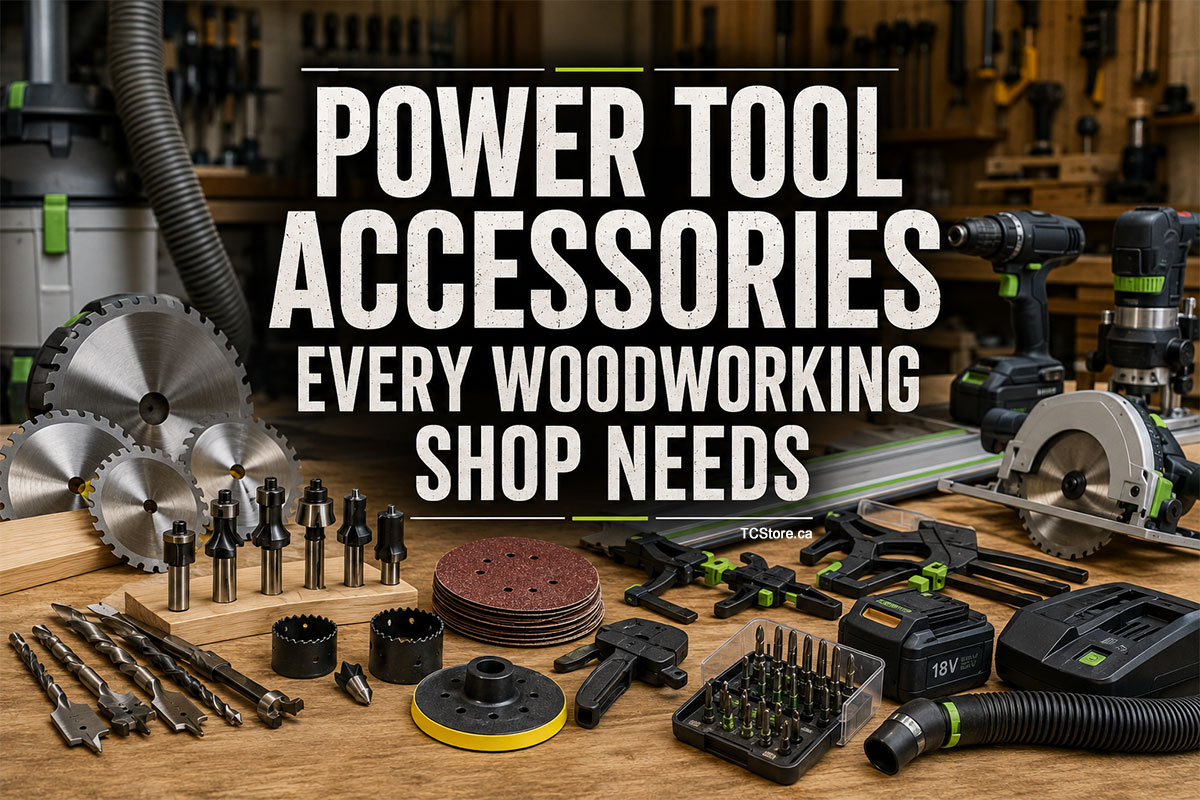
Power Tool Accessories Every Woodworking Shop Needs
Posted by TCStore on 2026 Aug 24th
Power tool accessories improve the accuracy, versatility, safety, and productivity of woodworking tools.
The right blade, router bit, sanding disc, guide rail, drill bit, dust extraction attachment, battery, or work support can make a power tool perform better and complete more applications.
The wrong accessory can create rough cuts, excessive dust, poor finishes, damaged materials, premature tool wear, and unnecessary downtime.
Professional woodworking shops should select accessories according to the power tool, material, production volume, finish requirement, and type of work being completed.
Quick Answer
The most important power tool accessories for woodworking shops include:
✓ Saw blades
✓ Router bits
✓ Drill and boring bits
✓ Sanding discs, sheets, and pads
✓ Guide rails and cutting guides
✓ Dust extraction attachments
✓ Batteries and chargers
✓ Clamps and workholding accessories
✓ Collets, chucks, and toolholders
✓ Driver bits and fastener accessories
✓ Worktables and mobile stands
✓ Storage cases and tool organizers
✓ Replacement filters, hoses, and connectors
✓ Measuring and layout accessories
These accessories support the core equipment discussed in Power Tools Every Professional Woodworking Shop Needs, including track saws, routers, drills, sanders, jigsaws, circular saws, impact drivers, and dust extractors.
Power Tool Accessories Overview
|
Accessory Category |
Common Examples |
Primary Benefit |
|
Cutting accessories |
Saw blades, jigsaw blades, oscillating blades |
Cleaner and faster cuts |
|
Routing accessories |
Router bits, collets, guide bushings |
Profiling, trimming, and joinery |
|
Drilling accessories |
Drill bits, countersinks, hole saws |
Accurate holes and fastening |
|
Sanding accessories |
Discs, sheets, pads, interface pads |
Better surface preparation |
|
Guidance accessories |
Guide rails, fences, edge guides |
Improved cutting accuracy |
|
Dust extraction |
Hoses, adapters, shrouds, filters |
Cleaner work and better visibility |
|
Power accessories |
Batteries, chargers, extension cords |
Reliable tool availability |
|
Workholding |
Clamps, stops, benches, supports |
Safer and more consistent operation |
|
Fastening accessories |
Driver bits, sockets, extensions |
Faster assembly |
|
Storage |
Cases, racks, mobile organizers |
Reduced damage and lost time |
Why Power Tool Accessories Matter
A power tool provides the motor, movement, and control.
The accessory performs the work.
A circular saw is only as effective as the blade installed on it.
A router depends on the correct router bit and collet.
A random orbital sander depends on the abrasive disc, backing pad, and dust extraction arrangement.
A cordless drill depends on suitable bits, batteries, and charging equipment.
Accessories can affect:
- Cutting quality
- Surface finish
- Accuracy
- Tool life
- Material waste
- Production speed
- Operator control
- Dust collection
- Setup time
- Jobsite mobility
Choosing the tool and ignoring the accessory is a common buying mistake.
The TCStore guide to Choosing the Right Power Tools for Woodworking Production also emphasizes that blades, bits, sanding products, batteries, chargers, guide rails, and dust extraction components all influence tool performance.
Saw Blades
Saw blades are among the most important accessories in a woodworking shop.
They are used with:
- Circular saws
- Track saws
- Mitre saws
- Table saws
- Portable jobsite saws
Blade selection should consider:
- Blade diameter
- Arbor size
- Tooth count
- Tooth geometry
- Kerf width
- Maximum RPM
- Material type
- Cutting direction
- Required finish
A ripping blade is designed to cut efficiently along the wood grain.
A crosscut blade uses more teeth to create a cleaner cut across the grain.
Combination blades support general-purpose work.
Specialized blades are available for plywood, melamine, laminates, aluminium, and other materials.
The article Essential Saw Blades for Woodworking Machinery provides additional guidance on matching blade construction and tooth geometry to the cutting application.
Router Bits and Routing Accessories
Routers are among the most versatile power tools in woodworking.
Their performance depends heavily on the bit installed.
Common router bits include:
- Straight bits
- Flush-trim bits
- Rabbeting bits
- Round-over bits
- Chamfer bits
- Cove bits
- Dovetail bits
- Pattern bits
- Spiral bits
- Mortising bits
- Slot-cutting bits
- Edge-forming bits
Professional shops should also consider router accessories such as:
- Collets
- Edge guides
- Guide bushings
- Template guides
- Router tables
- Dust extraction hoods
- Bit storage systems
The router bit should match the material, required profile, cutting depth, feed direction, and router speed.
A damaged or incorrectly installed bit can create vibration, poor finishes, and unsafe operating conditions.
Drill Bits, Countersinks, and Hole Saws
Cordless and corded drills require different accessories for different materials and hole types.
A basic drilling inventory may include:
✓ Brad-point bits for accurate wood drilling
✓ Twist bits for general drilling
✓ Forstner bits for clean, flat-bottomed holes
✓ Spade bits for fast larger holes
✓ Hole saws for large openings
✓ Countersinks for flush fasteners
✓ Self-centering bits for hardware installation
✓ Step bits for selected materials
✓ Driver bits for screws and fasteners
Bits should be kept sharp, clean, and protected from impact.
A dull drill bit increases heat and requires more force.
That can reduce hole quality, shorten battery runtime, and place additional load on the drill.
Sanding Discs, Sheets, and Backing Pads
The sander is only one part of the sanding system.
The abrasive determines how quickly material is removed and what finish remains.
Common power sanding accessories include:
- Random orbital sanding discs
- Hook-and-loop discs
- Pressure-sensitive adhesive discs
- Sanding sheets
- Detail-sander triangles
- Interface pads
- Backing pads
- Polishing pads
- Dust extraction pads
- Abrasive sponges
Grit selection should follow the production stage.
Lower grits remove material more aggressively.
Higher grits refine the surface before finishing.
Skipping too many grit steps can leave deep scratches that remain visible after coating.
The guide to Choosing the Right Sanding Supplies for Your Shop explains how belts, discs, sheets, rolls, sponge abrasives, and specialty finishing products affect surface quality and labour efficiency.
Guide Rails, Fences, and Cutting Guides
Guide systems improve the accuracy of portable cutting tools.
They are especially valuable for track saws, circular saws, routers, and drilling tools.
Useful guidance accessories include:
- Track-saw rails
- Rail connectors
- Anti-splinter strips
- Parallel guides
- Angle guides
- Router edge guides
- Rip fences
- Crosscut guides
- Drilling templates
Guide rails help create straight, repeatable cuts without moving large panels to stationary machinery.
This can reduce material handling and support jobsite adjustments.
Guide systems should remain clean, straight, and free of damage.
Worn anti-splinter strips and dirty rail surfaces should be serviced or replaced when accuracy declines.
Dust Extraction Accessories
Portable power tools create dust directly beside the operator and the workpiece.
Dust extraction accessories help capture that material at the source.
Common accessories include:
- Dust extraction hoses
- Hose adapters
- Tool-specific dust ports
- Shrouds
- Extraction hoods
- Hose sleeves
- Pre-separators
- Replacement filters
- Collection bags
- Anti-static hoses
- Hose connectors
A dust extractor performs best when the hose diameter, adapter, filter, and tool port are compatible.
Loose connections and undersized adapters can reduce airflow.
Dust control supports cleaner work surfaces, improved visibility, better finish quality, and reduced dust entering power-tool motors and controls.
TCStore’s article on Why Dust Collection Systems Are Critical for Woodworking Shops explains how dust management affects machinery, maintenance, product quality, and shop efficiency.
Batteries and Chargers
Cordless tools depend on reliable battery management.
A professional shop should avoid relying on one battery for several critical tools.
Consider maintaining:
- Standard-capacity batteries
- High-capacity batteries
- Rapid chargers
- Multi-battery chargers
- Backup batteries
- Battery storage cases
- Battery adapters approved by the manufacturer
Before standardizing a cordless platform, compare:
- Tool availability
- Battery sizes
- Charging speed
- Runtime
- Replacement cost
- Warranty
- Future product compatibility
Using fewer battery platforms can simplify charging, inventory, and replacement.
Batteries should be protected from moisture, impact, excessive heat, and unsuitable charging conditions.
Clamps and Workholding Accessories
A sharp blade or powerful router cannot produce accurate work if the material moves.
Workholding accessories include:
- Track-saw clamps
- Quick clamps
- Trigger clamps
- Bench clamps
- Corner clamps
- Edge clamps
- Vacuum clamping accessories
- Bench dogs
- Stops
- Support stands
Clamps should secure the workpiece without damaging finished surfaces.
The correct workholding arrangement improves accuracy and allows operators to maintain better control of the tool.
Improvised workholding may save a few seconds during setup but create much larger problems during cutting, routing, sanding, or assembly.
Collets, Chucks, and Toolholders
Collets and chucks connect accessories to power tools.
They should be inspected for:
- Wear
- Corrosion
- Dust buildup
- Resin
- Burrs
- Cracks
- Reduced clamping force
- Excessive runout
A worn router collet can cause vibration and uneven bit wear.
A damaged drill chuck may fail to hold bits securely.
These components should be cleaned and replaced when they no longer maintain dependable tool retention.
Driver Bits and Fastening Accessories
Impact drivers and drills are used heavily for assembly, installation, hardware, and maintenance.
Useful fastening accessories include:
- Phillips bits
- Robertson bits
- Torx bits
- Hex bits
- Nut drivers
- Socket adapters
- Bit holders
- Magnetic extensions
- Right-angle attachments
- Depth stops
Driver bits are consumable.
Worn tips can strip fasteners, damage finished surfaces, and slow assembly.
Frequently used profiles and sizes should be stocked in sufficient quantities.
Worktables, Stands, and Material Supports
Portable tools become more effective when paired with stable work surfaces.
Useful accessories include:
- Folding worktables
- Mobile workbenches
- Mitre-saw stands
- Roller supports
- Outfeed supports
- Sawhorses
- Extension wings
- Tool mounting plates
- Mobile bases
These accessories can reduce setup time and improve material control.
A mobile worktable can also move tools closer to the job instead of requiring every component to return to a fixed workstation.
Storage Cases and Organizers
Power tool accessories are easy to lose or damage.
Small bits, blades, adapters, batteries, and fasteners should be organized by tool and application.
Effective storage options include:
- Original tool cases
- Stackable storage systems
- Drawer organizers
- Wall-mounted racks
- Mobile carts
- Blade cases
- Bit cases
- Foam-lined trays
- Labelled bins
Storage protects cutting edges and helps operators find the correct accessory quickly.
A shop that owns the correct accessory but cannot locate it still loses production time.
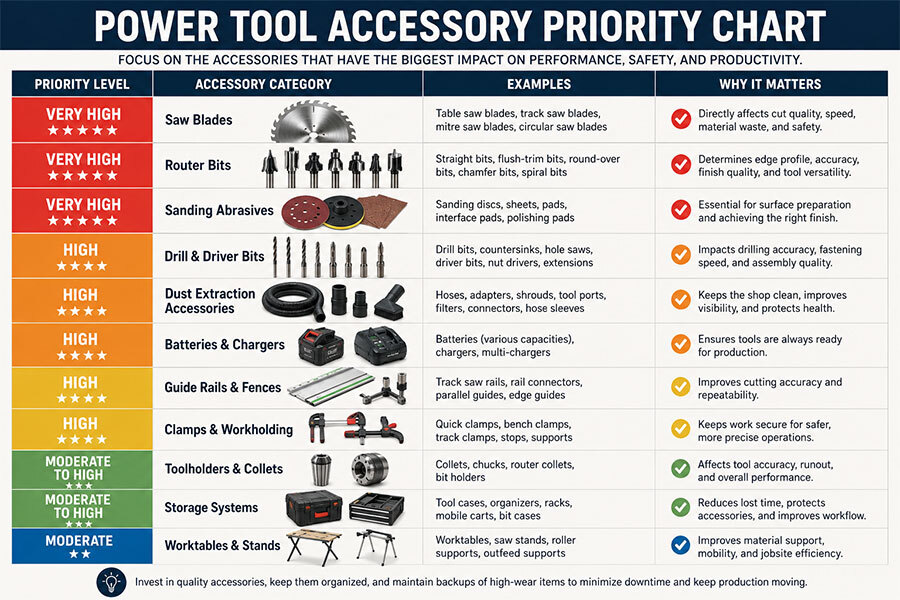
Power Tool Accessory Priority Chart
|
Accessory |
Production Importance |
|
Saw blades |
Very high |
|
Router bits |
Very high |
|
Sanding abrasives |
Very high |
|
Drill and driver bits |
High |
|
Dust extraction accessories |
High |
|
Batteries and chargers |
High |
|
Guide rails and fences |
High |
|
Clamps and workholding |
High |
|
Toolholders and collets |
High |
|
Storage systems |
Moderate to high |
|
Worktables and stands |
Moderate to high |
|
Specialty attachments |
Application dependent |
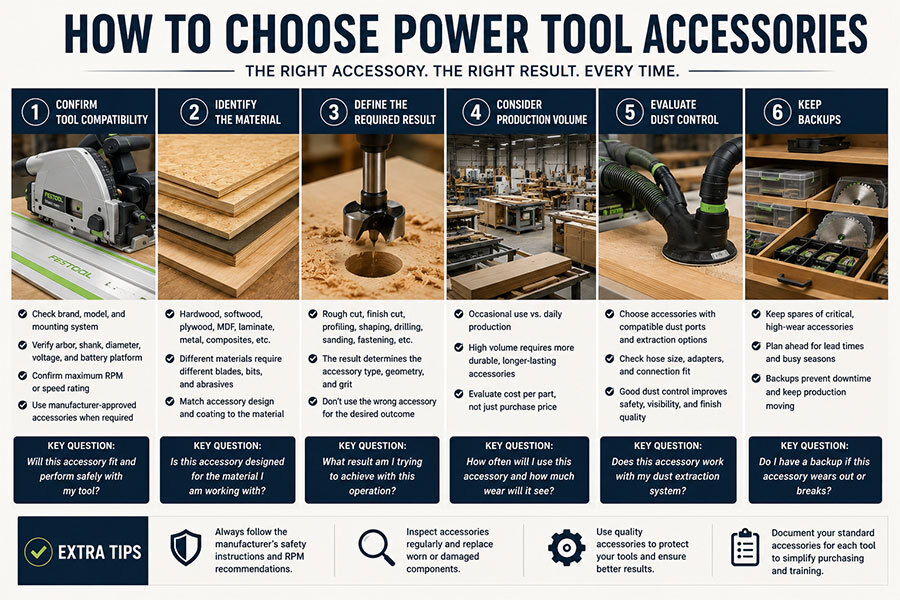
How to Choose Power Tool Accessories
Use the following process:
1. Confirm Tool Compatibility
Check the brand, model, mounting system, arbor, shank, diameter, voltage, battery platform, and maximum operating speed.
2. Identify the Material
Accessories for hardwood, softwood, MDF, melamine, laminate, metal, and composite materials may require different geometries or abrasive types.
3. Define the Required Result
A rough cut, finish cut, drilled hole, profiled edge, prepared surface, and installed fastener each require a different accessory.
4. Consider Production Volume
Occasional work may not justify the same accessory as daily production.
High-use accessories should prioritize durability, replacement availability, and cost per completed part.
5. Evaluate Dust Control
Choose accessories with compatible extraction ports, perforation patterns, hoses, and adapters where possible.
6. Keep Backups
Frequently used blades, bits, discs, batteries, filters, and adapters should be available before the active accessory fails.
This inventory approach supports the same downtime-reduction principles described in How to Reduce Downtime With Better Woodworking Tooling.
Common Power Tool Accessory Mistakes
What Not to Do
X Buying accessories based only on price
X Installing an accessory with the wrong maximum RPM
X Using dull blades or bits
X Mixing incompatible battery platforms without a plan
X Ignoring dust extraction compatibility
X Using damaged collets or chucks
X Storing cutting edges loosely in drawers
X Running sanding discs after abrasive performance is gone
X Using the wrong blade for the material
X Operating without secure workholding
X Waiting for the only accessory to fail before ordering a replacement
Final Thoughts
Power tool accessories determine what woodworking tools can do and how well they do it.
A high-quality power tool paired with the wrong accessory will still produce poor results.
Professional shops should prioritize compatible blades, bits, abrasives, guide systems, dust extraction components, batteries, chargers, clamps, toolholders, work supports, and organized storage.
The best accessories improve quality, reduce setup time, support safer operation, and help power tools complete more work.
TCStore supplies professional power tools, parts, accessories, sanding products, woodworking tooling, dust extraction equipment, storage systems, and replacement supplies for cabinet shops, furniture manufacturers, millwork companies, installers, and woodworking professionals.
Frequently Asked Questions
What are the most important power tool accessories for woodworking?
The most important accessories include saw blades, router bits, drill bits, sanding abrasives, guide rails, dust extraction attachments, batteries, chargers, clamps, collets, driver bits, and storage systems.
Do professional power tools require brand-specific accessories?
Some accessories are universal, while batteries, chargers, guide rails, dust ports, toolholders, and mounting systems may be brand- or model-specific. Always confirm compatibility before purchasing.
How many spare power tool accessories should a shop keep?
Keep at least one backup for critical accessories that wear frequently or can stop production. High-volume shops may require several spare blades, bits, abrasive packs, batteries, filters, and adapters.
Are premium saw blades and router bits worth the cost?
Premium accessories can provide better cut quality, longer service life, improved consistency, and more sharpening potential. Their value should be judged by cost per completed part rather than purchase price alone.
Why is dust extraction important for portable power tools?
Dust extraction captures particles close to the cutting or sanding source. It supports cleaner work areas, better visibility, improved finish quality, and reduced dust entering tools and surrounding equipment.