

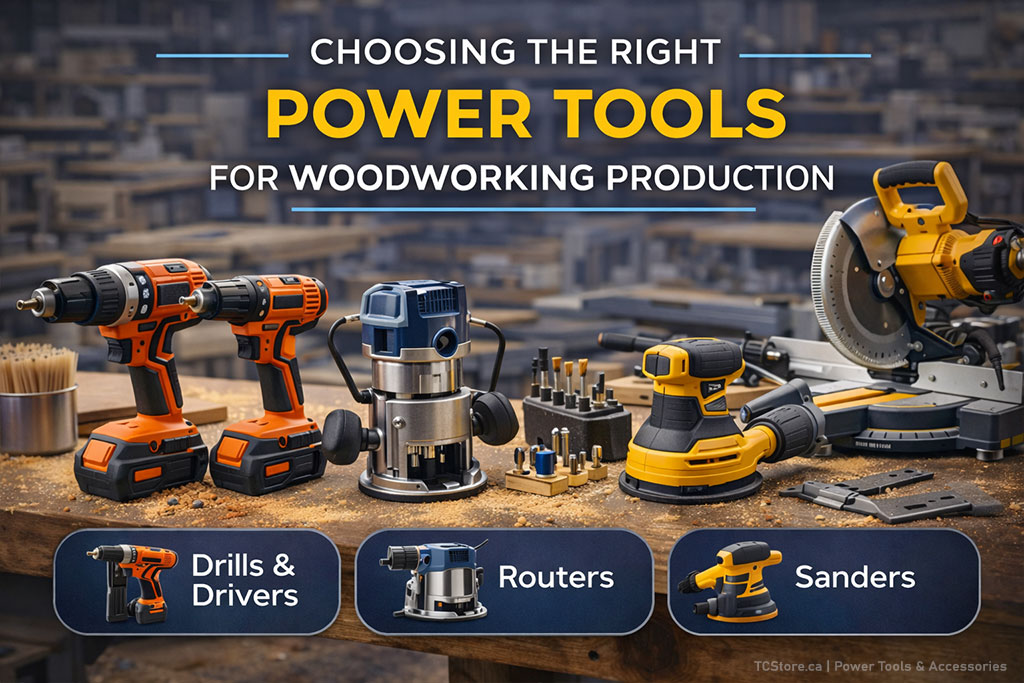
Choosing the Right Power Tools for Woodworking Production
Posted by TCStore on 2026 Apr 27th
Power tools are a core part of efficient woodworking production. While large machinery handles major cutting, routing, and shaping tasks, the right power tools support precision work, finishing, assembly, adjustments, and day-to-day productivity across the shop floor. In many woodworking environments, the difference between a slow workflow and an efficient one often comes down to having the right tools in the hands of the team.
Whether your business focuses on cabinetry, furniture, millwork, store fixtures, or custom wood products, selecting the right power tools can improve quality, reduce labor time, and help maintain consistent production standards.
Why Power Tools Matter in Woodworking Production
In woodworking production, not every task is handled by a large machine. Teams still rely on portable and bench-style power tools for trimming, drilling, fastening, sanding, cutting, fitting, and on-site adjustments. These tools help bridge the gap between automated production and hands-on finishing work.
The right power tools accessories help woodworking shops:
- Improve speed and efficiency
- Increase precision during finishing and assembly
- Reduce operator fatigue
- Maintain cleaner, more consistent results
- Support both production and installation work
- Handle detail work that larger machines cannot manage
When chosen carefully, power tools become an important part of a smooth and reliable production process.
Start with the Type of Work You Do
Before selecting power tools, it is important to look at your actual workflow. A cabinet shop may need different tools than a millwork business or custom furniture manufacturer. Some shops rely heavily on drilling and fastening tools, while others need more focus on sanding, trimming, and precision cutting.
A few good questions to ask include:
- What tasks are repeated most often in production?
- Which tools are used daily versus occasionally?
- Where are bottlenecks happening right now?
- Do operators need cordless flexibility or corded power?
- Are the tools being used in-shop, on-site, or both?
Understanding how your team works each day will help you choose power tools that actually improve production rather than just add more equipment.
Essential Power Tools for Woodworking Production
There are several categories of power tools that are especially important in woodworking environments.
Drills and Drivers
Drills and impact drivers are essential for assembly, hardware installation, pilot holes, and fastening tasks. In cabinet and furniture production, these tools are used constantly.
Look for features such as:
- Strong battery life for cordless models
- Comfortable grip and balanced design
- Multiple speed settings
- Durable chuck and gearbox construction
- Consistent torque output
Reliable drills and drivers help reduce downtime and improve assembly speed.
Routers and Trim Routers
Routers are among the most versatile power tools in woodworking. They are commonly used for trimming laminate, shaping edges, cutting grooves, and detail work that supports larger production processes.
Trim routers are especially useful for:
- Flush trimming edgebanding
- Softening edges
- Light profiling
- On-site touch-ups
For production environments, accuracy and ease of control are critical when choosing routing tools.
Sanders
Sanding is one of the most important finishing stages in woodworking production. Good sanders improve surface quality, reduce manual labor, and help create a more professional end result.
Common sanding tools include:
- Random orbital sanders
- Belt sanders
- Detail sanders
- Finishing sanders
The right power tools in this category should provide smooth performance, strong dust collection, and comfortable handling for extended use.
Circular Saws and Track Saws
These cutting tools are valuable for breaking down panels, making accurate field cuts, and handling situations where full-size machinery is not practical.
Track saws are particularly useful because they offer:
- Straight, precise cuts
- Better control on large panels
- Cleaner finishes
- Reduced need for secondary trimming
In many production shops, these power tools improve flexibility and support custom or overflow tasks.
Jigsaws and Reciprocating Saws
While not used for every job, these tools are useful for specialty cuts, curves, cutouts, and quick modifications. Shops that handle custom work often benefit from having these power tools available when needed.
Nailers and Staplers
For assembly, upholstery support, backing panels, trim, and packaging tasks, pneumatic or cordless nailers and staplers can greatly improve speed. These tools are especially valuable in higher-volume production environments where repetitive fastening is common.
Cordless vs Corded Power Tools
One of the biggest decisions when choosing power tools is whether to go cordless, corded, or a mix of both.
Cordless Power Tools
Cordless models offer:
- Better mobility
- Easier handling
- Cleaner work areas with fewer cords
- Greater flexibility for installation or job site work
They are ideal for drills, drivers, trim routers, and many portable tools used throughout the day.
Corded Power Tools
Corded options offer:
- Continuous power
- Strong performance for demanding applications
- No battery downtime
- Reliable use for longer tasks
They are often preferred for tools like heavier routers, sanders, and saws that are used for extended periods.
Many woodworking businesses benefit from using both types of power tools depending on the task.
Durability and Ergonomics Matter
In production environments, tools are used frequently and sometimes aggressively. Low-quality power tools may cost less upfront, but they often wear out faster, perform inconsistently, and create frustration for operators.
When evaluating tools, consider:
- Build quality
- Motor performance
- Weight and balance
- Grip comfort
- Ease of bit or blade changes
- Dust collection compatibility
- Serviceability and replacement part access
Ergonomic design is especially important. A more comfortable tool can improve control, reduce fatigue, and help workers maintain accuracy through long shifts.
Support Tools, Accessories, and Supplies
Choosing the right power tools also means choosing the right supporting accessories. Blades, sanding discs, bits, batteries, chargers, guide rails, and dust extraction components all affect performance.
Important accessories may include:
- Router bits
- Drill bits
- Saw blades
- Sanding abrasives
- Batteries and chargers
- Dust collection attachments
- Storage and transport cases
A good tool performs best when paired with quality accessories and proper maintenance.
Choosing a Reliable Supplier
The best power tools are not only about brand or specs. They are also about support. A trusted supplier can help you select the right tools, recommend the right accessories, and ensure you have access to replacement parts and consumables when needed.
A good supplier should offer:
- Quality tool brands
- Accessories and consumables
- Expert product guidance
- Replacement parts
- Ongoing support for production needs
This becomes especially important for woodworking shops that depend on reliable equipment every day.
Final Thoughts
Choosing the right power tools for woodworking production is about more than convenience. It is about improving workflow, supporting accuracy, reducing downtime, and helping your team work more efficiently. From drills and routers to sanders and saws, each tool plays a role in creating a more productive shop.
By investing in durable, well-matched power tools and the right accessories, woodworking businesses can improve output, maintain quality, and support long-term growth.
Frequently Asked Questions About Power Tools
1. What are the most important power tools for woodworking production?
The most important power tools for woodworking production often include drills, impact drivers, routers, sanders, circular saws, and nailers. The exact mix depends on the type of products your shop produces.
2. Are cordless power tools good for woodworking shops?
Yes, cordless power tools are very useful in woodworking shops because they improve mobility and reduce cord clutter. They are especially helpful for assembly, installation, and general day-to-day production tasks.
3. How do power tools improve woodworking production?
Power tools improve woodworking production by speeding up cutting, fastening, sanding, trimming, and assembly work. They help reduce manual labor while improving consistency and efficiency.
4. What should I look for when buying power tools?
When buying power tools, look for durability, ergonomic design, performance, dust collection compatibility, and access to replacement parts and accessories. The right tool should fit both the task and the production environment.
5. Do woodworking shops need both corded and cordless power tools?
Yes, many woodworking shops benefit from having both corded and cordless power tools. Cordless tools offer flexibility, while corded tools often provide more consistent power for longer or heavier-duty applications.