


How to Choose Industrial Dust Collection Filters
Posted by TCStore on 2026 Aug 19th
Industrial dust collection filters should be selected according to the dust collector model, airflow requirements, particle size, dust volume, filter surface area, cleaning method, and the type of woodworking machinery connected to the system.
The filter is not simply a bag or cartridge that traps dust.
It is a critical part of the complete dust collection system.
An incorrectly sized, poorly matched, or overloaded filter can restrict airflow, reduce suction at woodworking machines, increase motor strain, release fine dust, and create unnecessary maintenance.
The right industrial dust collector filter supports consistent airflow, cleaner machinery, better shop conditions, and more reliable production.
Quick Answer
When choosing an industrial dust collection filter, evaluate:
✓ Dust collector make and model
✓ Manufacturer filter specifications
✓ Required airflow capacity
✓ Type and size of dust particles
✓ Filter efficiency or micron rating
✓ Filter surface area
✓ Expected dust loading
✓ Initial and operating pressure drop
✓ Filter-cleaning method
✓ Whether filtered air returns to the shop
✓ Replacement availability and lead time
✓ Installation dimensions and connection style
Never choose a replacement filter based only on its physical size or purchase price.
The filter must be compatible with the collector and the dust-producing application.
Industrial Dust Collection Filter Overview
|
Selection Factor |
What to Check |
Why It Matters |
|
Collector compatibility |
Model, dimensions, mounting and seals |
Prevents installation and air-leak problems |
|
Particle size |
Chips, sawdust or fine airborne dust |
Determines filtration requirements |
|
Airflow |
Required system CFM |
Maintains extraction at connected machines |
|
Filter efficiency |
Manufacturer-rated particle capture |
Controls fine dust |
|
Filter area |
Total filtering surface |
Affects dust capacity and airflow |
|
Pressure drop |
Resistance through the filter |
Influences fan and system performance |
|
Cleaning method |
Manual, pulse, shaker or reverse air |
Determines maintenance requirements |
|
Dust loading |
Amount of dust generated |
Affects cleaning and replacement frequency |
|
Filter media |
Fabric, cartridge, pleated or specialty media |
Must suit the application |
|
Replacement supply |
Cost, stock and lead time |
Reduces emergency downtime |
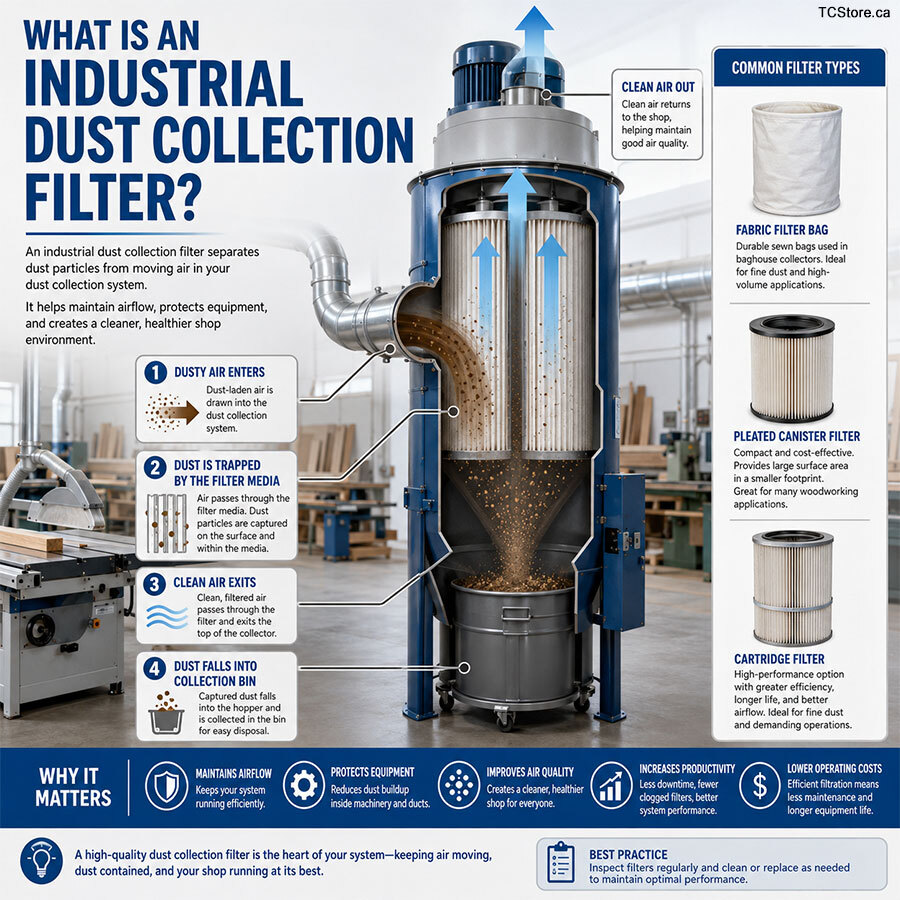
What is an Industrial Dust Collection Filter?
An industrial dust collection filter is the component that separates dust particles from the air moving through a collection system.
Wood chips, sawdust, sanding dust, and fine particles enter the collector through ductwork.
The system separates or filters that material before air is discharged outside or returned to the shop.
Depending on the collector design, filters may include:
- Fabric filter bags
- Pleated canister filters
- Cartridge filters
- Panel filters
- Pocket filters
- Final-stage high-efficiency filters
- Activated carbon filters
- Specialty filter media
Not every filter type is suitable for every collector.
A central baghouse, portable workshop collector, cartridge collector, ambient air cleaner, and portable dust extractor all use different filtration arrangements.
Before comparing filters, confirm that the dust collector itself is properly matched to the shop. The TCStore guide to choosing the right dust collector for your woodworking shop explains how shop size, machinery, ducting, airflow, and future expansion affect the complete system.
Why the Right Dust Collection Filter Matters
The fan creates airflow.
The filter determines how effectively dust is separated from that air without creating excessive resistance.
When the filter is properly selected and maintained, it can help:
✓ Preserve suction at woodworking machinery
✓ Capture fine dust more effectively
✓ Reduce airborne particles
✓ Protect fan and collector components
✓ Reduce dust accumulation on equipment
✓ Support cleaner finished products
✓ Decrease unnecessary cleanup
✓ Maintain more predictable production
When a filter is clogged, damaged, undersized, or poorly matched, extraction performance can decline throughout the shop.
This is one reason dust collection systems are critical for woodworking shops. Dust management affects more than housekeeping. It can influence machinery performance, maintenance requirements, product quality, and production efficiency.
Start With the Dust Collector Manufacturer
The safest starting point is the dust collector’s original documentation.
Record:
- Manufacturer
- Model number
- Serial number
- Filter part number
- Filter dimensions
- Filter media
- Rated airflow
- Cleaning method
- Mounting configuration
- Seal or gasket requirements
Two filters may have similar dimensions but different media, pleat spacing, efficiency, pressure-drop characteristics, or dust capacity.
Installing a filter that physically fits does not guarantee that it will perform correctly.
When the original filter is discontinued, the replacement should be cross-referenced by a knowledgeable supplier or system specialist.
Identify the Dust Being Collected
Different woodworking processes create different types of dust.
A planer or moulder may produce large chips.
A panel saw produces a mixture of chips and sawdust.
A CNC router processing MDF can generate substantial quantities of fine particles.
A wide-belt sander creates very fine dust that can load filters quickly.
Common dust-producing materials include:
- Solid hardwood
- Softwood
- MDF
- Particleboard
- Plywood
- Melamine panels
- Laminated panels
- Veneered products
- Composite materials
- Adhesive-contaminated waste
The filter media must be suitable for the smallest important particles, not merely the most visible debris.
Fine sanding and MDF dust generally place greater demands on filtration than large planer chips.
Understand Micron Ratings and Filter Efficiency
A micron is one-millionth of a metre.
Dust collector filters are often described by the particle sizes they are designed to capture.
However, a micron number alone does not provide the complete picture.
Two filters with the same stated micron rating may perform differently because of:
- Filter media construction
- Testing method
- Efficiency percentage
- Particle-size range
- Airflow
- Dust loading
- Seal quality
- Collector design
Ask for the filter’s documented efficiency and the conditions under which it was rated.
Avoid assuming that a lower micron number automatically makes a filter better for every application.
A denser filter may capture smaller particles but can also create more resistance if the fan and collector were not designed for it.
Airflow and Pressure Drop
Airflow is essential to dust collection performance.
The collector must move enough air through the machine hood, ductwork, separator, and filter.
Every component creates resistance.
The resistance created by a filter is commonly described as pressure drop.
As dust accumulates on the filter, pressure drop generally increases.
Excessive resistance can lead to:
- Weak suction at machinery
- Dust remaining inside machine enclosures
- Increased airborne dust
- Higher fan load
- Longer cleanup time
- Poor chip transport
- Clogged ducts or hoses
The replacement filter should operate within the pressure range expected by the collector.
A filter with inadequate surface area may load rapidly and restrict airflow even when its particle-capture rating appears suitable.
Filter Surface Area and Dust Loading
Filter surface area determines how much media is available for air to pass through.
Pleated filters create a large surface area within a compact space.
More filter area can provide:
✓ Lower air velocity through the media
✓ Greater dust-holding capacity
✓ More stable airflow
✓ Longer intervals between cleaning
✓ Potentially longer filter life
However, pleats must be spaced appropriately.
Very tightly packed pleats can trap dust between them and become difficult to clean in heavy woodworking applications.
Dust loading should be evaluated according to:
- Number of connected machines
- Hours of operation
- Dust volume
- Particle size
- Production schedule
- Filter-cleaning frequency
- Presence of a cyclone or pre-separator
A pre-separator that removes larger chips before they reach the filter can reduce filter loading substantially.

Common Types of Dust Collection Filters
Dust Collection Filter Comparison
|
Filter Type |
Common Application |
Main Advantages |
Main Considerations |
|
Fabric filter bag |
Traditional workshop collectors |
Simple and economical |
Fine-particle performance varies |
|
Pleated canister filter |
Mobile and workshop collectors |
Large surface area in compact form |
Pleats require effective cleaning |
|
Cartridge filter |
Industrial cartridge collectors |
High filter area and efficient dust capture |
Must match collector and cleaning system |
|
Panel filter |
Ambient air cleaners |
Easy staged replacement |
Not a replacement for source collection |
|
Pocket filter |
Industrial air-cleaning systems |
High dust-holding capacity |
Usually part of a staged system |
|
High-efficiency final filter |
Specialized systems and extractors |
Captures very fine particles |
Can create significant resistance |
|
Activated carbon filter |
Odour or vapour control |
Helps control certain gases and odours |
Does not replace a particulate filter |
Fabric Filter Bags
Fabric bags are common on traditional woodworking dust collectors.
They allow air to pass through while retaining sawdust and particles.
Advantages may include:
- Simple construction
- Lower initial cost
- Easy visual inspection
- Wide availability
The filtration performance depends heavily on the fabric and media rating.
A basic woven bag may capture larger dust effectively while allowing more fine particles to pass than a higher-efficiency filter.
Bags must also remain free of holes, failed seams, and poor seals.
Pleated Canister Filters
Canister filters use pleated media to create more filtration area than a basic bag within a similar footprint.
They are common on workshop dust collectors.
Benefits may include:
✓ Greater filter area
✓ Better fine-dust capture
✓ Compact installation
✓ Improved airflow when clean
Many canister filters include a manual cleaning mechanism that dislodges dust from the pleats.
The cleaning system must be used regularly.
Dust packed deeply between pleats can become difficult to remove and may shorten usable filter life.
Cartridge Filters
Cartridge filters are used in many industrial dust collectors.
They may be arranged vertically, horizontally, or in banks inside the collector.
Cartridges can be designed for automatic pulse cleaning or other cleaning systems.
Selection factors include:
- Cartridge dimensions
- Media type
- Pleat design
- Filter area
- Temperature limits
- Moisture resistance
- Cleaning compatibility
- Dust characteristics
- Seal configuration
Never substitute a cartridge solely because it fits the collector housing.
Panel and Pocket Filters
Panel and pocket filters are often used in ambient air-cleaning equipment rather than primary source-collection systems.
They can form part of a staged filtration arrangement.
For example, a system may use:
- A pre-filter for larger particles
- A secondary filter for finer dust
- A final filter or carbon stage
Source collection captures dust where it is produced.
Ambient filtration helps remove particles that remain suspended in the shop.
The TCStore article on how air filtration improves shop safety and equipment life explains how these two systems perform different but complementary roles.
Activated Carbon Filters
Activated carbon is designed primarily to adsorb certain odours, gases, and vapours.
It is not a substitute for an appropriate particulate filter.
Carbon filters may be used in staged air-cleaning systems where odour control is required.
Their useful life is not always determined by visible dirt.
Replacement may depend on:
- Operating time
- Contaminant concentration
- Carbon weight
- Odour breakthrough
- Manufacturer instructions
TCStore’s guide on when it is time to replace ICA air filters provides an example of how staged pre-filters, carbon filters, and final filters can have different replacement schedules.
Cleanable vs Disposable Filters
|
Factor |
Cleanable Filter |
Disposable Filter |
|
Initial cost |
Often higher |
Often lower |
|
Maintenance |
Requires regular cleaning |
Replaced when loaded |
|
Downtime |
Cleaning time required |
Fast replacement if stocked |
|
Service life |
Can be extended through cleaning |
Limited to one service cycle |
|
Consistency |
Depends on cleaning quality |
New media restores expected condition |
|
Best application |
Systems designed for filter cleaning |
Staged air cleaners and selected collectors |
A filter should only be cleaned using a method approved for that filter.
Aggressive compressed air, high-pressure washing, brushing, or impact can damage media and seals.
Some filters are designed for pulse cleaning.
Others are not cleanable and must be replaced.
Signs a Dust Collection Filter Needs Attention
Inspect the filter when the system shows:
✓ Reduced suction
✓ Higher pressure-drop readings
✓ Increased airborne dust
✓ Dust escaping from the collector
✓ Longer machine cleanup times
✓ More dust remaining in machine cabinets
✓ Frequent duct or hose blockages
✓ Visible holes or damaged seals
✓ Excessive fan or motor strain
✓ Filter media that no longer cleans effectively
These symptoms do not always prove that the filter is the only problem.
Weak suction may also result from:
- Air leaks
- Damaged hoses
- Closed or blocked blast gates
- Clogged ductwork
- Worn belts
- Impeller damage
- Incorrect system balancing
Troubleshoot the complete system before replacing parts unnecessarily.
Keep Replacement Filters in Stock
Filters are production components.
Waiting until a filter fails can create avoidable downtime.
For critical collectors, consider stocking at least one compatible replacement set.
The TCStore guide to dust collector parts every shop should stock also recommends maintaining inventory of collection bags, flexible hose, blast gates, clamps, belts, fittings, gaskets, and seals.
Record the following information in the spare-parts system:
- Filter part number
- Compatible collector
- Quantity required per change
- Supplier
- Lead time
- Last replacement date
- Typical service interval
- Storage location
Filters should be stored clean, dry, and protected from impact or deformation.
Filter Selection Decision Table
|
Shop Condition |
Filter Priority |
|
Large chips from planers or moulders |
Strong pre-separation and durable media |
|
Fine MDF or sanding dust |
High-efficiency media with adequate surface area |
|
Multiple machines operating together |
High airflow capacity and low operating resistance |
|
Air returned to the shop |
Verified filtration and system compliance |
|
High dust volume |
Large filter area and effective cleaning |
|
Limited maintenance labour |
Easy-access filter with practical servicing |
|
Long replacement lead time |
Stock a complete backup set |
|
Frequent shop expansion |
Scalable collector and available filter supply |
Common Filter Buying Mistakes
What Not to Do
X Choosing a filter only by physical dimensions
X Buying solely on the lowest price
X Ignoring pressure drop
X Installing denser media without checking fan capacity
X Assuming all one-micron filters perform identically
X Using an ambient air filter as machine source collection
X Cleaning disposable filters
X Operating damaged filter media
X Ignoring failed gaskets and seals
X Waiting until airflow collapses before maintenance
X Modifying filtration without reviewing system safety
Wood dust can present serious fire and combustible-dust hazards.
Filter and collector modifications should be reviewed by qualified professionals and must comply with manufacturer requirements and applicable codes.
Evaluate Total Operating Cost
The cheapest filter is not always the lowest-cost filter.
Consider:
- Purchase price
- Expected service life
- Cleaning labour
- Replacement frequency
- Energy consumption
- Production interruptions
- Shipping costs
- Disposal requirements
- Effect on machine extraction
- Availability of future replacements
A higher-quality filter may provide better value when it maintains airflow longer, cleans more effectively, and reduces emergency downtime.
The goal is not to buy the least expensive filter.
The goal is to maintain reliable filtration at the lowest practical operating cost.
Final Thoughts
Choosing an industrial dust collection filter requires more than matching dimensions.
The filter must work with the collector, fan, cleaning system, ductwork, machinery, and type of dust being produced.
Start with the dust collector manufacturer’s specifications.
Then evaluate particle size, airflow, pressure drop, filter area, cleaning method, dust loading, replacement supply, and whether air is returned to the shop.
A well-selected filter supports cleaner air, stronger extraction, more reliable machinery, and consistent production.
A poorly selected filter can restrict the entire system.
TCStore supplies dust collection equipment, filters, hoses, fittings, collection accessories, replacement parts, and shop air-filtration products for professional woodworking operations.
Frequently Asked Questions
What micron rating is best for a woodworking dust collector?
The appropriate micron rating depends on the collector, airflow, dust type, and system design. Fine MDF and sanding dust may require higher-efficiency filtration than large wood chips. Use the collector manufacturer’s approved specifications rather than selecting by micron rating alone.
Are dust collector filters washable?
Some industrial filters are designed for cleaning, while others are disposable. Never wash or clean a filter unless the manufacturer specifically approves that method.
How often should an industrial dust collector filter be replaced?
Replacement frequency depends on production volume, dust loading, filter type, cleaning effectiveness, pressure drop, and operating hours. Reduced airflow or damaged media can indicate that service is required.
Is a canister filter better than a filter bag?
A pleated canister filter often provides more filter area and improved fine-particle capture compared with a basic fabric bag. However, it must be compatible with the collector and cleaned correctly.
Should a woodworking shop keep spare dust collector filters?
Yes. Shops that depend on dust collection for critical machinery should keep compatible replacement filters available, particularly when supplier lead times could interrupt production.