

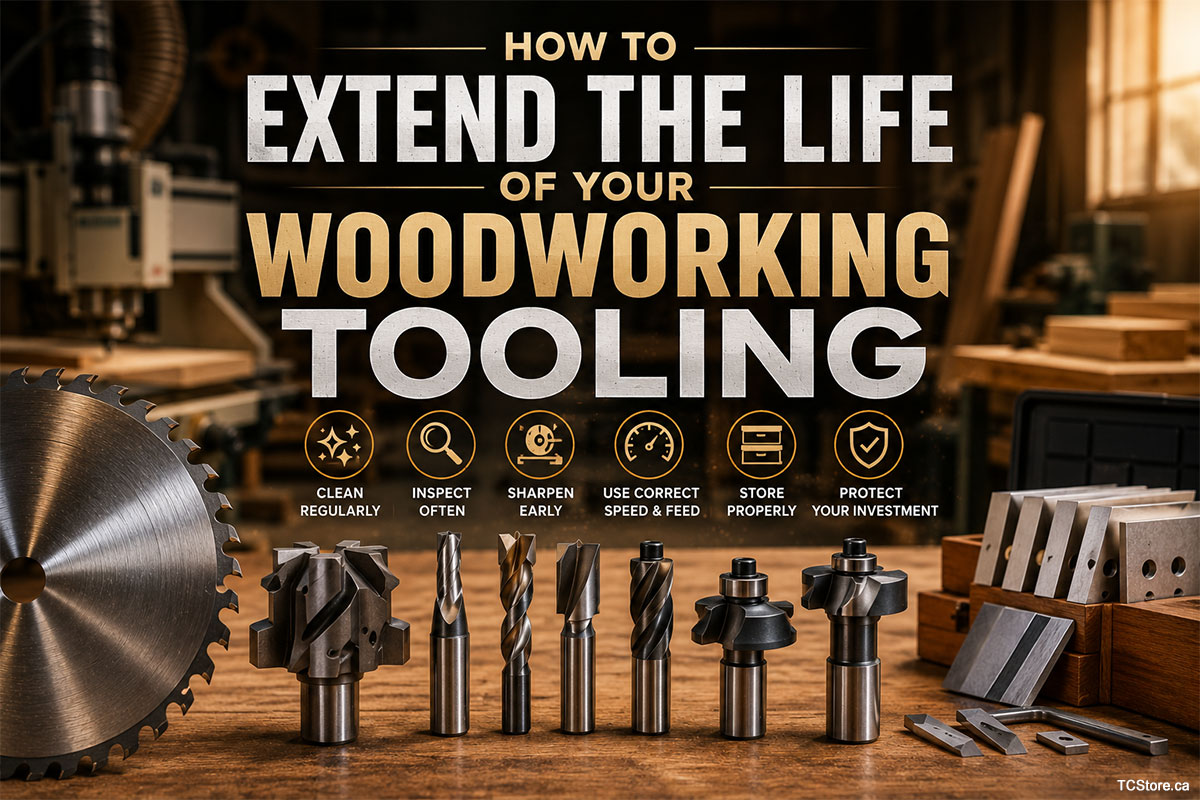
How to Extend the Life of Your Woodworking Tooling
Posted by TCStore on 2026 Aug 3rd
Woodworking tooling lasts longer when it is kept clean, sharpened before severe wear develops, operated at the correct speeds and feed rates, and stored in a way that protects cutting edges from moisture and impact.
Saw blades, router bits, drill bits, knives, inserts, and shaper cutters are exposed to heat, friction, resin, abrasive materials, and repeated cutting forces.
Without proper care, even high-quality tooling can become dull, damaged, or unreliable earlier than expected.
A consistent maintenance routine helps woodworking shops improve cut quality, reduce replacement costs, prevent unexpected downtime, and get more production from every tool.
Quick Answer
To extend the life of woodworking tooling:
✓ Clean resin, pitch, adhesive, and dust from cutting surfaces
✓ Inspect tooling before and after production
✓ Sharpen tools before they become severely dull
✓ Use the correct spindle speed and feed rate
✓ Match tooling to the material and application
✓ Prevent overheating during cutting
✓ Check toolholders, collets, and machine alignment
✓ Store tooling in protective racks, cases, or sleeves
✓ Rotate frequently used tools instead of running one to failure
✓ Replace cracked, severely chipped, or unsafe tooling immediately
Proper tooling care improves both tool life and the performance of the woodworking machinery using it.
Woodworking Tooling Maintenance Overview
|
Maintenance Area |
What to Do |
Why It Matters |
|
Cleaning |
Remove pitch, resin, adhesive, and dust |
Prevents heat and cutting resistance |
|
Inspection |
Check edges, teeth, bodies, and shanks |
Finds damage before failure |
|
Sharpening |
Service tools before severe dulling |
Preserves usable tool material |
|
Machine setup |
Verify alignment, speed, and feed |
Reduces uneven wear |
|
Toolholding |
Clean and inspect collets and holders |
Controls vibration and runout |
|
Storage |
Protect edges from moisture and impact |
Prevents corrosion and chipping |
|
Tracking |
Record hours, materials, and sharpening |
Improves replacement planning |
|
Material selection |
Use the correct tool for the workpiece |
Prevents premature wear |
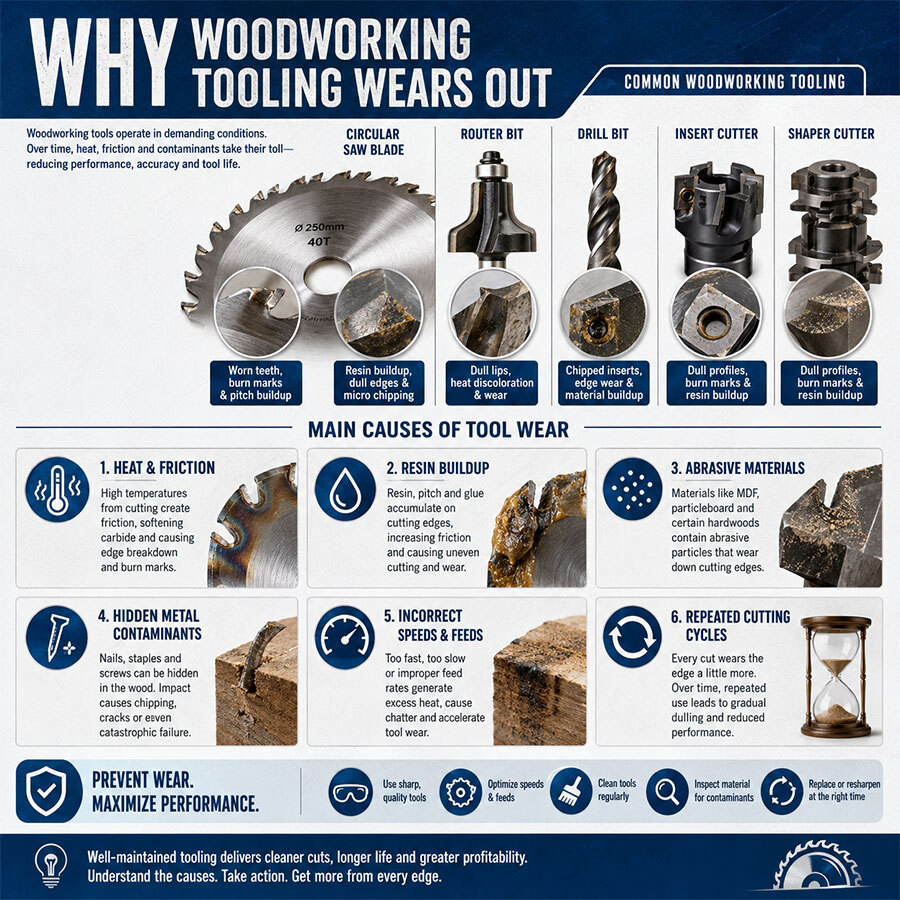
Why Woodworking Tooling Wears Out
Every cutting operation places mechanical and thermal stress on a tool.
As the cutting edge contacts wood or engineered panels, friction gradually rounds the edge and changes its geometry.
Tool wear can accelerate when processing:
- MDF
- Particleboard
- Plywood
- Laminated panels
- Melamine
- Hardwood
- Reclaimed lumber
- Abrasive composite materials
- Panels containing adhesive or mineral content
Engineered wood products can be especially demanding because their adhesives and compressed fibres may be more abrasive than natural wood.
Contaminants such as dirt, sand, staples, nails, and hidden fasteners can also damage tooling instantly.
Tool life is influenced by the tool material, cutting geometry, machine condition, production speed, workpiece material, cooling, cleaning, and operator setup.
Keep Woodworking Tooling Clean
A cutting tool does not need to be completely dull to perform poorly.
Resin, pitch, adhesive, and compressed dust can build up around teeth, flutes, and cutting edges.
This buildup increases friction and limits the tool’s ability to clear chips.
The result may include:
- Higher cutting temperatures
- Burn marks
- Rough edges
- Reduced feed speed
- Additional motor or spindle load
- Material tearing
- Shorter tool life
Tooling should be cleaned with products and procedures suitable for its material and coating.
Avoid aggressive scraping that could damage carbide edges or protective finishes.
After cleaning, dry the tooling fully before it is returned to storage or production.
Inspect Tools Before Production
A quick inspection can prevent damaged tooling from causing poor-quality parts or machine problems.
Look for:
✓ Chipped cutting edges
✓ Missing carbide teeth
✓ Cracks in the tool body
✓ Burn marks or heat discolouration
✓ Resin and adhesive buildup
✓ Bent shanks
✓ Damaged threads
✓ Uneven wear
✓ Corrosion
✓ Loose components
Saw blades should be checked for cracked plates, damaged teeth, and signs of overheating.
Router bits and end mills should be inspected for flute damage, edge wear, and shank condition.
Disposable inserts should be checked for chips and rotated or replaced when the active edge becomes worn.
Any tool that appears structurally unsafe should be removed from service.
Sharpen Tools Before Severe Wear Develops
Waiting until a cutting tool can no longer produce an acceptable part often results in unnecessary damage.
A severely dull edge creates more friction and requires more material to be removed during sharpening.
Early sharpening can preserve more of the carbide, high-speed steel, or tool body.
Signs that tooling may need sharpening include:
- Slower cutting performance
- Increased spindle or motor load
- Burned edges
- Excessive noise
- Surface tearing
- Chipped laminates
- Increased vibration
- Poor finish quality
- Additional sanding requirements
- Dimensional inconsistency
A scheduled sharpening program is usually more effective than waiting for tools to fail.
Shops can group tooling by machine, application, or production line and rotate sharpened tools into service before current tools become excessively worn.
New Tool vs Properly Maintained Tool
|
Performance Factor |
Neglected Tool |
Properly Maintained Tool |
|
Cutting quality |
Declines quickly |
Remains more consistent |
|
Heat generation |
Higher |
Better controlled |
|
Machine load |
Increased |
Closer to normal |
|
Tool life |
Shortened |
Extended |
|
Sharpening potential |
Reduced by damage |
More regrinding cycles possible |
|
Part rejection |
More likely |
Less likely |
|
Downtime risk |
Higher |
More predictable |
|
Replacement cost |
Frequent |
Better controlled |
Use the Correct Speed and Feed Rate
Tool life depends heavily on how the tool is operated.
Running a tool too slowly, too quickly, or at an unsuitable feed rate can create heat, vibration, rubbing, or excessive cutting forces.
If the feed rate is too low, the cutting edge may rub against the workpiece instead of removing a proper chip.
If the feed rate is too high, the tool may be overloaded or damaged.
Spindle speed and feed rate should be based on:
- Tool diameter
- Number of cutting edges
- Tool material
- Workpiece material
- Depth of cut
- Machine rigidity
- Required finish
- Tool manufacturer recommendations
Production settings should be documented instead of being adjusted by guesswork for every job.
Match the Tool to the Material
One tool is not ideal for every woodworking material.
A blade designed for solid wood may not provide the best life or edge quality on melamine panels.
A router bit designed for general cutting may wear quickly when used continuously on abrasive MDF.
Tool selection should consider:
- Natural wood or engineered panels
- Hardwood or softwood
- Coated or laminated surfaces
- Grain direction
- Material thickness
- Required finish
- Cutting direction
- Production volume
Using application-specific tooling may cost more initially, but it can reduce chipping, improve output, and increase the useful service life of the tool.
Prevent Tool Overheating
Heat is one of the most common causes of premature cutting-tool wear.
Excessive heat can weaken cutting edges, damage coatings, increase resin buildup, and create burn marks on the workpiece.
Common causes of overheating include:
- Dull cutting edges
- Incorrect feed rates
- Excessive spindle speed
- Poor chip evacuation
- Dirty tooling
- Excessive cutting depth
- Repeated cutting without adequate recovery
- Improper tool geometry
Operators should not assume that burn marks are caused only by the material.
They may indicate that the tool is dull, contaminated, improperly selected, or being operated under unsuitable conditions.
Check Collets, Holders, and Machine Alignment
Tooling life is also affected by the parts holding and driving the tool.
Dirty or damaged collets can prevent a router bit from seating correctly.
Excessive runout can cause one cutting edge to remove more material than the others.
That creates uneven wear and may shorten tool life significantly.
Inspect:
- Collets
- Chucks
- Arbors
- Toolholders
- Spindle tapers
- Blade flanges
- Bearings
- Mounting surfaces
These components should be clean and free of dust, resin, burrs, and corrosion.
Machine alignment should also be checked when tooling wears unevenly or when cut quality changes unexpectedly.
Store Woodworking Tooling Properly
Cutting edges can be damaged before they are ever installed in a machine.
Tools should not be piled together in drawers or placed loosely on workbenches.
Carbide edges can chip when they strike other tools.
Moisture and temperature changes can also lead to corrosion.
Good storage options include:
- Individual protective sleeves
- Tool cases
- Wall-mounted racks
- Labelled drawers
- Blade storage cabinets
- Foam-lined trays
- Dedicated tooling carts
Tooling should be stored clean, dry, and separated by type or application.
Frequently used tools should remain accessible without being exposed to unnecessary impact.
Tool Storage Comparison
|
Storage Method |
Protection Level |
Best Use |
|
Loose drawer |
Low |
Not recommended for cutting tools |
|
Open shelf |
Low to moderate |
Large tools away from traffic |
|
Individual sleeve |
High |
Router bits, knives, and drills |
|
Foam-lined drawer |
High |
Precision tools and inserts |
|
Blade cabinet |
High |
Circular saw blades |
|
Dedicated tool cart |
High |
Production cells |
|
Original case |
Very high |
Specialty and high-value tooling |
Rotate Tooling Instead of Running It to Failure
A shop that relies on one tool until it fails may face unnecessary downtime.
A better system keeps backup tooling available and rotates tools according to use.
For example:
- One tool is installed in the machine.
- A second sharpened tool is stored as a backup.
- A third tool may be out for service.
- The active tool is removed before severe wear develops.
This approach creates more predictable maintenance and reduces emergency replacement orders.
It also allows sharpening providers enough time to service tooling correctly.
Track Tooling Performance
Tool tracking does not need to be complicated.
A spreadsheet, maintenance system, or labelled tool card can record:
- Tool identification number
- Machine used
- Material processed
- Installation date
- Production hours
- Number of parts produced
- Sharpening history
- Measured diameter
- Reason for removal
- Replacement cost
Tracking helps identify which tools provide the best value.
It can also reveal whether a specific machine, material, operator, or production setting is causing premature wear.
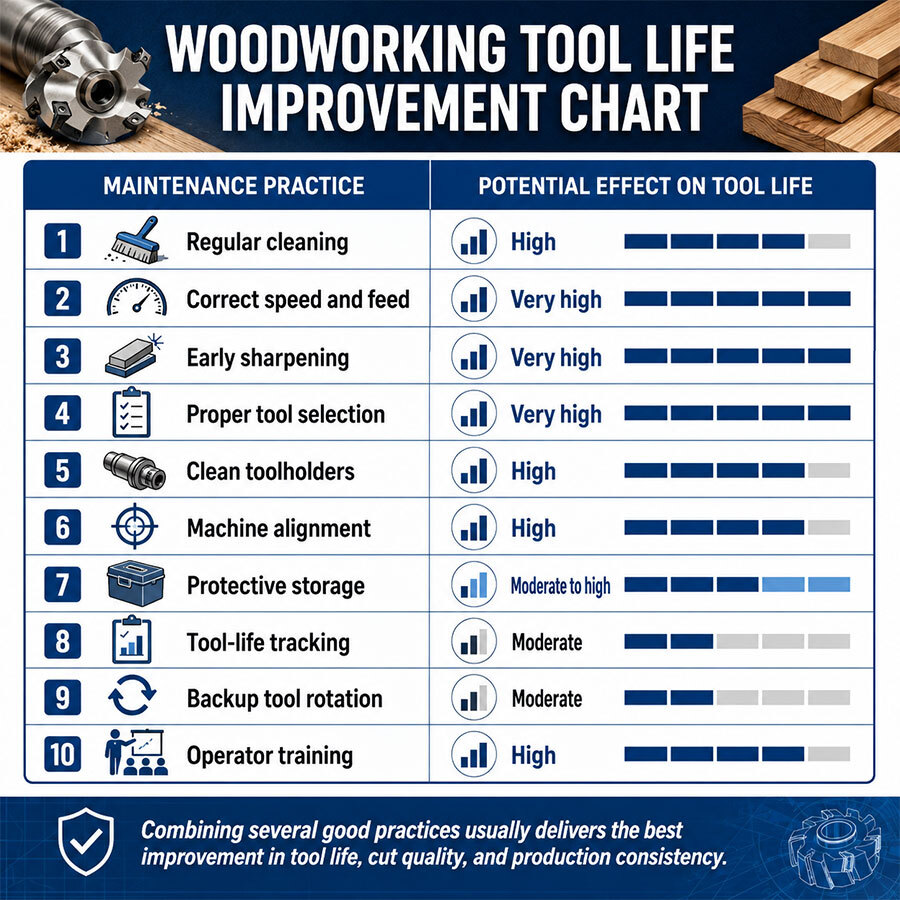
Woodworking Tool Life Improvement Chart
|
Maintenance Practice |
Potential Effect on Tool Life |
|
Regular cleaning |
High |
|
Correct speed and feed |
Very high |
|
Early sharpening |
Very high |
|
Proper tool selection |
Very high |
|
Clean toolholders |
High |
|
Machine alignment |
High |
|
Protective storage |
Moderate to high |
|
Tool-life tracking |
Moderate |
|
Backup tool rotation |
Moderate |
|
Operator training |
High |
The exact improvement depends on the tooling, material, and production environment.
However, combining several good practices usually creates much better results than focusing on only one.
When Should Woodworking Tooling Be Replaced?
Not every tool can or should be sharpened indefinitely.
Replace tooling when:
✓ Cracks appear in the body or carbide
✓ Teeth are missing beyond economical repair
✓ The shank is bent or damaged
✓ The tool can no longer meet its required diameter
✓ Excessive material has been removed through repeated sharpening
✓ The tool produces unsafe vibration
✓ Repair costs exceed replacement value
✓ The tool no longer matches the application
A low-cost disposable tool may be more economical to replace.
A large saw blade, custom profile cutter, or high-value carbide tool may justify several professional sharpening cycles.
How to Choose Replacement Woodworking Tooling
When replacement becomes necessary, avoid choosing tooling based only on the lowest purchase price.
Consider:
- Tool material
- Number of teeth or flutes
- Cutting geometry
- Workpiece material
- Machine compatibility
- Expected production volume
- Sharpening potential
- Coating
- Supplier support
- Cost per finished part
The cheapest tool may cost more if it produces poor finishes, requires frequent replacement, or causes production interruptions.
TCStore supplies woodworking tooling, replacement parts, machine accessories, sanding products, saw blades, and related shop supplies for professional woodworking operations.
Final Thoughts
Extending woodworking tool life requires more than occasional sharpening.
Tooling must be cleaned, inspected, operated correctly, stored safely, and matched to the material being processed.
Machine condition also matters.
Poor alignment, damaged collets, excessive runout, and incorrect operating settings can destroy high-quality tooling quickly.
A consistent tooling program helps woodworking shops reduce costs, improve finish quality, avoid emergency replacements, and maintain more predictable production.
The best time to maintain a cutting tool is before severe wear creates a larger problem.
Frequently Asked Questions
How often should woodworking tools be sharpened?
Sharpening frequency depends on the tool, workpiece material, production hours, cutting conditions, and required finish. Tools should be serviced when cutting quality or machine load begins to change, rather than waiting for complete failure.
What makes woodworking tooling wear out faster?
Common causes include abrasive materials, resin buildup, incorrect speeds and feeds, excessive heat, poor chip evacuation, machine misalignment, toolholder runout, and operating a dull tool for too long.
Can carbide woodworking tools be sharpened?
Many carbide saw blades, router bits, drills, cutters, and knives can be professionally sharpened. The number of sharpening cycles depends on the tool design, damage, and remaining carbide.
How should saw blades and router bits be stored?
Saw blades should be stored vertically in a blade cabinet or separated protective slots. Router bits should be kept in individual sleeves, cases, racks, or foam-lined drawers that prevent the cutting edges from contacting other tools.
Is expensive woodworking tooling always better?
Not necessarily. The best tooling is the option that matches the machine, material, finish requirement, and production volume. Cost per finished part is generally more important than purchase price alone.