

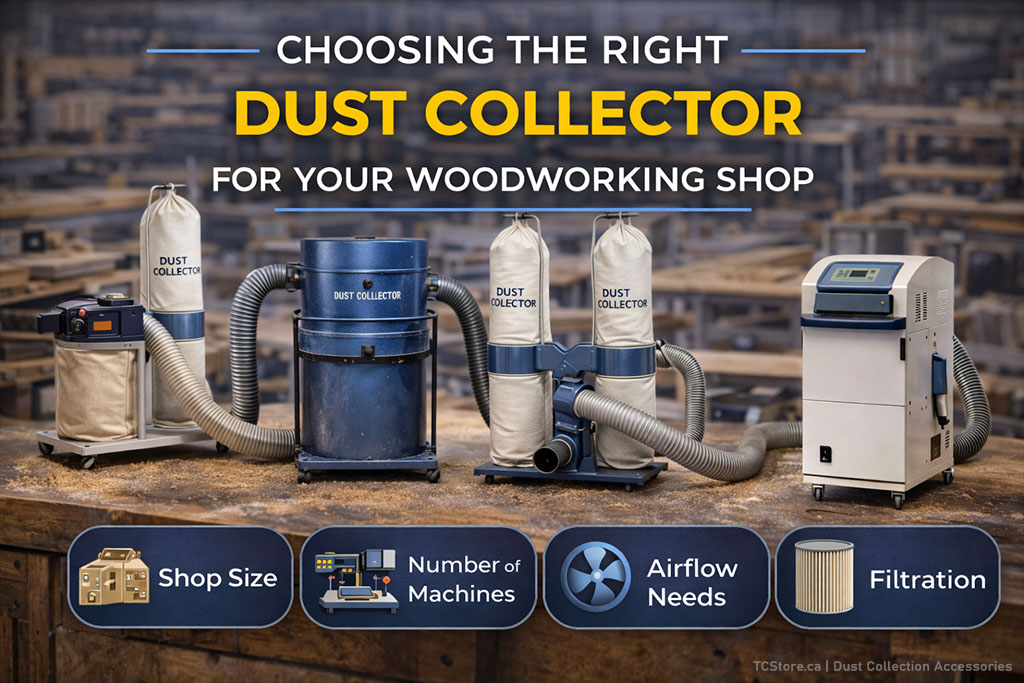
Choosing the Right Dust Collector for Your Woodworking Shop
Posted by TCStore on 2026 Apr 7th
Choosing the right dust collector is one of the most important decisions a woodworking shop can make. Dust control is not only about keeping the workspace cleaner. It also affects air quality, equipment performance, worker comfort, shop efficiency, and the overall quality of production. A well-matched dust collector can help a shop run more smoothly every day, while the wrong system can create bottlenecks, poor suction, excess maintenance, and ongoing frustration.
Whether your business focuses on cabinetry, furniture, millwork, panel processing, or custom woodworking, selecting the right dust collector requires a clear understanding of your workflow, machine setup, and production demands.
Why the Right Dust Collector Matters
Every woodworking shop produces dust, but not every shop produces it in the same way. A small custom shop with a few machines will have very different needs than a high-volume production facility running multiple saws, CNC systems, sanders, and edgebanders.
The right dust collector helps:
- Remove dust and debris at the source
- Improve shop cleanliness
- Support better air quality
- Reduce dust buildup on machines
- Improve production efficiency
- Help maintain a safer work environment
A poorly sized or poorly matched system can leave fine dust behind, reduce machine performance, and create more cleanup work than it prevents.
Start with Your Shop Size and Layout
One of the first things to consider is the size of your shop. A compact woodworking business may be well served by a smaller mobile dust collector, while a larger facility may need a central collection system connected to several machines at once.
Think about:
- Total square footage of the shop
- Number of active workstations
- Distance between machines
- Ceiling height and ducting routes
- Available floor space for collection equipment
A large shop with long duct runs needs a different solution than a smaller space where the dust collector can sit close to the source of debris.
Consider How Many Machines You Need to Connect
Another key factor is how many machines will feed into the system. If the dust collector accessories will only serve one machine at a time, a simpler setup may be enough. If it needs to support multiple stations, that changes the airflow and capacity requirements significantly.
Common machine connections include:
- Table saws
- Jointers and planers
- Wide belt sanders
- CNC routers
- Edgebanders
- Drill presses
- Cutoff saws
- Shapers and moulders
The more machines involved, the more important it becomes to select a dust collector with the right airflow, filtration, and system design.
Airflow and Suction Capacity Are Critical
A dust collector needs enough airflow to capture dust effectively where it is created. If the system is undersized, dust will remain in the air and around the machine even if the collector is running.
When evaluating systems, airflow capacity matters because different tools create different kinds of debris. A planer may produce heavy chips, while a sander creates fine airborne particles. A CNC machine may produce both depending on the application.
This is why choosing a dust collector is not just about buying the biggest unit possible. It is about matching the collector to the type of dust being produced and the number of machines being used.
Portable vs Central Dust Collector Systems
Many shops choose between portable units and central systems depending on workflow and scale.
Portable Dust Collector Systems
Portable systems are often ideal for:
- Smaller shops
- Single-machine use
- Flexible layouts
- Budget-conscious operations
- Shops that want to move collection between stations
A mobile dust collector can be a practical choice when production is more limited or when only one machine is running at a time.
Central Dust Collector Systems
Central systems are better suited for:
- Larger shops
- Multiple machine connections
- Higher production environments
- Permanent ducting layouts
- Consistent daily machine use
A central dust collector helps streamline dust management in busy production environments where mobility matters less than overall capacity and convenience.
Filtration Quality Matters
Not all dust is large and visible. Fine airborne particles are often the most difficult to control, which is why filtration quality is so important. A good dust collector should not only move air. It should also filter it effectively.
Better filtration helps:
- Reduce fine dust in the air
- Improve overall shop cleanliness
- Support healthier working conditions
- Keep dust from circulating back into the space
For many woodworking shops, pairing the main dust collector with additional air filtration equipment can create a more complete solution.
Think About Maintenance and Access
A dust collector should also be practical to maintain. If filters are difficult to access, bags are hard to empty, or servicing takes too much time, the system may become less effective over time simply because it is harder to keep up with.
Before choosing a system, consider:
- Filter replacement or cleaning requirements
- Bag or bin capacity
- Ease of emptying collected material
- Access to replacement parts
- Overall durability of the unit
The best dust collector for your shop is one that fits your workflow not only during operation, but also during routine maintenance.
Accessories Make a Difference
A good dust control setup includes more than the collector itself. Hoses, fittings, blast gates, clamps, adapters, filter upgrades, and collection accessories all affect performance. Even a high-quality dust collector can underperform if the supporting components are poorly matched.
A complete setup should be designed so the system works efficiently from machine to collector.
Match the Dust Collector to Your Growth Plans
It is also worth thinking ahead. A shop that plans to add more machines, increase production, or change layout in the near future should choose a dust collector that can support growth. Buying only for current needs may lead to replacement sooner than expected.
If expansion is likely, selecting a more scalable solution now may save time and money later.
Final Thoughts
Choosing the right dust collector for your woodworking shop is about more than collecting sawdust. It is about improving air quality, supporting machine performance, reducing cleanup, and creating a more efficient workspace overall.
The best dust collector is the one that fits your shop size, machine count, workflow, and long-term goals. With the right setup, woodworking businesses can create a cleaner and more productive environment that supports both quality and efficiency.
Frequently Asked Questions About Dust Collectors
1. How do I choose the right dust collector for my woodworking shop?
To choose the right dust collector, look at your shop size, number of machines, airflow needs, layout, and the type of dust your equipment creates. The best choice depends on how your shop operates day to day.
2. What is the difference between a portable dust collector and a central dust collector?
A portable dust collector is usually designed for smaller shops or one machine at a time, while a central dust collector is meant to support multiple machines through a more permanent ducting system.
3. Why is filtration important in a dust collector?
Filtration is important because a dust collector should capture not only larger debris but also fine airborne dust. Better filtration helps improve shop cleanliness and overall air quality.
4. Can one dust collector handle multiple woodworking machines?
Yes, one dust collector can handle multiple woodworking machines if it is properly sized and the system is designed with the right airflow, ducting, and accessories.
5. Should I buy a larger dust collector for future growth?
If you expect to add machines or increase production, choosing a larger or more scalable dust collector can be a smart long-term investment.